
Gyeongbokgung isn’t just “a pretty palace for photos.” It’s a place where 500 years of Joseon politics, along with the scars of fires, wars, and colonial occupation that ran through those 500 years, are etched into individual buildings.
Kings were crowned in Geunjeongjeon. A queen was assassinated in Geoncheonggung. Sejong-era cutting-edge science lived inside Heumgyeonggak. Today, we’re walking through 15 of Gyeongbokgung’s core buildings in the order you’d actually visit them, digging into the real history and meaning behind each one.
First, Let’s Understand Gyeongbokgung as a Whole
Gyeongbokgung was completed in 1395 by King Taejo, the founder of Joseon, as part of his relocation of the capital to Hanyang — Joseon’s first and most prestigious main royal palace. Jeong Do-jeon, a key founding minister, named it with the meaning “may the new dynasty enjoy great blessings and prosperity,” and he also named the palace’s major halls, including Geunjeongjeon, Gangnyeongjeon, and Gyotaejeon. At completion, it spanned roughly 390 bays — modest by today’s standards.
In 1592, the palace burned to the ground during the Japanese invasion of Korea, and it sat in ruins for the next 270-plus years. During that period, Changdeokgung took over as Joseon’s main royal palace instead. In 1865, Heungseon Daewongun launched a massive reconstruction effort to reassert royal authority, and Gyeongbokgung was reborn on a massive scale — 7,225 bays within the palace walls alone.
That glory didn’t last long, though. During Japanese colonial rule, thousands of bays’ worth of buildings were torn down or sold off, and even after liberation, more structures were demolished during the process of establishing the new government. Right before large-scale restoration efforts began in earnest, only 36 buildings remained — a mere 7% of what had stood during King Gojong’s reconstruction. Restoration starting with the Gangnyeongjeon and Gyotaejeon areas in 1990 continues in phases to this day.

Every building we’re about to walk through survived, or was brought back from, all of this upheaval.
From the Main Gate to the Throne Hall — The Face of Gyeongbokgung
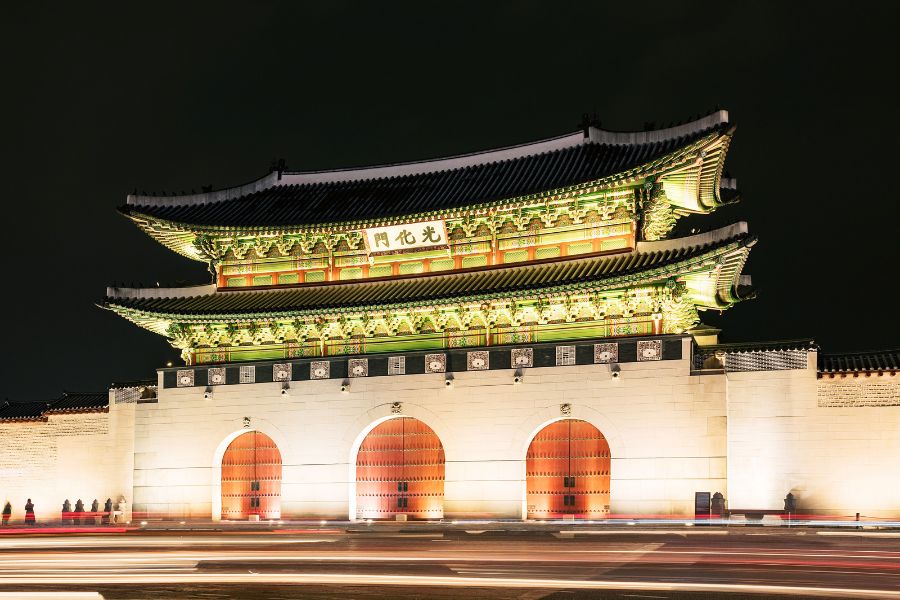
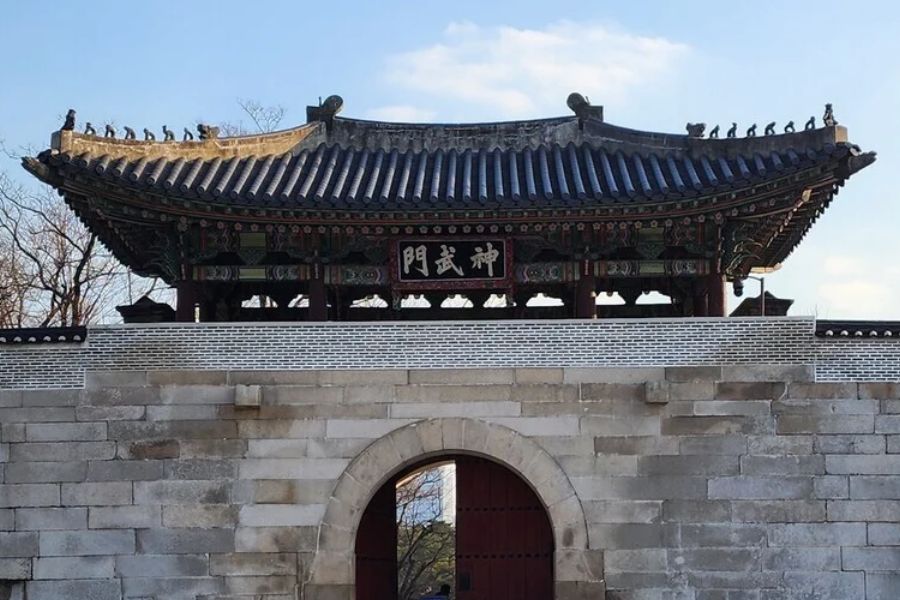
Gwanghwamun — The Main Gate, Relocated Three Times
Gyeongbokgung’s main gate was called “Omun” when it was first built in 1395, and received its current name under King Sejong in 1426. The name carries the meaning “virtue radiates widely, illuminating all directions.”
Gwanghwamun’s history of hardship compresses the entire story of Gyeongbokgung into one building. Japanese colonial authorities relocated it eastward from its original spot to build the Government-General Building, and its wooden gate tower was completely destroyed during the Korean War. In 1968, the Park Chung-hee government rebuilt it in concrete, but even then it was placed to align with the former Government-General building rather than its true original location. Today’s Gwanghwamun is the result of a re-restoration project carried out from 2006 to 2010, which corrected a 3.75-degree tilt and restored both the original wooden form and the exact original position. It took over 100 years for a single main gate to find its way back home.
Heungnyemun — The Second Gate, Once Displaced by the Government-General Building
This is the middle gate between Gwanghwamun and Geunjeongmun. It was named Hongnyemun (“spreading propriety widely”) under King Sejong in 1426, then renamed Heungnyemun in 1867 during reconstruction to avoid using a character from a Qing emperor’s name.
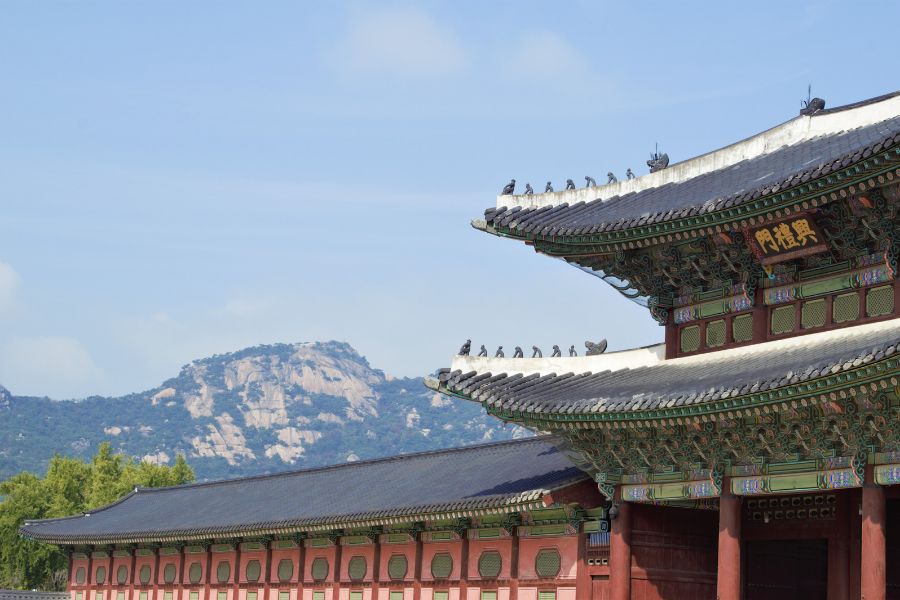
In 1915, Japanese colonial authorities demolished Heungnyemun and its surrounding corridors to hold an exposition called the Joseon Industrial Exhibition, and the following year built the Government-General Building right on that spot. A massive stone building ended up blocking the view directly in front of Geunjeongjeon. That Government-General building continued serving as government offices and a museum even after liberation, until it was finally demolished as part of the 1990s restoration project — and in 2001, Heungnyemun reclaimed its rightful spot after 85 years.
Yeongjegyo — The Stone Bridge That Marked the King’s Domain
This stone bridge crosses the ceremonial stream (geumcheon) between Heungnyemun and Geunjeongmun. It was first built under King Taejong in 1411 and received the name Yeongjegyo under King Sejong in 1426. Carved mythical creatures beneath the bridge were meant to ward off evil energy — a symbolic boundary marking that once you crossed it, you were in the king’s domain and needed to mind your conduct.
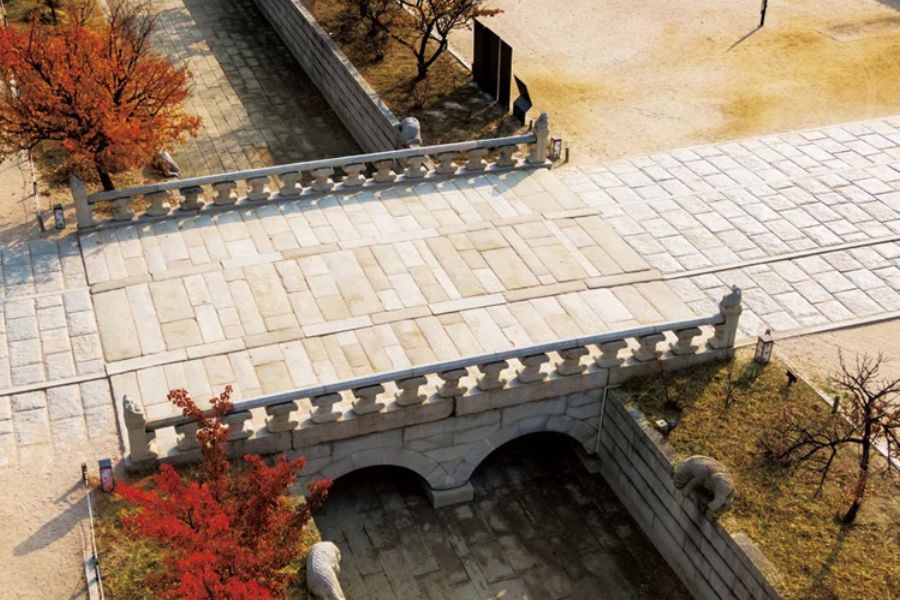
Being made of stone spared it from the fires of the Japanese invasion, but during Japanese colonial rule, construction of the Government-General Building displaced it from its original spot for more than 80 years. It was stored in pieces near a museum, temporarily placed in front of Sujeongjeon in the 1950s, then moved east of Geunjeongjeon in the 1970s — a process that damaged it so much that its original two arches were reduced to one. In 2001, alongside the restoration of Heungnyemun, it finally returned to its true original location.
Where Royal Authority Was Concentrated — The Outer Court
Geunjeongjeon — A National Treasure-Level Icon That Survived Three Crises
This was Gyeongbokgung’s main hall — the most formal space where the king held court with officials, was crowned, and received foreign envoys. Jeong Do-jeon named it with the meaning “governing diligently.” Built atop a two-tiered stone platform, its railing posts are carved with the twelve zodiac guardian animals, combining grandeur with authority.

Remarkably, today’s Geunjeongjeon is the building that weathered both Japanese colonial rule and the Korean War head-on. The Government-General used it as a venue for various events, but it was never demolished. It was designated National Treasure No. 223 in 1985, and underwent major restoration in the early 2000s to reach its current form.
Sujeongjeon — Where Sejong’s Hall of Worthies Once Stood
Located south of Gyeonghoeru, this is where the Jiphyeonjeon (Hall of Worthies), where Sejong-era scholars conducted research, once stood. Later in the Joseon period, it served as the office of the State Council (roughly equivalent to a modern cabinet), and during the 1894 Gabo Reform, it was even used as a temporary cabinet meeting site. This makes it one of the few Gyeongbokgung buildings that held its original position even before Japanese colonial rule began — a fact that gives it particular significance.

Gyeonghoeru — The Grand Wooden Pavilion That Even Ming Envoys Admired
Set over a wide pond west of Geunjeongjeon, this two-story pavilion is the largest surviving traditional wooden structure in Korea, as a single building. First built under King Taejong, it was rebuilt to its current scale in 1412. It hosted banquets during national celebrations, entertained foreign envoys, and served as the site for rain-prayer ceremonies during droughts.

Of the 48 pillars supporting the structure, the outer ones are square and the inner ones round, representing earth and heaven respectively. Gyeonghoeru became such an iconic image of Korea that during the 1997 Asian financial crisis, a foreign newspaper ran an image of it appearing to sink underwater with the headline “Korea’s Economy Sinks.”
Where the King and Queen Lived — The Inner Court
Gangnyeongjeon — The King’s Bedchamber, Sacrificed for a Changdeokgung Fire
This was where the king slept, read, and met informally with officials. It’s made up of nine rooms total, with doors between rooms that could be lifted for a cool summer breeze or lowered to stay warm in winter — a distinctly Korean architectural feature.
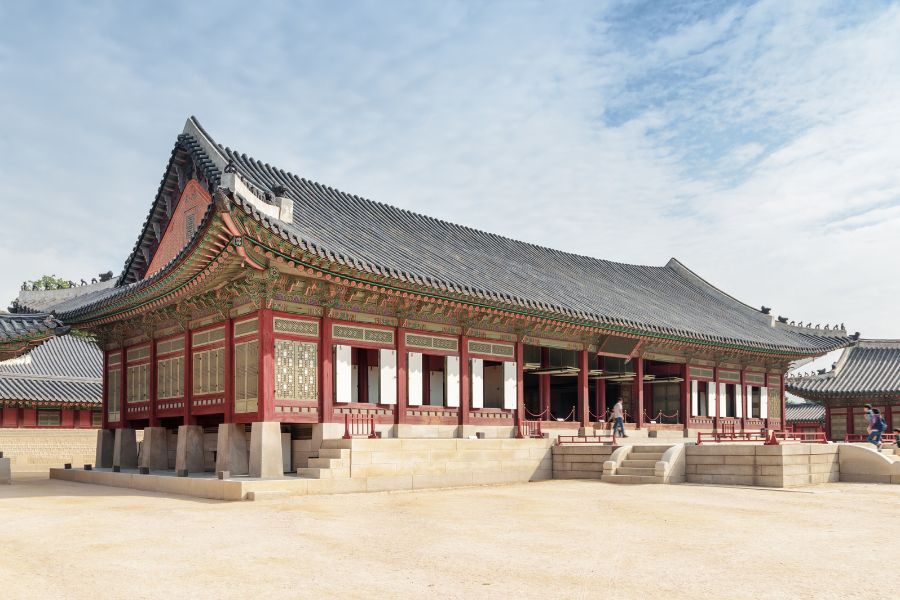
In 1917, when a fire broke out in Changdeokgung’s inner quarters, Japanese colonial authorities dismantled Gangnyeongjeon entirely, under the pretext of sourcing rebuilding materials. Gyeongbokgung’s own royal bedchamber was effectively cannibalized to rebuild Changdeokgung. Today’s building is a 1994 reconstruction based on old photographs and records.
Gyotaejeon — The Queen’s Bedchamber, Once the Most Ornate Building in the Palace
Located directly north of Gangnyeongjeon, at the very end of Gyeongbokgung’s central axis, this was the queen’s bedchamber. Its name comes from the I Ching concept of “heaven and earth meeting in harmony.” It’s believed to have been the most lavishly decorated of the roughly 150 buildings that once made up Gyeongbokgung.

Like Gangnyeongjeon, it was dismantled in 1917 to help rebuild fire-damaged Changdeokgung, and reconstructed in 1994–1995. Its rear garden features Amisan, an artificial hill built from soil excavated while digging the Gyeonghoeru pond, and its chimneys are famous enough for their beautiful floral carvings to be designated a Korean Treasure.
Hamwonjeon — The Only Buddhist Space in a Confucian Palace
Located just past Gyotaejeon toward Gyeonghoeru, this was where Buddhist statues were enshrined and Buddhist rites held during King Sejong’s reign — the only space within Gyeongbokgung built specifically for Buddhism. The very existence of such a space within a Confucian dynasty’s palace is a genuinely interesting detail.
It burned down during the Japanese invasion, was rebuilt during King Gojong’s reconstruction, then burned again during Japanese colonial rule. The building standing today was reconstructed in 1995.

Heumgyeonggak — The Hall Housing Sejong’s Cutting-Edge Automated Water Clock
Located west of Gangnyeongjeon (west of Cheonchujeon at the time of its original construction), this was where Jang Yeong-sil, acting on King Sejong’s orders, installed an automated water clock and astronomical timepiece called the “Ongnu” in 1438. A standard water clock (Jagyeongnu) already existed, but since it sat too far from the astronomical observation facilities in the rear garden, this hall was built to solve that inconvenience.
The Ongnu wasn’t just a clock — it was an elaborate mechanism with figures that moved on their own to mark the time and depict farming scenes across all four seasons. It stood as a symbol of Sejong’s philosophy: “observe the will of heaven, and treasure the farming labor of the people.” It was destroyed during the Japanese invasion, rebuilt in the early Gwanghaegun era, then lost again, with only the building itself reconstructed in 1995. In 2019, the National Science Museum of Korea rigorously researched historical texts and rebuilt the Ongnu itself at full scale, 581 years later — and in the process, discovered that what scholars had long believed was a “four-tier” time-signaling mechanism was actually five tiers. (The reconstructed Ongnu is currently on display at the National Science Museum in Daejeon.)
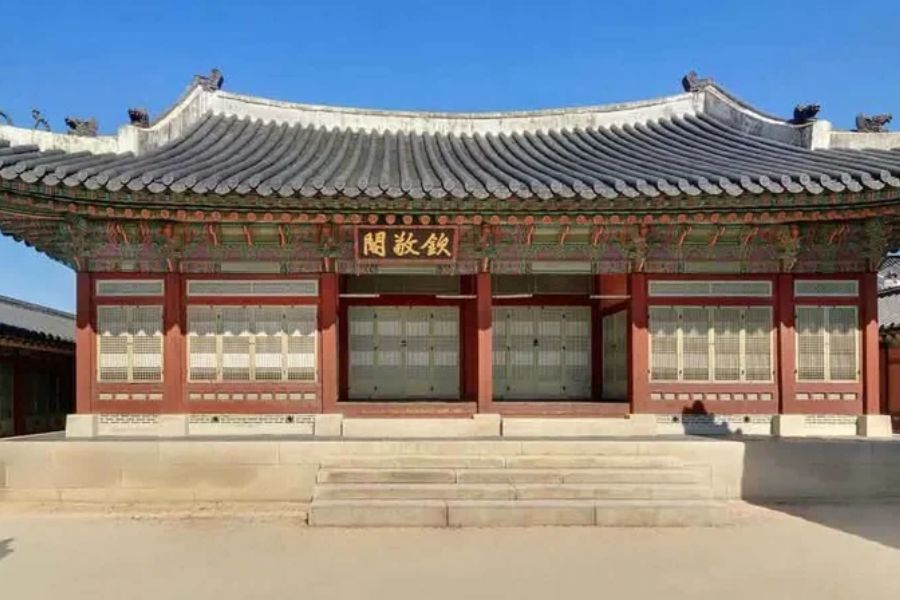
The Concubines’ Quarters and the Palace’s Deepest Corner
Hamhwadang and Jipgyeongdang — The King’s Bedchamber Once Mistaken for Concubines’ Quarters
North of Heungbokjeon and south of Hyangwonjeong sit these two buildings, connected by a covered corridor. They were long believed to have housed royal concubines, but in 2007, a construction record discovered during repairs to Hamhwadang revealed they were actually built as King Gojong’s personal bedchamber.
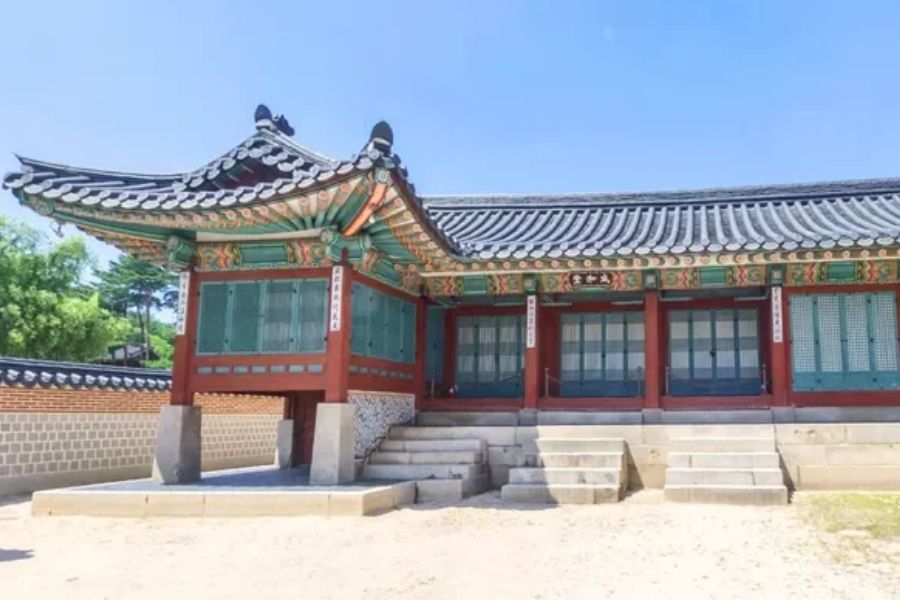
Starting in 1892, Gojong used Hamhwadang to discuss state affairs with officials and receive foreign envoys. Records even show that during the 1894 Sino-Japanese War, when Japanese troops occupied Gyeongbokgung, Gojong and Empress Myeongseong were staying here. These two buildings survived even when most of Gyeongbokgung’s structures were torn down during Japanese colonial rule, continuing to serve as office space for the Government-General Museum and later the Joseon Folk Museum.
Hyangwonjeong — A Royal Retreat, Now a Designated Treasure
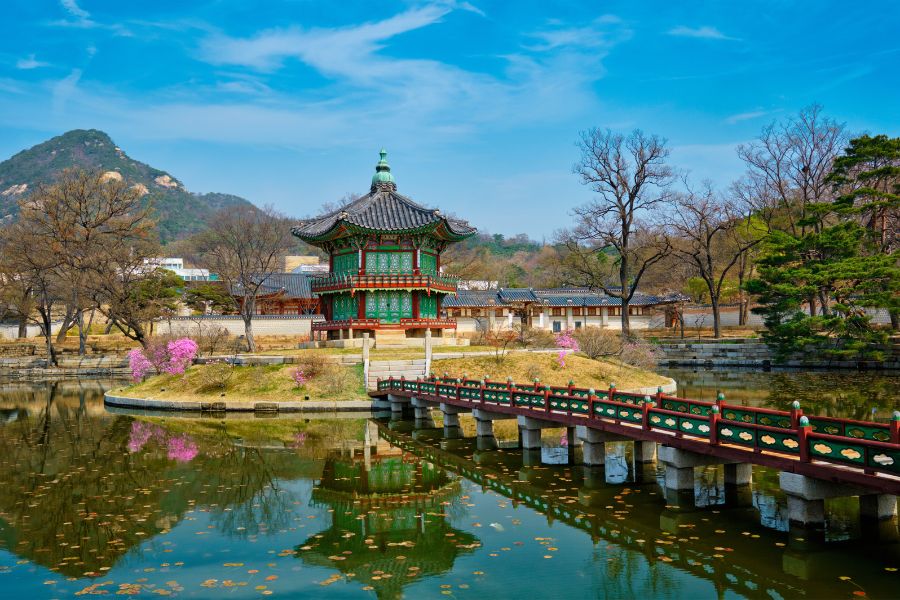
Just south of Geoncheonggung, this hexagonal pavilion sits on an island in the middle of a pond. It was built in 1867, alongside Geoncheonggung, when Gojong began residing there. It served as a signature relaxation space for the late Joseon royal family and is now a designated Korean Treasure. It’s known for its beauty in every season, and is especially beloved in summer when lotus flowers bloom across the pond.
Geoncheonggung — A Palace That Doesn’t Look Like a Palace, and the Site of a Tragedy
Tucked into the deepest corner of Gyeongbokgung, Geoncheonggung looks noticeably different from the other halls. It wasn’t painted with the traditional dancheong colors at all, and was built in the style of an ordinary noble family’s residence. Built in 1873, King Gojong constructed this “palace within a palace” using his own private funds, without his father Heungseon Daewongun’s knowledge — one interpretation holds it as a political statement, an attempt to govern independently, free from his father’s shadow.
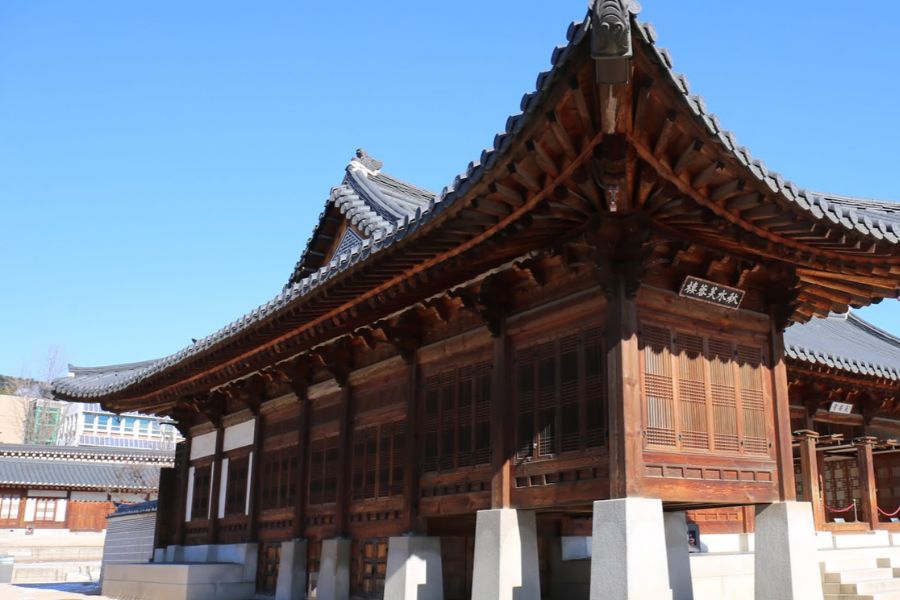
It consists of Gojong’s space, Jangandang, and Empress Myeongseong’s space, Gonnyeonghap. In 1887, Asia’s first Edison-style electric streetlights were installed here — though the generator’s cooling water discharged into the Hyangwonjeong pond, killing off the fish inside, leading to the bitter phrase “steaming fish, ruining the nation.”
But what truly made Geoncheonggung a place of tragedy was a separate event. In 1895, during the Eulmi Incident, Japanese assassins broke in and murdered Empress Myeongseong. Her body was briefly placed in the Okhoru pavilion within Gonnyeonghap before being burned at Noksan, just east of Geoncheonggung. Following this event, Gojong relocated to the Russian legation the following year, and the now-abandoned Geoncheonggung was demolished by Japanese authorities in 1909, replaced by a Government-General art museum. Today’s Geoncheonggung was reconstructed and opened to the public in 2007 — 98 years after it was torn down.
Sinmumun — The Northern Gate That Stayed Closed
This is Gyeongbokgung’s north gate. Unlike the east, west, and south gates (Geonchunmun, Yeongchumun, Gwanghwamun), which existed from the palace’s earliest construction, the name Sinmumun first appears in records only in 1475, under King Seongjong. The north was considered symbolic of yin energy and death, so the gate normally stayed closed, opened only briefly for rain-prayer ceremonies during droughts or when the king headed to the archery range located on what is now the Blue House grounds.
This gate also serves as a direct passage from outside Gyeongbokgung’s walls straight into Geoncheonggung. It remained closed to the public for decades after 1961, when a security unit guarding the Blue House was stationed nearby, and only reopened alongside Geoncheonggung in 2006.
Practical Information
- Visiting hours: March–May & September–October, 9 AM–6 PM; June–August, 9 AM–6:30 PM; November–February, 9 AM–5 PM (last entry one hour before closing)
- Closed: Every Tuesday (if it falls on a public holiday, the palace stays open, and the closure shifts to the next non-holiday weekday)
- Admission: Adults (ages 19–64), ₩3,000; Youth (ages 7–18), ₩1,500. Free for children 6 and under, seniors 65 and over, anyone wearing hanbok, and on the last Wednesday of each month (“Culture Day”)
- Getting there: Subway Line 3, Gyeongbokgung Station, Exit 5 (216m walk), or Line 5, Gwanghwamun Station, Exit 2 (471m walk)
- Regular guided tours: Groups under 10 can join without a reservation; groups of 10+ need to book ahead. Tours are offered in six languages.
- Geoncheonggung & Hyangwonjeong special openings: These two spots, normally closed to interior viewing, occasionally get paid special-access tours run by the Korea Heritage Service — check official channels if your visit dates might overlap
- Royal Guard-Changing Ceremony: 10 AM and 2 PM (for full details, see our separate Gyeongbokgung & Bukchon guide)
Pre-Visit Checklist
- Wearing hanbok gets you free entry, so renting an outfit is worth considering for photos and savings alike
- Plan around Tuesday closures
- If you want to see inside Geoncheonggung and Hyangwonjeong, check the special-access schedule in advance
- A guided tour makes each building’s story land much more vividly
- Shade is limited in peak summer, so bring water and a parasol
Ready to Walk Through These Stories?
It’s easy to walk through Gyeongbokgung and leave with nothing but pretty photos. But once you know it took over a century for Gwanghwamun to return to its rightful spot, that Gangnyeongjeon and Gyotaejeon were dismantled to rebuild a fire-damaged Changdeokgung, and that Geoncheonggung carries the tragedy of a queen’s assassination, you’re looking at a completely different palace. On this visit, let the story behind each building come to mind before the photo does. If one hall stood out to you the most, share it in the comments.