
In the middle of Myeongdong, past the wall-to-wall cosmetics shops and shopping streets, look up toward the top of a hill and you’ll find a massive red-brick Gothic cathedral.
This isn’t just a landmark that photographs well. It’s the site where Korean Catholicism first took root, the resting place of martyrs’ remains, and the ground where a 6-day sit-in in 1987 reshaped South Korean democracy into what it is today. Here’s a detailed look at how Myeongdong Cathedral was built, who it has sheltered over the years, and exactly how to visit it now.
Built on the Site of a Martyr’s Home
The land Myeongdong Cathedral now stands on was never just ordinary ground. It was once the home of Kim Beom-woo, one of Korea’s earliest Catholic converts. In 1785, Yi Seung-hun, the three Jeong brothers, and the Gwon brothers gathered here for religious meetings under the guidance of Yi Byeok — widely considered the very first Catholic faith community in Korean history. The following year, however, officials from the Ministry of Justice discovered the gathering, forcibly disbanding it and exiling Kim Beom-woo to Dangjang in Gyeongsang Province.
Roughly a century later, in 1882, Bishop Blanc, the 7th head of the Korean vicariate, anticipating that religious freedom would open up as Joseon signed a treaty with the United States, purchased this very land as the site for a cathedral. The year after the 1886 Korea-France Treaty of Amity and Commerce was signed, the remaining land was acquired, and work began cutting down the hillside to prepare the site. French priest Father Coste took charge of the design, with financial backing from the Paris Foreign Missions Society, and construction began in earnest in 1892.
After six years of construction and $60,000 in costs, the cathedral was finally consecrated on May 29, 1898 — Pentecost Sunday — presided over by Bishop Mutel.
Korea’s First Brick Building, and Once Its Tallest
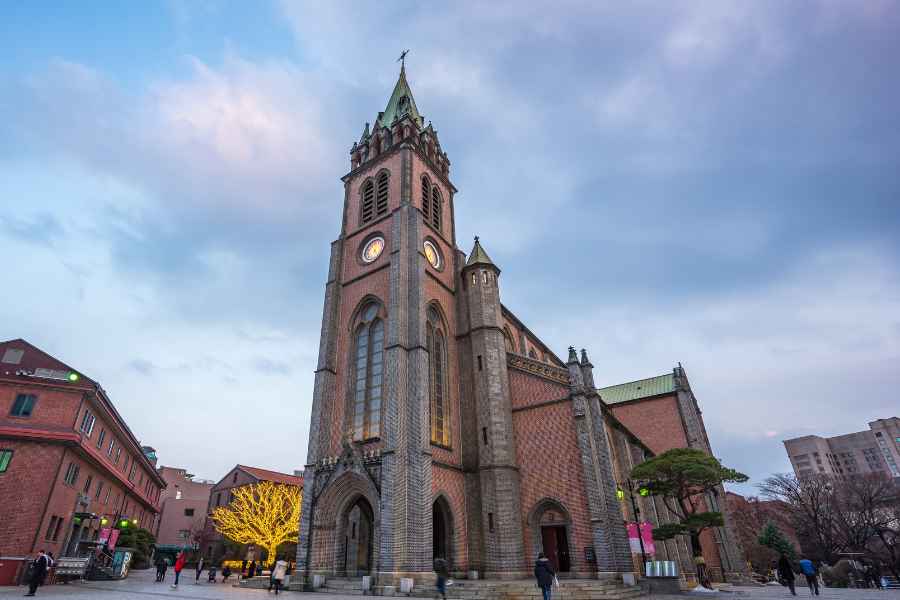
Myeongdong Cathedral was the first building in Korea constructed by stacking brick. Unlike typical Gothic cathedrals, which primarily use stone, this one was built with brick fired directly in Korea — more than 20 different shapes, combining red and gray tones in careful balance. The roof was finished with copper plating.
The floor plan is cross-shaped, with the nave rising 23 meters and the bell tower reaching 45 meters (about 141 feet). Until the Government-General Building was constructed, Myeongdong Cathedral was the tallest building on the Korean peninsula. The English-language edition of The Independent, in its June 2, 1898 issue, described it this way: “Standing atop Jonghyeon Hill, this cathedral offers a beautiful panorama of Seoul to anyone who climbs it.” The interior is considered to convey an even stronger Gothic impression than the exterior, and the building is now designated Historic Site No. 258.
Martyrs Resting Below
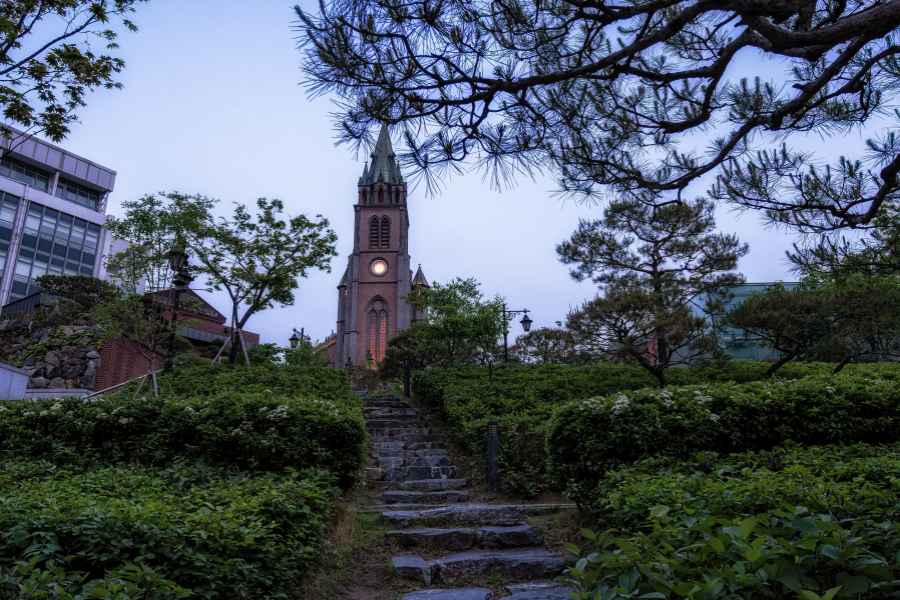
Beneath Myeongdong Cathedral lies a special space: a martyrs’ tomb, holding the remains of those who died during Korea’s periods of Catholic persecution. The remains of Bishop Imbert and others martyred during the Gihae Persecution of 1839 were originally recovered at great risk — by believers willing to die for it — 20 days after their deaths, and buried at Nogosan (the site of today’s Sogang University). They were later relocated to Samseongsan, on the slopes of Gwanaksan, in 1843, before finally being moved here to Myeongdong Cathedral’s crypt in 1901. The remains of Father Pourthie and Father Petitnicolas, martyred during the Byeongin Persecution of 1866, along with two unnamed martyrs, rest here as well. The history of Korean Catholic martyrdom, spanning the Gihae and Byeongin persecutions, is compressed into this single underground space.
1987: The Cathedral Becomes a Revolution’s Last Stronghold
The most dramatic moment in Myeongdong Cathedral’s history wasn’t a religious one — it was political. In January 1987, a Seoul National University student named Park Jong-cheol died under torture at the Namyeong-dong Anti-Communist Investigation Bureau. That May 18, during a memorial mass marking the 7th anniversary of the Gwangju Democratization Movement, Father Kim Seung-hoon of the Catholic Priests’ Association for Justice revealed that police had fabricated and covered up the circumstances of Park’s death. Combined with President Chun Doo-hwan’s “April 13 Constitution Preservation Declaration” and the death of Yonsei University student Lee Han-yeol, struck by a tear gas canister, public outrage grew uncontrollably.
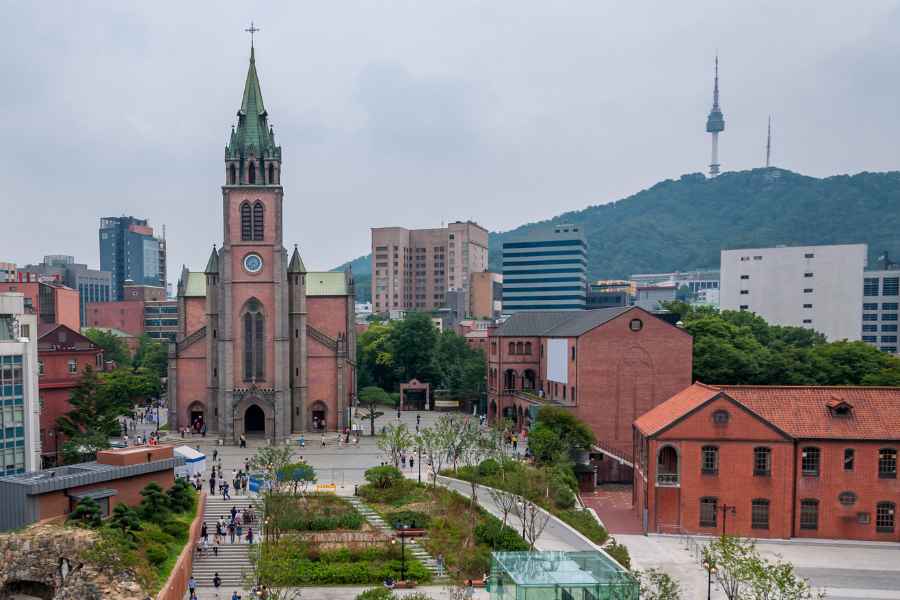
On June 10, 1987, a rally denouncing the cover-up of Park Jong-cheol’s torture-death and demanding constitutional reform was held at the Anglican Cathedral of Korea, and fierce clashes broke out between police and protesters throughout Myeongdong. Chased by tear gas, protesters converged on the courtyard of Myeongdong Cathedral — with no single leader directing them there. The sit-in that followed was entirely unplanned, but it continued for six days and nights, roughly 110 hours, until June 15.
There was a specific reason this sit-in became so significant. Because Myeongdong Cathedral was the symbolic seat of Korean Catholicism, even the most powerful military dictatorship found it difficult to send police in to forcibly arrest the protesters. Deploying police inside the cathedral risked being interpreted as a direct challenge to the authority of the global Catholic Church. As word of this spread through the media nationwide, the public’s desire for democratization exploded, expanding into the nationwide June Democratic Uprising. Ultimately, on June 29, Roh Tae-woo, then leader of the ruling Democratic Justice Party, was forced to issue the June 29 Declaration, accepting direct presidential elections through constitutional amendment. Even after this event, Myeongdong Cathedral continued to serve as a rallying point for social movements through the 1990s, including protests over the Uruguay Round negotiations and the treatment of migrant workers.
Many travelers walking through Myeongdong today have no idea that this cathedral courtyard was the decisive stage in modern Korean democracy’s history. As you climb this hill past the cosmetics shops, keeping just this one fact in mind will make Myeongdong Cathedral feel like an entirely different place.
Myeongdong Cathedral Today — the “1898 Myeongdong Cathedral” Cultural Complex
Beneath the cathedral is a cultural complex called “1898 Myeongdong Cathedral.” It reinterprets the red-brick Gothic exterior in a modern indoor space, with high ceilings and lighting designed to mimic natural sunlight — making it a popular urban retreat from the summer heat. The complex houses Gallery 1898, a Catholic information center, and “1898 Plus,” the Archdiocese of Seoul’s official gift shop.
The cathedral’s official name is “Cathedral of the Immaculate Conception of the Blessed Virgin Mary, Roman Catholic Archdiocese of Seoul,” commonly shortened to “Myeongdong Cathedral” or simply “Myeongdong Daeseongdang” due to its length. Its patron saint is the Blessed Virgin Mary, Immaculately Conceived. The bell tower still rings daily at 6 AM, noon, and 6 PM for the Angelus prayer — the current bell, installed in 2001, is the third bell in the cathedral’s history.
After the Cathedral: What Else to Do in Myeongdong
True to its name, Myeongdong Cathedral sits right in the middle of Myeongdong, Seoul’s biggest shopping and tourism district. If the cathedral left you with a sense of history and quiet weight, heading down the hill afterward brings a completely different kind of energy.
The Heart of K-Beauty Shopping
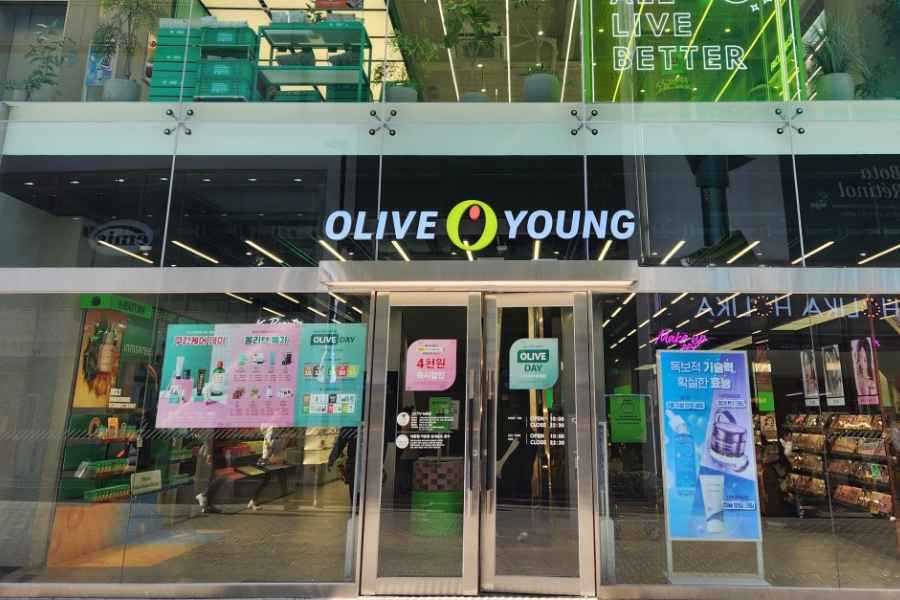
Myeongdong is the epicenter of Korean cosmetics shopping, packed with flagship stores from K-beauty brands like Olive Young, Innisfree, and Etude. Most stores have English-speaking staff and instant tax refund desks, so you can shop and claim your duty-free savings without any language barrier. Lately, the neighborhood has expanded beyond beauty into Korean street fashion too, increasingly drawing attention as a fashion destination in its own right.
The Underground Shopping Arcade — Where the Real Deals Are
Beneath Myeongdong runs an underground shopping arcade where clothing, accessories, and everyday goods sell for 30–40% less than at street-level stores. If you’d rather skip the tourist markup upstairs and shop somewhere more practical, this is worth seeking out.
Myeongdong Street Food Alley — A Festival That Starts at Dusk
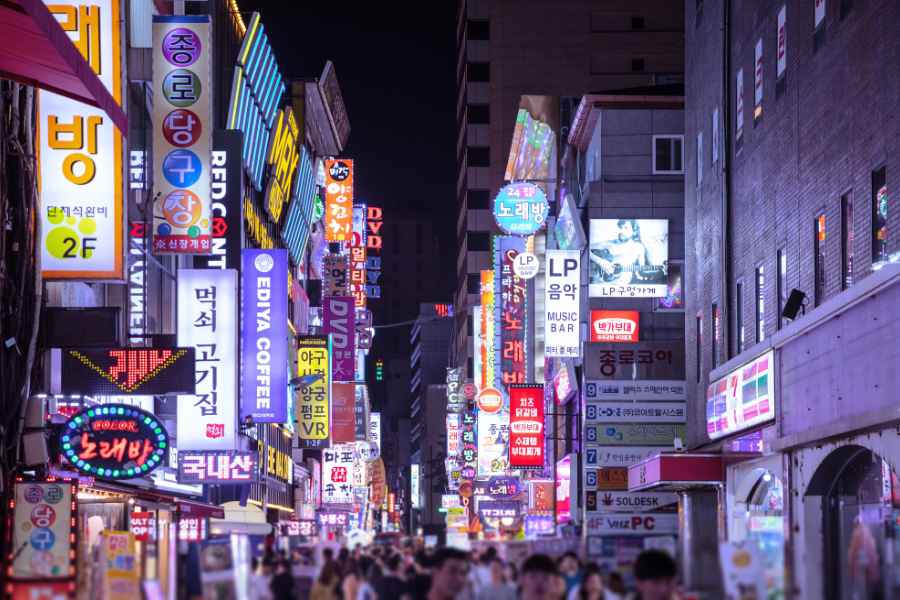
Every evening around 4 PM, street vendors start setting up, and the pedestrian shopping street transforms almost instantly into an open-air food market. Working your way down the street with a tornado potato in one hand, hotteok in the other, and a stop for jeukseok tteokbokki along the way is considered the classic way to experience Myeongdong.
Nanta — A Non-Verbal Show With No Language Barrier
Myeongdong is home to a dedicated theater for “Nanta,” Korea’s first non-verbal performance. It comically dramatizes chaos in a kitchen, set to the rhythm of traditional samulnori percussion, built entirely around rhythm and physical comedy rather than dialogue — meaning travelers of any nationality can enjoy it without worrying about the language. There are even moments where audience members are invited up on stage to join in, making it less a show you watch and more one you participate in.
An Easy Continuation to Namsan Seoul Tower
A short walk from Myeongdong brings you to the cable car station leading up to Namsan Seoul Tower, making it easy to end the day looking out over the Seoul skyline after your cathedral visit and shopping.
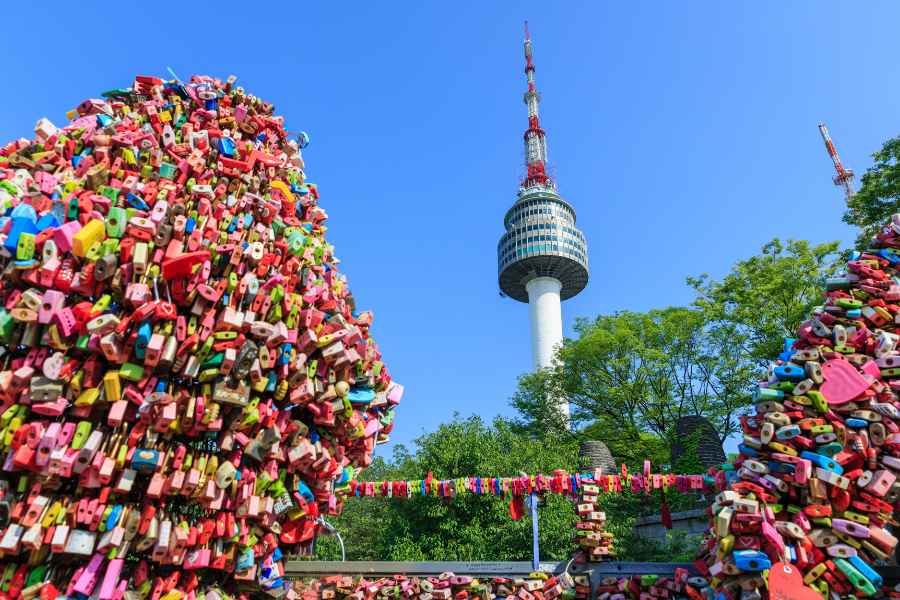
In short, once you come down the hill from the history and faith of Myeongdong Cathedral, an entirely different kind of day — shopping, food, performance, and a night view — is waiting right there. That contrast is exactly what makes this neighborhood work.
Practical Information
- Location: 74 Myeongdong-gil, Jung-gu, Seoul
- Getting there: Walkable from Exit 5 or 8 of Myeongdong Station (Line 4), Exit 5 of Euljiro 1-ga Station (Line 2), or Exit 12 of Euljiro 3-ga Station (Line 3)
- Opening hours: The cathedral interior is open free of charge from morning until evening, except during mass (access may be limited during special masses)
- Weekday masses: Mon–Sat, 7 AM and 10 AM, 6 PM and 7 PM (no 7 PM mass on Mondays; exact times can change, so it’s worth confirming in advance)
- Sunday masses: 7 AM, 9 AM (English mass), 10 AM, 11 AM, noon (main congregational mass), and 4 PM, 5 PM, 6 PM, 7 PM (youth mass), 9 PM
- English mass: Held every Sunday at 9 AM, making it a useful option for international visitors who want to experience mass in English
- Etiquette: This is still an active place of worship, so please stay quiet during mass and prayer times, and avoid flash photography near the altar
- Parking: There’s an underground lot, though access from Myeongdong-gil is sometimes restricted, so public transit is recommended
- Nearby to pair with your visit: The Myeongdong shopping district and Namdaemun Market are both within walking distance
Ready to Climb This Hill Yourself?
Myeongdong Cathedral stands on the site of Korea’s first Catholic faith community, holds the remains of martyrs, and carries the memory of a six-day sit-in that helped protect Korean democracy. Once you know how much history is layered into every one of those red bricks, it stops being a quick photo stop on a Myeongdong shopping trip and becomes something with real weight. If a particular part of the story stood out to you after visiting, share it in the comments.