
Sindang-dong’s name literally means “the neighborhood of shrines.” During the Joseon dynasty, shamans gathered here to perform rites for the spirits of the dead who had passed through Gwanghuimun Gate, just outside the old city walls — and the neighborhood took its name from the shrines (sindang) that gradually multiplied around them. Today, this same neighborhood is buzzing for the opposite reason.
Search interest in “Seoul Central Market” has jumped more than 5,000% over the past five years, driven by scone cafes and cocktail bars opening up between shaman shops and old market alleys — enough to earn the neighborhood a new nickname: “Hipdang-dong” (hip + Sindang-dong).
From Shaman Village to the Birthplace of Tteokbokki
The name Sindang-dong (神堂洞) tells you exactly where this neighborhood came from. During the Joseon dynasty, grieving families would hire shamans to perform rituals for loved ones whose bodies had passed through Gwanghuimun Gate (the gate historically used to carry the dead out of the city), and shrines gradually multiplied in the area as a result, eventually giving the neighborhood its name.
But what actually made this neighborhood famous nationwide wasn’t shamanism — it was tteokbokki. Right after the Korean War armistice in 1953, a woman named Ma Bok-rim opened a street stall here selling tteokbokki. She’d once been served a Chinese-style dish of rice cakes in black bean sauce and found it a bit too rich, which led her to develop a spicier version stir-fried in gochujang (red chili paste) — the origin of what’s now Korea’s beloved “jeukseok tteokbokki” (fresh-cooked tteokbokki).
The dish became nationally famous after being featured on a popular radio program in the 1970s, and even today, the stretch known as “Sindang-dong Tteokbokki Town,” between Sindang and Cheonggu stations, is still lined with Ma Bok-rim’s original shop and the offshoots her sons later opened.
Seoul Jungang Market — Once One of Seoul’s Big Three Markets
Near Tteokbokki Town, Seoul Jungang Market opened in 1946 and was once counted among Seoul’s three major markets, alongside Namdaemun and Dongdaemun Markets. Right after the Korean War, it grew rapidly as a wholesale and retail market for rice, grain, and vegetables, and at its peak, more than 80% of the rice consumed by Seoul residents passed through this market. It took on its current name, Seoul Jungang Market, starting in 1962, and today still holds around 600 individual stalls.
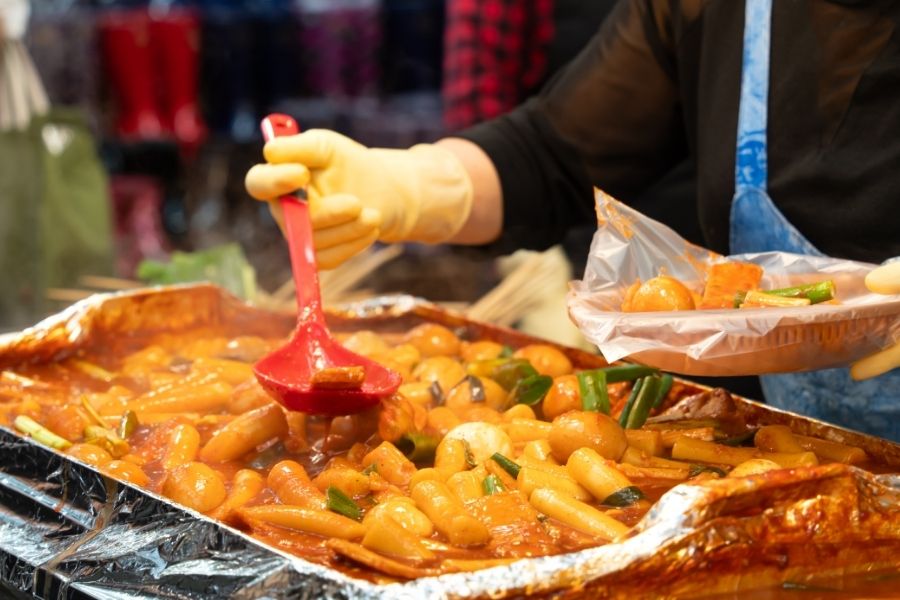
Its signature food alleys include Gopchang Alley (grilled beef tripe), Boribap Alley (barley rice), and Kalguksu Alley (hand-cut noodle soup).
⚠️ One thing worth clarifying: there’s a separate, similarly named traditional market nearby called “Sin-Jungang Market” (“New Jungang Market”).
Recent news coverage of Sin-Jungang Market’s dramatic redesign — a bold “Roof Wave” architectural project — helped drive up general interest in Sindang-dong as a whole. It’s worth knowing the two markets apart before you go.
Why “Hipdang-dong” Is Happening Right Now
A recent article capturing the scene at the entrance to Seoul Jungang Market nailed this transformation perfectly: shops that have “hauled kitchen furniture for decades” now sit right beside “30-somethings with AirPods in, snapping photos on their smartphones in front of the old storefronts.” It’s the same formula that’s already been proven in Euljiro and Seongsu — an aging traditional market layered with a wave of new cafes and bars — now repeating itself in Sindang-dong.
New spots have opened up between the traditional market stalls, including scone specialty shop Brickhouse, uniquely designed cafe Apothecary, and a cocktail bar called Jusindang that leans directly into the neighborhood’s “sindang” (shrine) theme. One dried-fish shop inside the market, “Okgyeong-ne Geonsaengseon,” suddenly became a hotspot after being featured in a YouTuber’s video — a textbook example of how a single piece of content can spike search interest almost overnight.
Practical Information
- Tteokbokki Town (Ma Bok-rim Halmeoni-jip): 5 Dasan-ro 35-gil, Jung-gu, Seoul / Walk from Exit 7 or 8 of Sindang Station (Lines 2 and 6), or Exit 1 of Cheonggu Station / Closed on the 2nd and 4th Monday of each month
- Seoul Jungang Market: Walkable from either Sindang or Cheonggu Station
- Suggested route: Get off at Sindang Station → explore Seoul Jungang Market’s gopchang and kalguksu alleys → grab jeukseok tteokbokki at Ma Bok-rim Halmeoni-jip → wander the Hipdang-dong cafe and bar streets — this route lets you experience both tradition and trend in one loop
- Parking: Public parking is available at the Sindang Intersection lot and the Seongdong High School lot
- Tip: Jeukseok tteokbokki takes time to cook, so if there are two or more of you, order a set menu and be sure to finish with the fried rice at the end
See Both Sides of This Neighborhood for Yourself
Sindang-dong has continuously reinvented itself — from a neighborhood where shamans once comforted the spirits of the dead, to the birthplace of Korea’s most iconic street food, to a place where a traditional market now coexists with a wave of hip cafes. Unlike the now well-established Euljiro or Seongsu, this neighborhood still has a rawer, less-polished edge — which might make right now the best time to visit. If you have a favorite alley or shop from your visit, share it in the comments.