
Here’s the bottom line: there are really just two things you need to know before visiting Deoksugung. First, why there’s a rumor that couples avoid its famous stone wall path. Second, how not to mix up Seokjojeon Hall with the museum building right next to it. Get these two things straight, and you’ll get far more out of Deoksugung than most visitors do.
What Deoksugung Is
Unlike Seoul’s other palaces, Deoksugung is a place where the Joseon Dynasty, the Korean Empire, and modern history all overlap in a single space. It began as the private residence of Prince Dowon, King Sejo’s eldest son, later served as a temporary royal residence after the Imjin War, and gained its status as a proper palace when Emperor Gojong made it his residence during the Korean Empire era. It’s the smallest of the five grand palaces, but it’s the only one where traditional hanok buildings and Western-style architecture sit inside the same walls.
Deoksugung Seokjojeon: The Korean Empire’s Last Western-Style Palace
History and Meaning
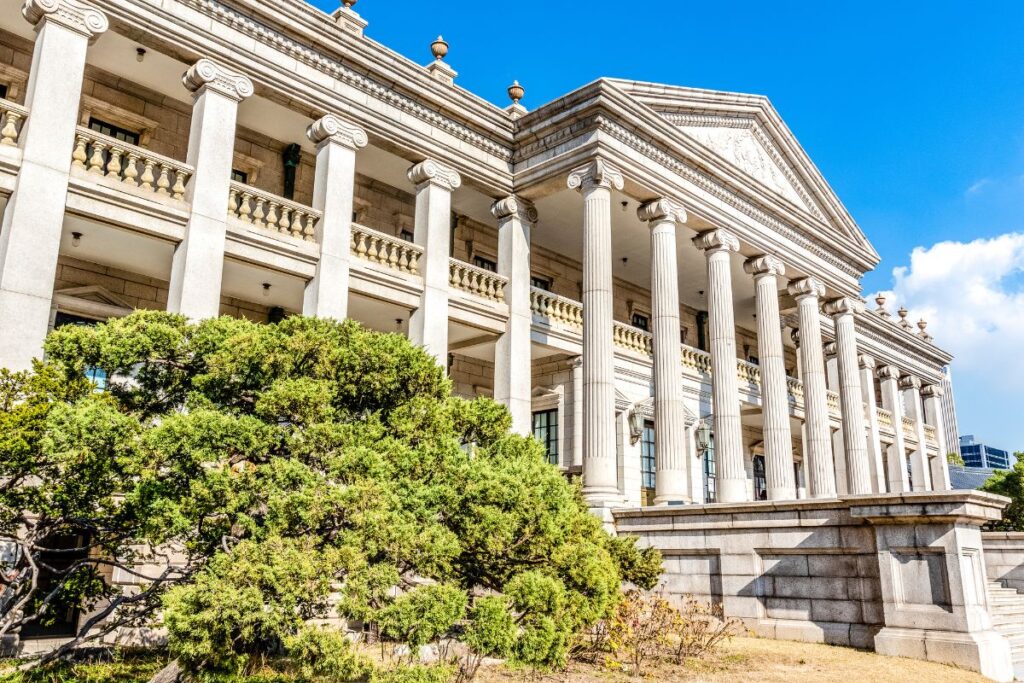
Seokjojeon’s construction began in 1897, the year the Korean Empire was founded, and finished in 1910, the year the Korean Empire collapsed. The gap between its ornate neoclassical exterior and the fact that its completion coincided exactly with the empire’s downfall is often read as a symbol of the turbulent, uncertain times it was built in. It also holds the distinction of being the Korean Empire’s first — and last — Western-style palace building.
The Mix-Up Almost Everyone Makes: Seokjojeon Hall vs. MMCA Deoksugung
This is where a lot of visitors get confused. There are actually two separate buildings inside Deoksugung with very different personalities.
- Seokjojeon Hall (Korean Empire History Museum): This space recreates the imperial household’s daily life. Entry to the interior (1st and 2nd floors) is only possible through a guided group tour with advance reservation. Online booking is standard; on-site booking is only available to visitors aged 65+ and foreign nationals.
- MMCA Deoksugung (National Museum of Modern and Contemporary Art): Housed in the Seokjojeon’s West Wing (completed in 1938), this is a separate museum building. It requires only a separate exhibition ticket (around 3,000 KRW) — no reservation needed — on top of your regular Deoksugung admission. It runs rotating exhibitions on modern and contemporary Korean art, and despite its modest size, it’s often praised for the quality of its shows.
In other words, “you have to reserve ahead to get inside Seokjojeon” is only half true. The history museum wing requires a reservation, but the museum building right next door doesn’t — just buy a ticket and walk in. If you’re short on time, the museum alone is enough to appreciate Seokjojeon’s distinctive Western architecture.
How to Book the Seokjojeon Interior Tour, Step by Step
As mentioned, the 1st and 2nd floor exhibition halls at Seokjojeon Hall (Korean Empire History Museum) are reservation-only. Walk-in access generally isn’t possible, so if you don’t plan ahead, you may end up turned away at the door.
- Go to the reservation page — visit the Royal Palaces and Tombs Center website (royal.khs.go.kr) select “Reservations → Seokjojeon Korean Empire History Museum Tour.”
- Choose General or In-Depth commentary — General commentary runs 40–45 minutes, a standard guided walk through the exhibition halls with a docent. In-depth commentary runs 65–70 minutes and goes into much more detail, but it’s only offered during the first session (9:30 AM) and the final session of the day. If you want the deeper version, you need to target one of those two slots.
- Pick your date and time slot — tours run between 9:30 AM and 5:30 PM. Choose a date on the calendar, then click “Apply” for your preferred time slot. You can reserve up to 5 tickets per person.
- Check the group size — each session caps at 15 people via online reservation. On-site booking isn’t generally allowed, but there’s an exception: visitors aged 65+ (with ID card or driver’s license) and foreign nationals (with passport or foreign resident card) can join on-site, up to 5 people per session.
- Confirm and adjust your booking — cancellations or changes are allowed up until 11 PM the night before your visit date. After that, changes aren’t possible, so it’s best to book once your schedule is firm.
If You Want the English Tour
Separate from the Korean-language sessions, English commentary runs only twice a day — at 11:50 AM and 2:50 PM. These slots are on-site reservation only, not available for online booking, so if you want the English tour, plan to show up at the front desk around that time.
One Thing That’s Changed Recently: The Ground Floor Is No Longer Open
Older guides often say “the ground floor can be viewed freely without a reservation” — that’s now outdated. After the nearby Deokdeokjeon Hall was restored in 2023, the exhibition function moved there, and the entire ground floor of Seokjojeon was converted into office space, closing it to general visitors. If you’re relying on an older blog post, you might end up walking there for nothing — worth double-checking before you go.
In short: Seokjojeon’s 1st and 2nd floors require reservation (up to 5 tickets per person, changeable until 11 PM the night before), the ground floor is currently closed to the public, and English commentary is available on-site only at 11:50 AM and 2:50 PM. Those three facts are all you really need to remember.
Visiting Tips
The museum operates Tuesday, Thursday, Friday, and Sunday from 10 AM to 6 PM, with extended hours until 9 PM on Wednesdays and Saturdays. From 6 PM to 9 PM on Wednesdays and Saturdays, admission is free — worth timing your visit around if your schedule allows.
Deoksugung Stone Wall Path: Why It’s Called the “Breakup Path”
Where the Legend Comes From
The 900-meter path running alongside Deoksugung’s stone perimeter wall is famous for an old legend: couples who walk it together are said to break up before long. There are two explanations for how this story took hold.
The first traces back to the fact that Seoul Family Court used to sit at the far end of this road. Couples finalizing their divorce would walk this path and part ways at the end of it — a scene repeated often enough that the road naturally picked up its “path of separation” reputation.
The second explanation has to do with the fact that the path was once physically broken. In 1883, the British legation purchased land bordering Deoksugung’s wall, cutting off roughly 170 meters of the route. From 1959 onward, the legation installed a gate across that section for security reasons, blocking public passage entirely. Couples who walked the path together literally couldn’t make it all the way to the end — a detail that likely added credibility to the legend.
But Today, the Path Is Fully Connected
Here’s the twist. Thanks to efforts by the Seoul city government and the Cultural Heritage Administration, the entire stretch of the stone wall path is now fully open to the public. The gap that once cut the road in half no longer exists — meaning the legend itself is really a relic of a different era. Knowing the backstory actually changes how you see the path: it’s not just a pretty walkway, it’s a piece of Seoul’s modern history.
Walking Route Tips
The path connects naturally into Jeongdong-gil, making it easy to continue on to cafes and galleries after visiting the palace. Spring and fall — especially late autumn, when the ginkgo leaves start to fall — are considered the most atmospheric times to walk it. It’s popular enough as a night walk that it made the Korea Tourism Organization’s list of top 100 nighttime attractions.
Insider Tips Roundup
- Wearing a hanbok gets you free admission — same rule as Gyeongbokgung, and it needs to be a proper full hanbok (top and bottom), not just a partial or casual version.
- Deoksugung is closed every Monday — check this doesn’t conflict with the rest of your palace itinerary.
- Visitors with a disability card get free admission (severely disabled visitors get free entry for themselves plus one companion, mildly disabled visitors for themselves only).
- The Royal Guard Changing Ceremony runs regularly at the front gate — check the day’s schedule before you go.
Pre-Visit Checklist
- Book ahead for the Seokjojeon Hall (Korean Empire History Museum) interior tour via the Royal Palaces and Tombs Center or the official Deoksugung website
- For the in-depth commentary, remember it’s only offered at the first (9:30 AM) or last session of the day
- English commentary is on-site reservation only, at 11:50 AM and 2:50 PM
- Cancellations or changes are allowed only until 11 PM the night before your visit
- The ground floor is currently closed to the public (changed in 2023) — don’t rely on older info
- MMCA Deoksugung only needs a separate exhibition ticket — no reservation required
- Take advantage of the free admission window at the museum, Wed/Sat 6–9 PM
- Deoksugung is closed every Monday — confirm your visit date
- Check the hanbok requirements for free admission
- Plan the stone wall path as part of a longer walk connecting to Jeongdong-gil
Turns out the breakup legend isn’t just superstition — there’s real history behind it. Next up, we’ll cover Changgyeonggung’s night opening and its historic Grand Greenhouse. If you had a memorable exhibit at the Deoksugung museum, drop it in the comments.