What This Guide Covers
In July 2025, Hollywood actress Scarlett Johansson visited Seoul for the Jurassic World Rebirth press tour and revealed that she had eaten seven kinds of kimchi for breakfast on her first morning. According to Korea Times and allkpop reporting from July 2, 2025, she specifically called out trying baek kimchi for the first time as a standout experience. Earlier that same year, the US Department of Health and Human Services (DHHS) and the US Department of Agriculture (USDA) included kimchi in their official dietary guidelines as a recommended fermented food for gut health.
This guide is a complete resource on baek kimchi (백김치, white kimchi) for foreign travelers and anyone curious about Korean food. It covers what baek kimchi is, how it differs from the red kimchi most people know, why the world is paying attention right now, and where to experience it in Korea.
What Is Baek Kimchi?
The Meaning of “Baek” (白)
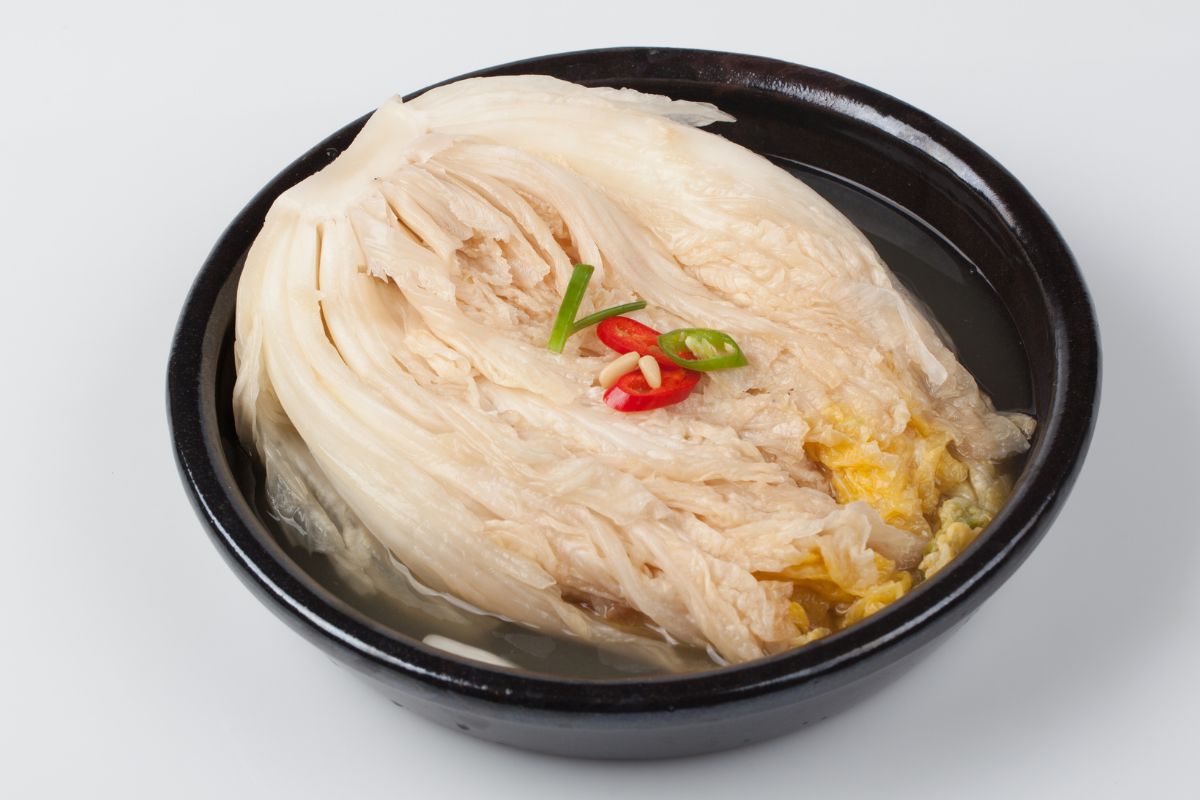
In baek kimchi (백김치), the word baek (白) means white. As the name suggests, it is kimchi made without gochugaru — the red chili pepper flakes that give standard kimchi its signature color and heat.
According to Wikipedia’s official entry on baek-kimchi, the dish uses salted napa cabbage, Korean radish, water parsley (minari), spring onion, Korean pear, chestnuts, jujube (red dates), ginger, garlic, salt, and sugar as its core ingredients. Thin chili threads may be added as garnish for visual contrast, but the brine itself is clear and white.
How Baek Kimchi Differs from Regular Kimchi
The kimchi most people outside Korea know is baechu kimchi — the spicy red fermented cabbage. It is bold, pungent, and assertive. Baek kimchi is an entirely different experience that recalibrates every one of those qualities.
| Regular Kimchi (Red) | Baek Kimchi (White) | |
|---|---|---|
| Color | Deep red | White / translucent |
| Flavor | Spicy, tangy, umami | Clean, sweet, lightly sour |
| Aroma | Strong gochugaru character | Pear, chestnut, gentle ginger |
| Texture | Soft-chewy | Crisp and refreshing |
| Brine | Red and thick | Clear and delicate |
| Best for | Those accustomed to heat | Anyone, including spice-sensitive eaters |
As Korean Bapsang’s official description states, baek kimchi is “child-friendly and great for people who have issues with spicy food” — making it one of the most universally accessible things on the Korean table.
Why Baek Kimchi Is More Than Just “Kimchi Without the Spice”
Baek kimchi is not simply a version with something removed. Without gochugaru competing for attention, the fermentation has to carry the dish on subtlety alone — and it does. Korean pear contributes floral sweetness, chestnut adds a quiet richness, and ginger provides a low, warm undertone. These layers build as fermentation progresses.
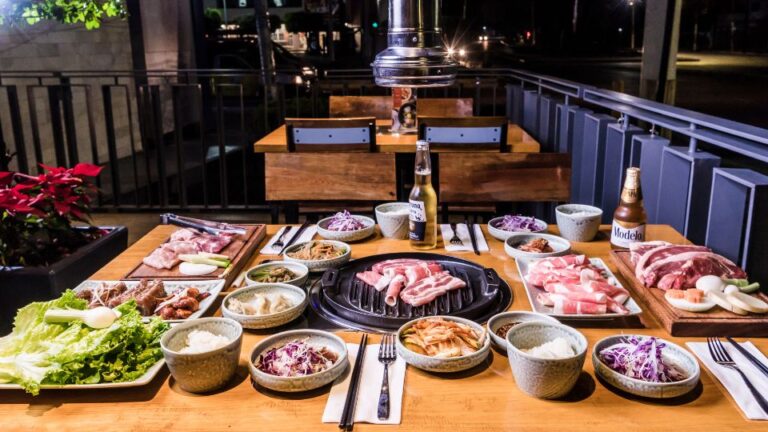
Wikipedia notes that “baek kimchi’s mild flavor and crunchy texture makes it a good appetizer when ordering main dishes consisting of beef such as galbi or bulgogi” — a description that captures exactly how it functions within a Korean meal.
Why Baek Kimchi Is Getting Global Attention Right Now
Scarlett Johansson and Seven Kinds of Kimchi
In July 2025, Scarlett Johansson came to Seoul for the Jurassic World Rebirth press tour — her first visit to Korea since 2017’s Ghost in the Shell press circuit. Speaking at the press conference, she said, according to both Korea Times and allkpop’s July 2025 coverage: “I went to Myeongdong this morning and bought a bunch of skincare and makeup products. And I think I had about seven kinds of kimchi at breakfast.”
MBC News reporting specifically highlighted that Johansson called out trying baek kimchi for the first time as a memorable part of that experience. The significance is notable: a Hollywood actress of her profile singling out not just kimchi but specifically its non-spicy white variety sent a clear signal to international audiences that Korean fermented food has moved well beyond its spicy reputation.
The US Government Just Put Kimchi on Its Official Diet List
According to MBC News reporting, the US Department of Health and Human Services (DHHS) and the US Department of Agriculture (USDA) included kimchi in their official dietary guidelines published in early 2025 as a recommended fermented food for gut health.
This is not a trend piece or a celebrity endorsement — it is a federal government document. The designation marks the first time a specifically Korean food has appeared in US national nutritional guidance at this level. Since the announcement, domestic US demand for kimchi products has accelerated measurably, with MBC News reporting that 40% of Korea’s kimchi exports in the first half of 2025 were destined for the United States.
The Google Trends Signal: A Window Still Open
Google Trends data (global, past five years) shows an average interest index of 20 for “Baek kimchi” — compared to the saturated and highly competitive “kimchi” keyword. English-language content covering baek kimchi specifically remains sparse relative to the growing search interest. For food content creators and travelers researching Korean cuisine, this is one of the clearest currently available mid-tier opportunities in the K-food content space.
What Goes into Baek Kimchi and What It Tastes Like
The Ingredients
Based on Wikipedia’s official ingredient list and Korean Bapsang’s verified recipe breakdown, here is what goes into a standard baek kimchi preparation.
Core ingredients:
- Napa Cabbage (배추): Salted in Korean coarse sea salt to draw out moisture and maintain crunch
- Korean Radish (무): Julienned strips that add sweet, cool freshness
- Water Parsley (미나리, minari): An aromatic herb unique to Korean cuisine, adding a clean herbal note
- Spring Onion (파): Mild sharpness
- Korean Pear (배, bae): Fruit sweetness and a naturally tenderizing enzyme
- Chestnut (밤): Earthy richness and textural variation
- Jujube (대추): Subtle sweetness and a small contribution of color
- Ginger (생강): Supports fermentation and adds a low, warm heat
- Garlic (마늘): Central to all kimchi fermentation
- Chili Threads (실고추, garnish only): Thinly sliced red chili for visual contrast; delivers negligible heat
What It Actually Tastes Like
The absence of gochugaru changes the flavor architecture entirely. What baek kimchi delivers instead is a clean sequence of sensations.
The first bite brings a crisp, cool crunch — the napa cabbage and radish together. Taking a sip of the brine introduces the pear’s gentle sweetness layered with warm ginger undertones. As fermentation progresses over days and weeks, a soft, refreshing sourness develops — closer to the clean tang of lemonade than the sharp bite of fermented red kimchi.
As Korean Vegan’s official recipe description notes, “white kimchi is typically served in summer — ice cubes are sometimes added to chill the broth further.” This is a useful image: baek kimchi functions, in many ways, as Korean cuisine’s natural palate refresher.
Health Benefits of Baek Kimchi
Endorsed by the American Heart Association
The American Heart Association (AHA) published official reporting on kimchi health research in May 2025, stating that “kimchi has been shown to fight inflammation, prevent colon cancer, reduce cholesterol and blood glucose, strengthen the immune system, and prevent atherosclerosis, the buildup of plaque in the arteries.”
In 2013, UNESCO inscribed kimjang — the Korean culture of making and sharing kimchi — on its Intangible Cultural Heritage of Humanity list. It is a rare distinction: not the food itself, but the act and culture of making it, recognized as having irreplaceable human value.
What Recent Research Shows
According to Healthline’s 2026 reporting, a 2024 clinical trial confirmed that kimchi consumption increased Akkermansia muciniphila — a beneficial gut bacterium — while reducing Proteobacteria, which is associated with obesity risk.
A 2025 review published in Springer Nature suggested that fermented foods including kimchi may carry anti-aging properties through their ability to manage inflammation, though researchers noted that more large-scale studies are needed.
All of these benefits apply equally to baek kimchi. Because it ferments through the same lactic acid bacterial process as red kimchi, the probiotic and microbiome effects are equivalent. For spice-sensitive visitors to Korea, baek kimchi is the most accessible entry point into fermented food’s full health profile — without the heat barrier.
How to Eat Baek Kimchi
① As Banchan (Side Dish)
The most common way to encounter baek kimchi in Korea is as banchan (반찬) — one of the small side dishes that arrive at the Korean table alongside rice and soup. One or two pieces alongside a spoonful of rice is the standard way to eat it. Sipping the brine is entirely normal and expected.
② Paired with Galbi or Bulgogi
Wikipedia specifically notes that baek kimchi’s “mild flavor and crunchy texture makes it a good appetizer when ordering beef dishes such as galbi or bulgogi.” The logic is clear: the kimchi’s clean sourness and crisp texture cut through the richness of grilled or marinated beef in a way that heavy red kimchi sometimes cannot.
③ Added to Cold Noodle Broth
In Korean cold noodle traditions — mul naengmyeon and makguksu — a small pour of baek kimchi brine into the noodle broth is a way to add brightness and complexity. It functions similarly to dongchimi (water radish kimchi), adding a cool, lightly fermented note that elevates the bowl without overwhelming it.
④ As a Fine Dining Ingredient
Baroo, the Los Angeles Korean fine dining restaurant named the LA Times’ 2024 Restaurant of the Year, uses white kimchi as a primary fermented ingredient in its tasting menu (per Airbnb’s official cooking experience listing with Baroo’s chefs). This signals where baek kimchi sits within international culinary circles: it is not a background ingredient — it is a featured element worth learning to work with.
Where to Experience Baek Kimchi in Korea
Korean Hanjeongsik Restaurants
Hanjeongsik (한정식) — Korea’s traditional full-course meal format — typically includes baek kimchi as one of the multiple banchan arranged across the table. High-end hanjeongsik and traditional Korean restaurants frequently serve both red and white kimchi side by side, offering a direct comparison of two distinct fermentation philosophies in the same meal.
Kimjang (Kimchi-Making) Experiences
According to MBC News reporting, demand for hands-on kimchi-making experiences among foreign visitors is rising internationally — including at a kimchi school that opened in Kingston, London. In Korea, various cultural programs offer kimjang experiences for foreign participants. Baek kimchi, with its absence of gochugaru and its straightforward ingredient list, is particularly well-suited as a first kimchi-making experience for those unfamiliar with Korean fermentation.
Korean Supermarkets
Major Korean supermarket chains — E-Mart, Homeplus, and Lotte Mart — all carry commercially produced baek kimchi in their kimchi sections. For foreign travelers wanting to taste and compare multiple kimchi varieties without a restaurant setting, purchasing from a supermarket is a practical option.
Baek Kimchi FAQ
Q: Is baek kimchi really not spicy? Generally, no. It is made without gochugaru — the red chili pepper flakes used in standard kimchi. As Korean Vegan’s recipe notes, some recipes include a small amount of fresh chili (serrano or jalapeño varieties) for a mild background heat, but the spice level is highly controllable and most traditional recipes include none at all.
Q: Is the fermentation process the same as red kimchi? Yes. The underlying mechanism is identical: salted napa cabbage undergoes lactic acid fermentation driven by naturally occurring and added bacteria. The difference is in the flavoring ingredients — gochugaru in red kimchi, and pear, chestnut, and ginger in baek kimchi.
Q: Where can I buy baek kimchi outside Korea? The major Korean food export brands — Jongga and CJ Bibigo — both export baek kimchi to international markets. Korean grocery stores in most major cities carry it. Outside dedicated Korean grocers, well-stocked Asian supermarkets are the most reliable alternative.
Q: How long does it keep? Refrigerated, baek kimchi is best within 2–4 weeks. Freshly made kimchi within the first week has the crispest texture and cleanest flavor. At two to three weeks, the acidity deepens and becomes more pronounced — a different but equally valid version of the same dish.
A Final Note
Baek kimchi represents a different face of Korean fermentation. If red kimchi shows the boldness of Korean food, baek kimchi shows its precision and restraint — a dish that achieves complexity through subtlety rather than intensity.
That Scarlett Johansson, out of seven different kimchi varieties, specifically mentioned her first encounter with the white one is not a coincidence. Without heat to carry the experience, baek kimchi has to win on finesse. And it does — even for first-time tasters who assumed kimchi wasn’t for them.
With the US government’s formal dietary endorsement now on record, the global question around Korean fermented food is shifting from “what is kimchi?” to “which kimchi, and how?” Baek kimchi is the best possible first answer to that question.
🇰🇷 Korean Kimchi Series continues — next up: Gat Kimchi (갓김치) Guide. Stay tuned.