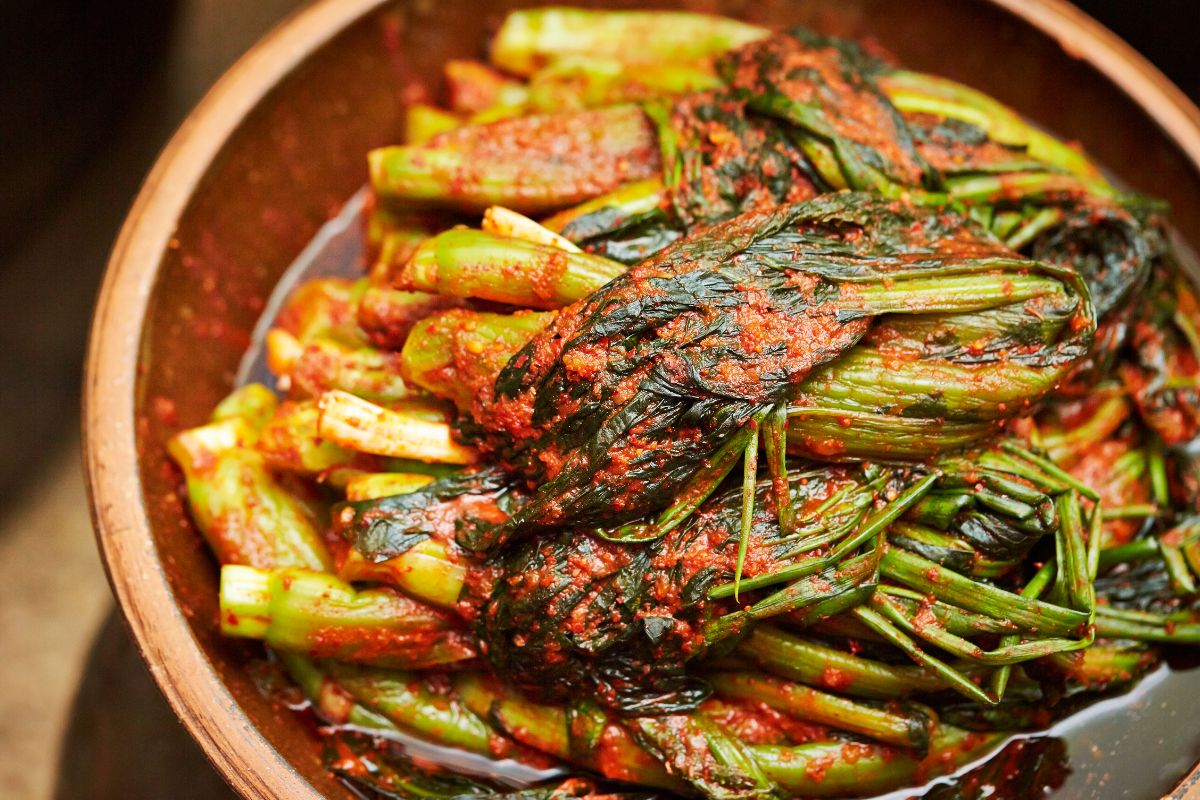
If baek kimchi — covered in Series #1 — shows the gentle, refined side of Korean fermentation, gat kimchi (갓김치) is its boldest, most regionally specific counterpart.
The warm oceanic climate, alkaline red clay soil, and sea breezes of Dolsan Island (돌산) in Yeosu, South Jeolla Province — that precise combination of conditions is what produces the mustard greens that make proper gat kimchi possible. Zuzu Korea Travel’s official kimchi guide (April 2026) describes gat kimchi in one sentence: “If baechu kimchi is the standard and kkakdugi is the everyday workhorse, gat kimchi is the connoisseur’s kimchi: polarising, regional, and unforgettable.”
This guide covers what gat kimchi is, why Yeosu is its origin and home, what it actually tastes like, and where to find it.
What Is Gat Kimchi?
What Is “Gat”?
Gat (갓) is the Korean name for mustard greens, scientifically classified as Brassica juncea. It is not a flat leafy green like spinach or lettuce — it has thick stems, broad leaves with purple or green colouring depending on the variety, and a naturally assertive aroma. It belongs to the same plant family as the mustard seed used in Western condiments, and the vegetable carries an inherent sharpness and slight bitterness before any fermentation occurs.
According to Wikipedia’s official entry, gat-kimchi (갓김치) is a regional variety of Korean kimchi made from mustard greens rather than the more typical napa cabbage. Dolsando Island (돌산도) in Yeosu, South Jeolla Province, is the officially recognised origin of the most celebrated version.
Why Dolsan Island? The Geography Behind the Flavour
The quality of gat kimchi begins with the quality of the gat — and the quality of the gat begins with where it grows.
According to Yeosu City’s official tourism documentation, the reason Dolsan gat is special comes down to three environmental conditions operating simultaneously: a warm oceanic climate where temperatures rarely fall below freezing, alkaline red clay soil, and sea breezes from the surrounding coastline. This combination produces a mustard green that is large yet remarkably tender, low in fibres compared to ordinary gat, and possessed of a distinctive aroma and flavour that standard mustard greens from other regions cannot replicate.
The official Yeosu City tourism resource states directly: “Dolsan gat-kimchi is a masterpiece made from a mixture of Dolsan’s warm oceanic climate, alkaline soil, and the wind.”
Gat Kimchi vs. Standard Baechu Kimchi: The Key Differences
| Regular Kimchi (Baechu) | Gat Kimchi | |
|---|---|---|
| Base vegetable | Napa cabbage | Mustard greens (Brassica juncea) |
| Origin | Nationwide | Yeosu / Dolsan Island, South Jeolla |
| Colour | Deep red | Deep purple-green |
| Flavour | Spicy, clean, umami | Bitter, earthy, pungent, oceanic |
| Texture | Soft-chewy | Crisp stems, tender leaves |
| Season | Year-round | Autumn and winter |
| Where to find it | Every Korean restaurant | Jeolla Province restaurants, Yeosu |
The History of Gat Kimchi
Recorded in an 18th-Century Agricultural Encyclopedia
Gat kimchi is not merely a regional speciality — it has a documented history spanning centuries. According to Grokipedia’s official academic documentation, gat kimchi appears in “Jeungbo sallim gyeongje” (증보산림경제), an 18th-century Joseon Dynasty agricultural encyclopedia published in 1765. This places gat kimchi within a verified historical record of at least 260 years as a distinct Korean fermented food.
Its rise in popularity during the late Joseon Dynasty (1392–1910) coincided with a broader diversification of kimchi varieties, as new vegetables including mustard greens were incorporated into fermentation practices — particularly in the fertile agricultural regions of Jeolla Province.
The 1980s: When Dolsan Gat Became What It Is Today
The specific Dolsan gat variety that defines the most prized gat kimchi today has a more recent origin. According to Grokipedia’s documentation, the Dolsan gat cultivar was introduced around 1980 from Japan and adapted to Dolsan Island’s unique environment of warm oceanic air, alkaline red clay soil, and coastal breezes. From this starting point on Dolsan Island, cultivation expanded across Yeosu and eventually gained nationwide recognition.
Yeosu’s official tourism materials confirm this timeline: “Dolsan gat first gained its fame about thirty years ago” — consistent with its emergence from the 1980s cultivation onwards.
Officially Listed as One of Yeosu’s Ten Tastes
Yeosu City officially designates ten representative foods (여수 10미, Yeosu’s Ten Tastes) that define the city’s culinary identity. Dolsan gat kimchi is one of these ten — an official designation that recognises it not merely as a local specialty, but as a core component of the city’s cultural heritage. It has also gained nationwide recognition through local festivals and commercial distribution, per Grokipedia’s documentation.
What Gat Kimchi Actually Tastes Like
The First Encounter
Gat kimchi can be disorienting on first contact. That is by design.
Zuzu Korea Travel’s official guide describes the flavour precisely: “The mustard leaf has a natural bitterness, a loamy earthiness, and a mild pungency that deepens significantly during fermentation.” Someone accustomed to the clean sourness of baechu kimchi will encounter something that hits with noticeably more force — a vegetable asserting its own character through the fermentation rather than being shaped by it.
This is what “polarising” means in the context of gat kimchi. It is not universally immediately likeable. But among those who have developed a taste for it, it becomes a reference point — the kimchi they seek out because nothing else is quite like it.
The Flavour Deepens With Time
According to Grokipedia’s official description, gat kimchi has “a tangy, slightly sweet and sour profile with a crisp texture that balances the tender leaves and thicker stems, resulting from the fermentation process that enhances its probiotic content and umami depth.”
Fresh gat kimchi leads with the mustard green’s sharpness and herbal pungency. As fermentation progresses over days and weeks, that initial edge softens — and in its place, a deeply layered, complex umami flavour develops. This evolution is why Zuzu Korea describes gat kimchi as the connoisseur’s choice: it rewards time, familiarity, and an appetite for complexity over immediate accessibility.
The Role of Anchovy Fish Sauce (Myeolchijeot)
Jeolla Province-style gat kimchi has one more distinguishing characteristic: the generous use of myeolchijeot (멸치젓) — fermented anchovy fish sauce.
Zuzu Korea Travel notes that “Jeolla-style gat kimchi is made with extra-generous amounts of fermented seafood — myeolchijeot (anchovy fish sauce) being the most common — which gives it a deeply savoury, almost oceanic richness.” It is the combination of this fermented seafood base with the mustard greens that produces the specific oceanic depth associated with Dolsan gat kimchi. The sea is literally part of the flavour.
What Goes into Gat Kimchi
Core Ingredients
Based on Wikipedia’s official ingredient documentation and Maangchi’s verified recipe breakdown:
Primary ingredients:
- Gat (갓, mustard greens): Both stems and leaves used; the Dolsan variety is preferred
- Gochugaru (고춧가루, red chili pepper flakes): Standard kimchi spice base
- Myeolchijeot (멸치젓, fermented anchovy fish sauce): The defining Jeolla ingredient; provides oceanic umami depth
- Garlic (마늘): Core to all kimchi fermentation
- Ginger (생강): Fermentation support and aromatic warmth
- Spring onion (파): Additional aromatics
- Sugar or maesil-cheong (plum syrup): Sweetness balance
- Coarse salt (굵은 소금): For salting the greens before mixing
The Salting Process
According to Maangchi’s official recipe documentation, gat leaves are rinsed in cold water, then salted and left to stand for approximately two hours, turned every 30 minutes for even distribution. Because mustard greens are thinner than napa cabbage, they require less salting time than baechu kimchi — but that two-hour window is essential for developing the right texture before fermentation begins.
The Buddhist Temple Cuisine Version
According to Prehealing.com’s professional documentation, a distinct version of gat kimchi exists within Korean Buddhist temple cuisine (사찰 음식, sachal eumsik), particularly in Jeolla Province. This version omits garlic and spring onion — two of the five pungent vegetables (오신채, oshinchae) prohibited in Korean Buddhist practice. The temple version represents gat kimchi in its most elemental form: the fermented character of the mustard leaf itself, without additional aromatics to modify it.
Health Benefits of Gat Kimchi
The Same Probiotic Foundation as All Kimchi
Gat kimchi undergoes the same lactic acid bacterial fermentation process as all Korean kimchi varieties — which means it carries the same probiotic and health benefits documented across the broader kimchi category.
As covered in Series #1, the American Heart Association’s May 2025 official reporting confirmed that kimchi “has been shown to fight inflammation, prevent colon cancer, reduce cholesterol and blood glucose, strengthen the immune system, and prevent atherosclerosis.” The 2024 clinical trial confirming increased Akkermansia muciniphila gut bacteria from kimchi consumption (reported by Healthline in 2026) applies equally to gat kimchi.
The Additional Nutritional Profile of Mustard Greens
Beyond the shared fermentation benefits, the gat vegetable itself carries its own nutritional characteristics. Yeosu City’s official documentation notes that Dolsan gat has higher protein content than other vegetables. According to Grokipedia, Brassica juncea (mustard greens) is high in vitamins A, C, and K, as well as calcium. Fermentation is known to increase the bioavailability of many of these nutrients.
How to Eat Gat Kimchi
① As Banchan, with Grilled Pork
Gat kimchi functions best as banchan (반찬) — served alongside main dishes rather than on its own. Its natural pairing is with rich, fatty pork dishes: samgyeopsal (삼겹살, pork belly), bossam (보쌈, steamed pork slices), or pork ribs. The bitterness and fermented pungency of the gat cut through the fat in a way that standard kimchi varieties approach but don’t quite match.
Zuzu Korea Travel specifically notes: “When you’ll eat it: Autumn and winter” — the seasons when the kimchi gat and gimjang gat varieties are freshest and most flavourful.
② Paired with Yeosu’s Seafood
Gat kimchi made with anchovy fish sauce carries a natural maritime character that pairs exceptionally well with seafood. In Yeosu itself, gat kimchi is a standard accompaniment at seafood restaurants — and the combination of a fermented, ocean-influenced kimchi alongside the city’s coastal catch is one of the most coherent food pairings in Korean regional cuisine.
③ The Temple Cuisine Version as a Gentle Introduction
For visitors who find the full-anchovy version of gat kimchi too intense as a first encounter, seeking out the Buddhist temple cuisine version (without garlic and fermented seafood) provides a calmer entry point. The mustard leaf’s own fermented character comes through most clearly in this format, offering a foundation for understanding what gat brings before the fish sauce amplification is added.
Where to Experience Gat Kimchi in Korea
Zuzu Korea Travel’s guide is direct: “Seek it out at Jeolla-style restaurants in Seoul, or make the trip to Yeosu to eat it where it belongs.” Both options are valid — but they deliver different experiences.
Making the Trip to Yeosu
Yeosu is approximately 2 hours 20–40 minutes from Seoul by KTX. As a coastal city in South Jeolla Province, it is worth visiting for more than the kimchi — but gat kimchi is a perfectly good reason to anchor a trip around it.
A Yeosu gat kimchi food itinerary:
- Cross the Dolsando Bridge to Dolsan Island — where the gat actually grows
- Yeosu city centre restaurants serving the official Yeosu Ten Tastes menu, of which gat kimchi is one
- Dolsan Park — viewpoint over the city and bay
- Odongdo Island or Hyangilam Hermitage — coastal scenery shaped by the same environment that grows the gat
- Yeosu night view — the famous illuminated harbour
Finding Gat Kimchi in Seoul
Jeolla Province-style Korean restaurants in Seoul regularly feature gat kimchi as a banchan. Areas with concentrations of Jeolla-style or hanjeongsik restaurants — around Mapo-gu, Insadong, or the Gwangjang Market area — are the most reliable starting points. Korean supermarkets (E-Mart, Homeplus, Lotte Mart) carry commercially produced Dolsan gat kimchi in their kimchi sections.
For international visitors outside Korea, CJ Bibigo and other major Korean export brands include gat kimchi in select international markets. Korean grocery stores in major cities carry it.
Gat Kimchi FAQ
Q: Is gat kimchi spicier than regular kimchi? It tends to feel more intense overall, though not necessarily hotter in the standard chili sense. The mustard green itself carries a natural sharpness — similar to the burn of wasabi or horseradish, though gentler — and this combines with the gochugaru seasoning. First-time eaters are often more struck by the unfamiliar bitterness and pungency than the heat level itself.
Q: Is gat kimchi vegetarian or vegan? Traditional gat kimchi uses myeolchijeot (fermented anchovy fish sauce) and is therefore not vegetarian or vegan in its standard form. However, the Buddhist temple cuisine version omits all fermented seafood and garlic, producing a plant-based version. Seeking out temple food restaurants in Jeolla Province is the most reliable route to the vegan version.
Q: When is the best time to eat gat kimchi? Autumn and winter, as noted by Zuzu Korea Travel. Yeosu City’s official materials describe three seasonal gat varieties: bomddong gat (spring), kimchi gat (summer), and gimjang gat (winter). The gimjang gat — used for the winter kimchi-making season — produces the most intensely flavoured gat kimchi.
Q: How long does it keep? Like all kimchi, gat kimchi is best refrigerated. The first one to two weeks offer the crispest stems and most vibrant flavour. By three to four weeks, the fermentation deepens and the sourness becomes more pronounced — a different but equally valid version. Many Korean cooks prefer it more fermented.
A Final Note
Gat kimchi is not as widely known as baechu kimchi, but it is arguably the best demonstration of how far Korean fermentation culture extends across regions and ingredients.
A history documented in a 1765 agricultural encyclopedia. A dedicated island with a specific microclimate that produces a vegetable available nowhere quite the same. Official recognition as one of a city’s ten defining foods. And a flavour that consistently produces the same reaction in first-time tasters: uncertain at first, then quietly impressed, then seeking it out again.
“Polarising, regional, and unforgettable” is how Zuzu Korea describes it. That is an accurate characterisation of a fermented food tradition at its most unapologetically specific — and a good description of what makes Korean kimchi culture worth exploring beyond the obvious starting point.
🇰🇷 Korean Kimchi Series continues — next: Dongchimi (동치미) Guide. Coming soon.