Cheonan is not a city most foreign travelers associate with food culture — but it holds a quiet claim to one of Korean cuisine’s most demanding dishes. Goun Yukhoe Bangagan (고운육회방앗간) is a yukhoe specialist built around a single idea: that the quality of the sesame oil pressed daily on-site is what separates an ordinary raw beef dish from an extraordinary one.
This guide covers everything foreign visitors need to know before arriving — the cultural background of yukhoe, how Goun Yukhoe Bangagan differs from other raw beef restaurants, what to order, and how to build a Cheonan visit around it.
Understanding Yukhoe — Korea’s Raw Beef Tradition
What Is Yukhoe?
According to the Korea Herald and the MICHELIN Guide Korea, yukhoe (육회) is one of Korea’s oldest and most distinctly Korean dishes. The name breaks down simply: yuk (육, 肉) means meat, and hoe (회, 膾) means raw sliced food. Yukhoe is, in essence, thinly sliced raw beef.
The MICHELIN Guide notes that “although the food cultures of Korea, China, and Japan have many similarities, yukhoe is a food that developed only in Korea. In China, raw meat is rarely eaten, while in Japan, sashimi is popular but meat is not eaten raw.” Yukhoe traces its roots to Korean royal court cuisine during the Joseon Dynasty — a dish built on the premise that excellent beef, handled with care and seasoned correctly, needs nothing more than that.
Yukhoe vs. French Beef Tartare: What’s Different
The simplest introduction is to call yukhoe Korea’s beef tartare — but the comparison has limits, as explained by The Soul of Seoul food publication (June 2026).
French tartare is minced, often mixed with capers, Worcestershire sauce, and served with bread or fries. Korean yukhoe is sliced into thin strips rather than minced, then seasoned with soy sauce, sesame oil, garlic, and sugar — producing a sweeter, nuttier, more aromatic profile. It’s served with julienned Korean pear (배, bae) for crisp sweetness, a raw egg yolk on top, and sometimes toasted pine nuts. One person typically mixes everything together tableside before the group eats from the shared plate.
The result, as specialty food publication 10mag describes, is “cool, silky, and surprisingly light — much closer to a refined appetizer than a dare-food.”
Is Yukhoe Safe to Eat?
The honest answer is: yes, when prepared by a specialist using fresh, same-day domestic beef. Korea has a long tradition of safe yukhoe preparation, and established yukhoe restaurants take freshness seriously — sourcing beef daily and preparing it to order.
Goun Yukhoe Bangagan uses Hanwoo female cow (한우 암소) beef processed daily, which is the highest-quality Korean domestic cattle designation. The daily preparation is not a marketing phrase — it’s the operational structure of a restaurant built around raw beef.
What Is Yukhoe Bibimbap?
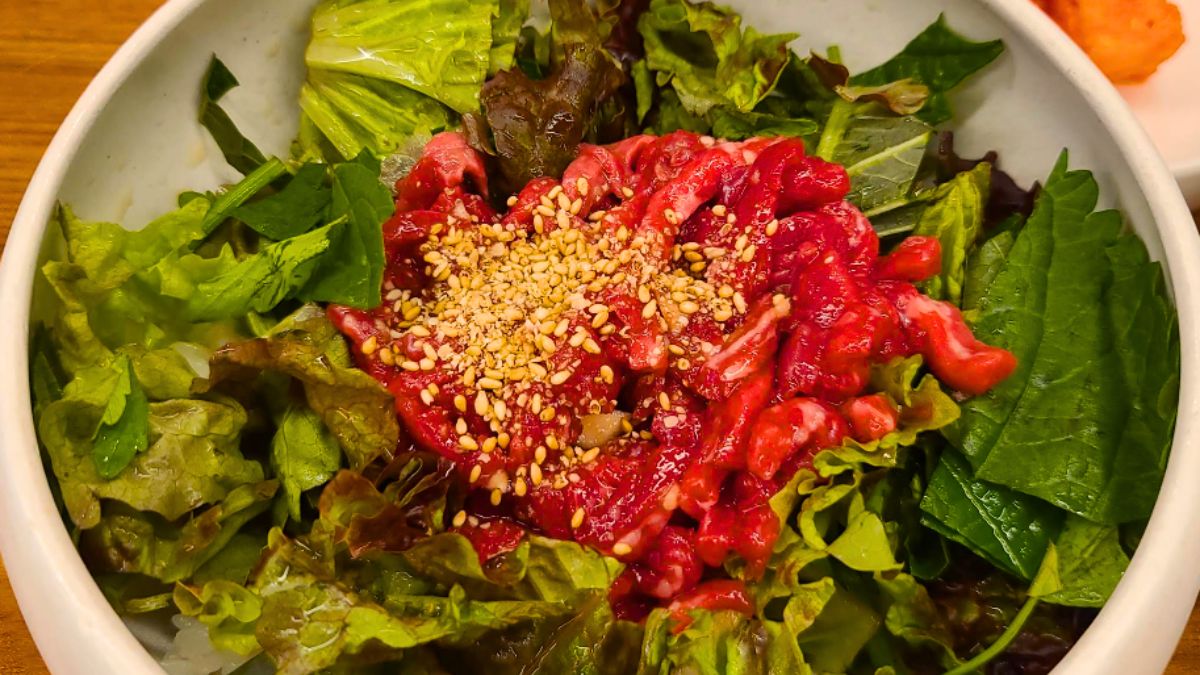
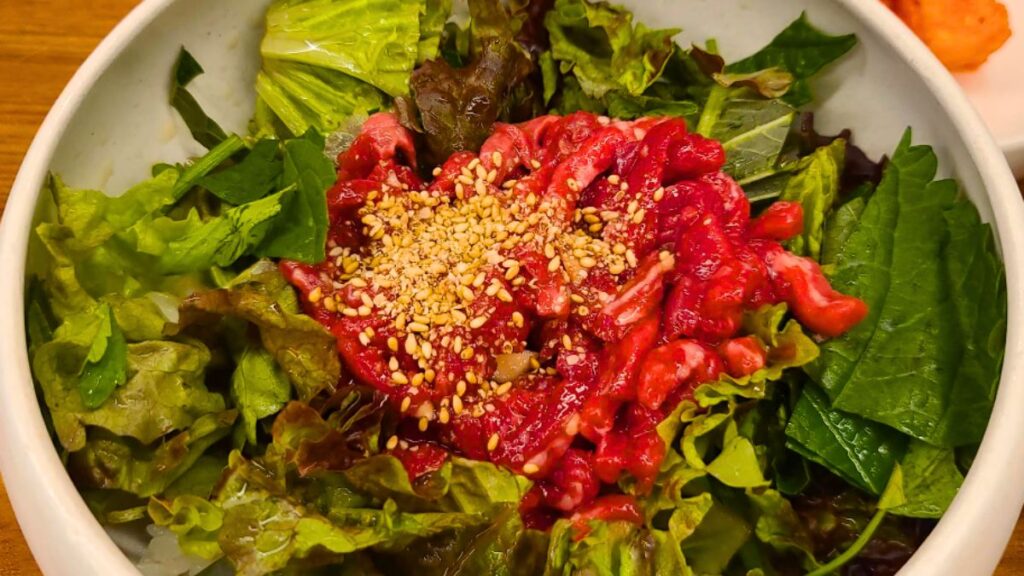
Yukhoe bibimbap (육회비빔밥) places cold raw beef strips directly on warm, freshly cooked rice, seasoned with soy sauce and sesame oil rather than the red gochujang sauce used in standard bibimbap.
The MICHELIN Guide describes the appeal precisely: “The combination of warm rice and cold yukhoe, gently mixed, serves to present the yukhoe bibimbap at just the right temperature. The contrast of taste, texture, and fragrance that this temperature difference gives cannot be enjoyed anywhere other than a yukhoe specialist.” This temperature contrast — cold, silky beef against warm, slightly sticky rice — is the dish’s defining quality.
What Makes Goun Yukhoe Bangagan Different
The Oil Mill Concept — Why Sesame Oil Defines This Restaurant
The name Bangagan (방앗간) refers to a traditional Korean oil mill — the kind of neighborhood establishment where sesame seeds and perilla seeds were pressed into oil fresh each day. These mills were once a fixture of Korean community life, and the oils they produced were notably more fragrant and complex than the commercial versions sold in bottles.
Goun Yukhoe Bangagan has built its identity entirely around this concept. Every day, sesame oil and perilla oil are pressed on-site and used immediately. The restaurant’s philosophy, as stated in its brand materials, is straightforward: “Good oil makes good yukhoe.” The freshness of the pressing oil — and its direct application to the beef the same morning — is what the restaurant believes separates its yukhoe from any version made with bottled commercial oil.
This is not a decorative concept. Visitors who are familiar with fresh-pressed sesame oil will immediately recognize the difference: a warm, round, deeply nutty aroma that store-bought oil cannot replicate. For visitors who are not familiar with it, this restaurant is an excellent first encounter.
What Is a Bangagan (방앗간)?
For context useful to foreign visitors: a bangagan is a traditional oil-pressing mill, once common in Korean neighborhoods, where locals would bring sesame seeds to be pressed into oil. The process produces oil that is significantly more aromatic than mass-produced commercial sesame oil, and the difference in food is noticeable.
The restaurant leans fully into this identity — its exterior features a red awning, stepping-stone path entrance, and signage that evokes a traditional oil mill rather than a restaurant. The concept extends to the retail section, where the restaurant sells small quantities of its freshly pressed sesame and perilla oil for visitors to take home.
Hanwoo Amso — Why Female Cow Beef?
All of Goun Yukhoe Bangagan’s yukhoe and yukhoe bibimbap uses 한우 암소 (Hanwoo amso) — specifically female Korean cattle.
Hanwoo (한우) is the Korean native cattle breed, known for its marbling quality and distinct flavor. Female Hanwoo, specifically, is considered by Korean beef specialists to produce meat with a cleaner, more delicate flavor than male cattle — less gamey, with a finer texture. For a raw beef dish where no cooking process will mask any imperfection in the meat, this distinction matters more than it would in a grilled or braised preparation.
The use of Hanwoo amso at yukhoe bibimbap prices of ₩10,000 (~$7 USD) is what generates the “how is this possible?” reactions consistently found in reviews of this restaurant.
Government Certification and Television Recognition
Goun Yukhoe Bangagan holds the 착한가격업소 (Good Price Business) designation from the Ministry of the Interior and Safety (행정안전부). This government certification identifies businesses that maintain fair pricing for quality goods, verified against market standards. It functions as an official endorsement of the value proposition this restaurant delivers.
The restaurant was also featured on KBS 2TV’s 생생정보 ‘고수의 부엌’ (Master’s Kitchen), a program that highlights specialized local restaurants with verified expertise.
Menu & Pricing Guide
Complete Menu
| Menu Item | Price | Description |
|---|---|---|
| Hanwoo Amso Yukhoe Bibimbap (일반) | ₩10,000 | Standard portion — cold raw beef on warm rice, soy-sesame marinade |
| Hanwoo Amso Yukhoe Bibimbap (특) | ₩15,000 | Special portion — more beef |
| Hanwoo Amso Andong Guksi (온면) | ₩10,000 | Warm noodle soup, Andong style |
| Perilla Oil Makguksu (들기름막국수) | ₩10,000 | Cold buckwheat noodles with fresh-pressed perilla oil |
| Hanwoo Amso Yukhoe | ₩28,000 | Raw beef tartare platter with egg yolk and pear |
| Hanwoo Amso Yuksa-simi | ₩32,000 | Raw beef sashimi — thicker, different cut |
| Yukhoe + Yuksa-simi Half and Half | ₩35,000 | Both on one platter |
| Yukjeon (Beef Pancake) | ₩19,000 / ₩10,000 | Full / half portion, pan-fried beef |
Every yukhoe bibimbap comes with soegogi muguk (소고기무국) — a warm, clear beef and radish soup — included at no extra charge. This is a meaningful addition that turns a bowl of rice into a complete meal.
💰 In perspective: Standard yukhoe bibimbap at Seoul’s specialist restaurants costs ₩10,000–15,000 per bowl. Goun Yukhoe Bangagan charges ₩10,000 for a Hanwoo amso version — the same or lower price for a higher-quality cut designation, outside the capital. By any comparison, this is remarkable value.
The ₩10,000 Yukhoe Bibimbap — What Makes It Worth It
The standard bowl at Goun Yukhoe Bangagan differs from generic bibimbap in three ways. First, the beef is raw Hanwoo amso cut that morning. Second, the marinade uses soy sauce and freshly pressed sesame oil rather than the red gochujang paste used in most bibimbap — producing a cleaner, nuttier flavor that doesn’t overwhelm the beef. Third, a warm beef-and-radish soup arrives alongside, completing the meal without additional cost.
Reviews consistently describe the flavor as “not spicy, not fishy, and continuously inviting” — the exact opposite of the raw beef intimidation that puts many visitors off the dish.
Perilla Oil Makguksu — The Unexpected Second Choice
For visitors who are not ready for raw beef, the perilla oil makguksu (들기름막국수) is the restaurant’s most recommended alternative.
Perilla oil (들기름, deulgirum) is pressed from perilla seeds — a Korean herb in the mint family. The oil has a distinctive earthy, slightly nutty character, deeper and more complex than sesame oil. Because the restaurant presses its perilla oil daily, the aroma in this dish is significantly more pronounced than in versions made with commercial oil. The noodles arrive cold, topped with green onion, seaweed flakes, and toasted sesame seeds.
Reviews routinely describe it as “addictive” — a dish ordered by people who came in unsure whether they’d like it, and reordered on subsequent visits.
What to Expect During Your Visit
The exterior is immediately distinctive. A red awning, a stepping-stone path leading to the entrance, and oil mill-style signage announce that this is not a generic Korean restaurant. The interior uses warm wood tones, an open kitchen, and a compact table layout suited to solo diners, lunch couples, and small family groups equally.
Lunch hours tend to see queues of local office workers — which, in the context of a Korean food trip, is itself a reliable quality signal. The kitchen moves quickly and tables turn over at pace, meaning even a short queue usually resolves within 15–20 minutes.
The yukhoebibimbap is served cold on warm rice and arrives ready to mix. The accompanying soegogi muguk (beef and radish soup) is clear and lightly seasoned — use it to pace the meal, sipping between bites of the bibimbap to cleanse the palate. Baby chairs are available for families traveling with young children.
Practical Information
| 📍 Address | 25 Baekseok 3-ro, Seobuk-gu, Cheonan, South Chungcheong Province (백석3로 25, 1층) |
| 🗺️ Map | Search “고운육회방앗간” on Naver Maps or Kakao Maps |
| ⏰ Hours | Tue–Sun 10:30 – 21:00 (break 15:30–17:00) |
| 📅 Closed | Every Monday |
| 💳 Payment | Cards accepted |
| 🪑 Facilities | Baby chairs available, open kitchen, street-level access |
고운 육회 방앗간 – https://maps.app.goo.gl/q9N91jkhhSaFH9Nh6
⚠️ Break time: The restaurant closes from 15:30–17:00 daily. If arriving in the afternoon, plan to arrive before 15:00 or after 17:00. The kitchen closes for final orders at 21:00.
Getting to Cheonan
- KTX: Seoul Station → Cheonan-Asan Station, approximately 35–40 minutes
- Mugunghwa/ITX: Seoul Station → Cheonan Station, approximately 1 hour 10 minutes
- From Cheonan-Asan Station to the restaurant: Taxi approximately 10–15 minutes (~₩8,000–10,000)
The restaurant is located in the Baekseok-dong area of Seobuk-gu, Cheonan — across from the Cheonan Sports Complex and Yu Gwan-sun Gymnasium. This position makes it a natural stop in the broader Cheonan travel circuit.
Connecting to Cheonan’s History Sites
Cheonan is home to the Independence Hall of Korea (독립기념관) and the Yu Gwan-sun Memorial Hall (유관순열사기념관) — two of the most significant historical destinations in central Korea.
The Independence Hall, approximately 20–25 minutes from the restaurant by taxi, houses seven permanent exhibition halls documenting Korea’s independence movement and the Japanese colonial period (1910–1945). Yu Gwan-sun Memorial commemorates the 16-year-old independence activist who led the 1919 Aunae Marketplace demonstration and died in prison at 18.
A Cheonan day that combines a morning at the Independence Hall with a lunch at Goun Yukhoe Bangagan provides both historical depth and a genuinely distinctive meal — two experiences that are difficult to replicate elsewhere.
💡 Timing suggestion: Independence Hall opens at 9:30 AM and a focused visit takes 2–3 hours. Arriving at Goun Yukhoe Bangagan by 12:00 PM captures the fresh preparation and avoids the peak lunch queue.
Practical Tips for Foreign Visitors
① How to eat yukhoe bibimbap When the bowl arrives, the raw beef sits on top of the rice unmixed. Hold the spoon in the center and fold everything inward — the soy-sesame marinade is already in the bowl and will coat both the beef and the rice as you mix. Mix thoroughly before the first bite. The soup (soegogi muguk) serves as a palate cleanser between mouthfuls.
② For visitors nervous about raw beef Order the perilla oil makguksu as an alternative or accompaniment. It’s the restaurant’s most reordered dish among visitors who were initially hesitant about raw beef, and it demonstrates the same oil-pressing philosophy in a fully cooked format.
③ The soegogi muguk (beef radish soup) is included No need to order it separately. Every yukhoe bibimbap order comes with the soup at no additional cost. It’s lightly flavored and designed to complement the richness of the bibimbap.
④ Note the break time The 15:30–17:00 break is consistent. Plan around it — the sweet spots are a 12:00 PM arrival for lunch or a 17:30 arrival for an early dinner.
⑤ Freshly pressed oil is available to purchase The restaurant sells small packages of its freshly pressed sesame and perilla oil at the counter. If the flavor of the oil is a significant part of the experience — and for many visitors, it is — purchasing some to bring home is a practical option.
Who Should Visit
✅ Foreign travelers visiting Cheonan’s Independence Hall or Yu Gwan-sun Memorial who need a lunch stop that matches the significance of the day
✅ Visitors who have encountered yukhoe in Seoul and want to try a regional specialist version at a lower price point than the capital
✅ Food travelers curious about traditional Korean oil-pressing culture and how it applies to cooking — rather than just eating it
✅ Anyone who wants to try a Korean-exclusive raw beef dish in a specialized environment with daily-processed, domestic beef
✅ Travelers looking for a ₩10,000 meal that outperforms its price — government certified, television-verified, and consistently reviewed as Cheonan’s leading yukhoe destination
Final Note
Yukhoe is a dish that Korea has refined over centuries, and the quality of the sesame oil used in its preparation has always been central to that refinement. What Goun Yukhoe Bangagan has done is make that premise visible — by pressing the oil itself, every morning, and using it the same day.
The result is a ₩10,000 bowl of Hanwoo amso yukhoe bibimbap that reviews consistently describe as unexpectedly subtle, clean, and addictive. Not aggressive, not intimidating — just honest, well-made Korean food at a price that reflects the restaurant’s stated mission: “Good oil makes good yukhoe.”
If Cheonan is on the itinerary for its history, this restaurant adds a reason to stay a little longer, eat a little better, and leave with a more complete picture of what Korean food actually looks like when it’s made with care.
🇰🇷 Budget-Friendly Eats in Korea — the series continues. More regional recommendations coming soon.