What This Guide Covers
If baek kimchi — Series #1 — shows the gentle, refined side of Korean fermentation, and gat kimchi — Series #2 — shows its most regionally specific and assertive form, then dongchimi (동치미) is Korean fermentation at its most transparent and honest.
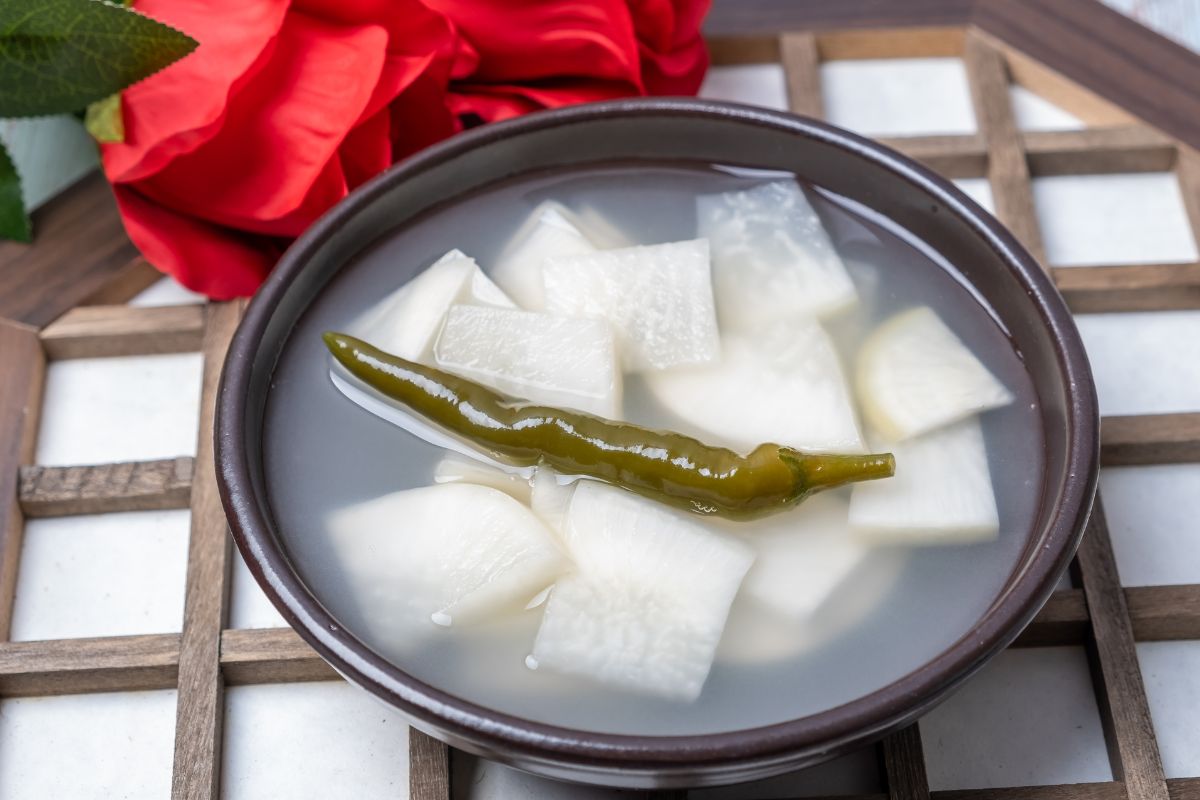
No gochugaru. No heavy seasoning. Whole radishes submerged in salted water, left to ferment slowly in the cold, producing a brine that is the colour of water and the flavour of winter. Korea Food Now’s official food guide describes dongchimi as “unlike its spicy napa cabbage cousin — a ‘water kimchi’ celebrated for its clear, clean, and effervescent brine, offering a crisp counterpoint to many rich Korean meals.”
This guide covers what dongchimi is, why it is central to Korean winter food culture, what it tastes like, and specifically why its brine is the starting point for one of Korea’s most beloved noodle dishes — mul naengmyeon.
What Is Dongchimi?
The Meaning of “Dong” (冬) — Why It Is Winter Kimchi
In dongchimi (동치미), the first syllable dong (동, 冬) means winter.
According to Maangchi’s official recipe documentation: “Dongchimi literally means ‘winter kimchi’ because it’s traditionally made right before the cold winter starts in Korea. In late fall, we can find small, palm-sized radishes in the market, and we start thinking ‘Oh, it’s time to make dongchimi already!’ The radishes harvested around that time of year are firm, crispy, and sweet.”
The sweetness and density of autumn-harvested Korean radish determines the character of the brine. Traditionally, dongchimi was one of winter’s essential preparations — a fermented food that provided nutrition and flavour through the cold months when fresh vegetables were scarce.
Dongchimi vs. Regular Kimchi: The Defining Difference
Easyneasy.com’s official guide makes a point worth holding onto: “To Korean diners, dongchimi is not ‘mild kimchi.’ It is intentional kimchi.”
| Regular Baechu Kimchi | Dongchimi | |
|---|---|---|
| Base vegetable | Napa cabbage | Whole Korean radish |
| Colour | Deep red | Clear / transparent |
| Brine | Thick, red seasoned liquid | Clear, clean water |
| Seasoning | Gochugaru-based | No gochugaru at all |
| Texture | Soft-chewy leaves | Crisp radish + delicate brine |
| Key element | Seasoned vegetables | The brine itself |
| Season | Year-round | Traditional winter |
The most important structural difference: in most kimchi varieties, seasoning penetrates the vegetable. In dongchimi, the goal is the liquid — the fermented brine that develops over weeks and months is the primary product, as important as the radish floating within it.
What Is Mul Kimchi (Water Kimchi)?
Dongchimi belongs to the mul kimchi (물김치, water kimchi) category. According to Pickled Plum’s official description, “dongchimi is a popular Korean dish mainly made of daikon radish but also including other ingredients such as napa cabbage, ginger, scallions, and chilis.” Water kimchi is defined by the ratio of liquid to solid being much higher than other kimchi varieties — you are fermenting not just the vegetable but the water around it.
The History of Dongchimi
The Essential Side Dish of Kimjang Season
According to Korea Food Now’s official food history documentation, “the origins of Dongchimi are deeply rooted in Korea’s agricultural history, particularly the need to preserve vegetables during harsh winters. Historically, Koreans relied on fermentation as a primary method of food preservation.”
Dongchimi was a staple of kimjang (김장) — the communal kimchi-making season that still takes place each late autumn across Korea. Alongside baechu kimchi, dongchimi was prepared to carry families through months when fresh produce was not available. In 2013, UNESCO inscribed kimjang on its Intangible Cultural Heritage of Humanity list. Dongchimi is part of that heritage.
Earthenware Jars Buried Underground
Easyneasy.com’s official historical documentation notes that traditionally, “dongchimi was prepared in late autumn and stored in large earthenware jars buried underground. The cold temperature slowed fermentation, allowing the kimchi to develop a gentle tang over months without becoming overly sour.”
Maangchi’s personal account captures what this looked like in practice: “When I was in high school in Seoul, I lived with my grandparents. My grandmother made her dongchimi in a huge earthenware pot. She used regular-sized radish which is very large, heavy, crispy, juicy, and sweet.” This image — a grandmother’s earthenware pot, the slow winter fermentation, the kitchen where everything smelled of radish and brine — is the cultural memory that dongchimi carries for millions of Koreans.
What Dongchimi Tastes Like
The First Encounter
Dongchimi is a flavour that is difficult to describe accurately before you have tasted it. Spoonsoul.com’s official tasting note remains the most evocative description found in English:
“The taste unfolds like icy mineral water laced with peppery radish, leaving a clean, tingling brightness that feels like winter air pressed against your tongue.”
For first-time tasters: there is no spice, no gochugaru burn, none of the assertive bitterness of gat kimchi. What arrives instead is cool and transparent — the natural sweetness of the radish at its autumn peak, a light salinity from the brine, and a gentle sourness that develops through fermentation. It is refreshing in the way that very cold, slightly mineral water is refreshing.
What Makes the Brine Distinctive
The most important element of dongchimi is its brine — which is both the medium for fermentation and the finished product.
Korea Food Now describes the fully fermented brine as “light, lightly tangy, and slightly effervescent — suitable for drinking on its own or as a perfect base for other dishes.” Beyond Kimchee’s recipe documentation captures what this means experientially: “chilled, with a crisp bite that cuts through BBQ, spicy dishes, or even works as a quick cold noodle broth.”
The brine’s clarity and clean flavour profile is what distinguishes it from the thick, intensely flavoured liquid of red kimchi — and what makes it so versatile as a cooking ingredient.
What Goes into Dongchimi
Core Ingredients
Based on My Korean Kitchen’s verified recipe documentation and Maangchi’s official ingredient list:
Primary ingredients:
- Korean radish (무, moo): Small, firm autumn radishes used whole — the type harvested in late October and November when sweetness and density peak
- Brine (소금물): Clear salted water made with unrefined Korean coarse sea salt; this is the foundation
- Garlic (마늘): Supports fermentation and contributes umami depth
- Ginger (생강): Aromatics and fermentation support
- Spring onion / scallion (파): Refreshing brightness
- Korean pear (배, bae): Natural sweetness and enzymatic tenderising of the radish
- Green chili or chili threads (고추): Small amounts for fragrance only — no heat is intended
As easyneasy.com’s recipe notes make clear: “instead of seasoning the vegetables themselves, dongchimi flavors the liquid — creating a crisp, clean brine that becomes just as important as the radish.”
Why Autumn Radish Matters
My Korean Kitchen’s official documentation specifies that “these radishes are more plump and sweeter” when harvested in autumn. That characteristic — lower bitterness, higher moisture, natural sweetness — is what carries into the finished brine. A spring or summer radish would produce a noticeably different result. The season is part of the recipe.
Traditionally, small whole radishes are used and the kimchi takes several weeks to months to properly ferment. Modern adaptations sometimes slice the radish for faster results, but the whole-radish tradition produces the cleaner, longer-lasting brine.
How Dongchimi Is Used: Far Beyond a Side Dish
The Starting Point of Mul Naengmyeon
The single most important culinary function of dongchimi brine — and the reason it appears in this guide’s title — is its role as the base for mul naengmyeon (물냉면, Korean cold noodles).
Seonkyoung Longest’s official recipe documentation states directly: “This Korean water kimchi’s juice is also what I use for the base of Mul-Naengmyeon, Korean cold noodles.” Pickled Plum’s official entry confirms the same: “The brine is also used for other dishes such as naengmyeon (냉면) and dongchimi guksu (동치미국수, dongchimi noodles).”
Mul naengmyeon is one of Korea’s most beloved cold noodle dishes — buckwheat noodles served in a chilled, clear broth that is lightly sour and cleanly refreshing. The broth’s character comes directly from dongchimi brine, either used on its own or combined with a meat stock. The dish cannot exist without the fermented liquid that dongchimi produces.
For visitors to Korea who have tried the makguksu at Giwa Memil Makguksu in Gyeongju (covered in this series) and added a pour of dongchimi brine to the broth at the self-serve bar — that is this. That habit among Korean diners is a direct expression of dongchimi’s fundamental role in Korean noodle culture.
As a Digestive Aid — Korea’s Natural Medicine
Seonkyoung Longest makes a claim that Korean home cooks have passed down for generations: “Korean water kimchi is not just food but also works like natural medicine. When you’re having a digestion problem, instead of taking TUMS, drink about 1/4 to 1/2 cup of this Korean water kimchi juice. You will feel much better!”
The Storied Recipe’s interview documentation confirms the same cultural understanding: “Dongchimi is a mild, non-spicy kimchi known to aid indigestion, and her mother made it for her when she was sick.” In Korean households, dongchimi occupied the space that many Western families reserve for ginger ale or peppermint tea — the thing you drink when your stomach is unsettled.
As a Natural Electrolyte Drink
The Storied Recipe’s official documentation describes a related use: “Dongchimi Drink is made by straining the delicious broth from the vegetables and combining it with water. This refreshing and slightly sour beverage is a natural Gatorade, restoring sodium and electrolytes.”
Before commercial sports drinks existed, the salted, lightly fermented brine of dongchimi served this function in Korea. The sodium content from the brine and the probiotic activity from fermentation combine to produce something that functions as a recovery drink in the most natural possible form.
Summer Drinking — Not Just for Winter
Dongchimi is traditional winter food, but its uses extend beyond the cold months. Beyond Kimchee’s recipe notes describe the experience of chilled dongchimi brine with ice added as particularly striking in summer — the cool, lightly sour liquid becoming one of Korea’s most natural cooling drinks in hot weather.
Health Benefits of Dongchimi
The Shared Probiotic Foundation
Dongchimi undergoes the same lactic acid bacterial fermentation as all Korean kimchi varieties, which means it shares the full range of probiotic health benefits documented across the kimchi category.
As covered in Series #1, the American Heart Association’s May 2025 official reporting confirmed that kimchi “has been shown to fight inflammation, prevent colon cancer, reduce cholesterol and blood glucose, strengthen the immune system, and prevent atherosclerosis.” The 2024 clinical trial confirming increased beneficial gut bacteria from kimchi consumption (per Healthline’s 2026 reporting) applies equally to dongchimi.
The Accessibility Advantage
Dongchimi’s most important health-related characteristic for international audiences is this: it contains no gochugaru, and no other spice or strong seasoning. This makes it accessible to people with sensitive stomachs, acid reflux, or any condition that makes spicy fermented food difficult.
Korea Food Now’s official description is precise about this role: “Dongchimi is more than just a side dish; it’s a palate cleanser, a digestive aid, and a source of incredible refreshment, especially during heavy meals or in warmer weather. Its light, tangy notes perfectly complement hearty stews, grilled meats, and even rich rice dishes.”
Where to Experience Dongchimi in Korea
Cold Noodle Restaurants
The most meaningful encounter with dongchimi for a food-focused visitor is at a mul naengmyeon (물냉면) specialist restaurant. The clear, cold noodle broth served in these restaurants carries dongchimi’s fermented character. In Seoul, the concentrations of serious cold noodle restaurants in Mapo-gu, Euljiro, and around the former Noryangjin and Mapo areas are reliable starting points.
Self-Serve Bars at Korean Restaurants
Many Korean noodle and seafood restaurants in Korea maintain a self-serve bar that includes dongchimi alongside other condiments and side dishes. Watching Korean diners add dongchimi brine to their noodle broth or sip it alongside grilled meat is the most direct observation of how this fermented liquid functions in daily Korean eating.
Korean Supermarkets
Packaged dongchimi is available in the kimchi section of Korean supermarkets nationwide — E-Mart, Homeplus, and Lotte Mart all carry it. For international visitors outside Korea, Korean grocery stores in major cities often stock it, and it appears in some CJ Bibigo export product ranges.
Dongchimi FAQ
Q: Is dongchimi spicy at all? No — not in any meaningful sense. There is no gochugaru in traditional dongchimi. Some recipes include a small whole green chili for fragrance, but it contributes no heat to the brine. Dongchimi is more accessible to spice-sensitive eaters than even baek kimchi (white kimchi), which at least contains some ginger warmth.
Q: Is dongchimi vegetarian and vegan? Traditional dongchimi is typically vegan — it does not contain the fermented seafood (myeolchijeot, anchovy fish sauce) used in many other kimchi varieties. Some contemporary recipes vary, so checking the label or asking the restaurant is advisable, but dongchimi is one of the most reliably plant-based kimchi options available.
Q: How long does it take to ferment? My Korean Kitchen’s official documentation specifies that traditional dongchimi using whole radishes takes “longer than a few weeks to properly ferment and develop a good taste.” Modern adaptations with sliced radish can be ready in one to two weeks. The flavour develops and deepens over time — most Korean cooks consider three to four weeks the sweet spot for brine character.
Q: How do you eat it in a Korean restaurant? It arrives in a small bowl — a few pieces of radish in clear brine. The radish is eaten with chopsticks; the brine is either sipped directly or used to pour a small amount into whatever noodle broth or soup is being served alongside. Both are completely normal and encouraged.
A Final Note
Baek kimchi is subtle and refined. Gat kimchi is regional and assertive. Dongchimi is honest.
Nothing is hidden here — no dramatic colour, no fierce seasoning, no single flavour dominating everything else. Whole autumn radishes and clean water, time and cold air, lactic acid bacteria doing their work slowly and without interruption. The result is a brine that has been cooling Korean palates, settling Korean stomachs, and forming the base of Korea’s best cold noodle bowls for centuries.
“To Korean diners, dongchimi is not ‘mild kimchi.’ It is intentional kimchi.” That is the point the easyneasy.com guide makes — and it is the one worth carrying away from this guide. Dongchimi’s clarity is not an absence. It is the goal.
🇰🇷 Korean Kimchi Series continues — next: Nabak Kimchi (나박김치) Guide. Coming soon.