Search “Korea trip budget” and you’ll get the same vague range over and over: somewhere between $800 and $2,500 for a week. What almost nobody shows you is where that money actually goes.
This post breaks down a 7-day Korea travel budget into five real categories — accommodation, food, transportation, shopping, and entrance fees — with actual prices plugged in for each. We’ve laid it out across three travel styles: backpacker, mid-range, and a more comfortable trip, so you can grab the numbers that match how you actually travel.
The Short Answer: 7-Day Totals (Excluding Flights, Per Person)
| Travel style | Average daily spend | 7-day total |
|---|---|---|
| Backpacker (hostels, street food) | ~₩70,000–90,000 | ~₩500,000–650,000 |
| Mid-range (regular hotel, restaurants) | ~₩150,000–200,000 | ~₩1,100,000–1,400,000 |
| Comfortable (upscale hotel, fine dining) | ~₩350,000+ | ~₩2,500,000+ |
Think of this table as a starting point, not the final answer. Once you see exactly where these numbers come from category by category below, you’ll have a much better sense of where to splurge and where to cut back.
1. Accommodation — Your Biggest Swing Factor
Accommodation is where your 7-day budget varies the most. The same city, Seoul, can cost you several times more or less per night depending purely on which type of place you book.
- Guesthouse/hostel dorm bed: ~₩25,000–40,000/night
- Standard 3-star business hotel: ~₩80,000–150,000/night
- 5-star luxury hotel: ₩300,000+/night, often exceeding ₩600,000 during peak season
Over 7 nights, that works out to roughly ₩170,000–280,000 for backpacker-style stays, ₩560,000–1,050,000 for mid-range, and ₩2,100,000+ for luxury. Location matters too — neighborhoods with great transit access like Myeongdong, Hongdae, and Gangnam tend to run a bit higher even within the same hotel tier.
2. Food — The Easiest Category to Control
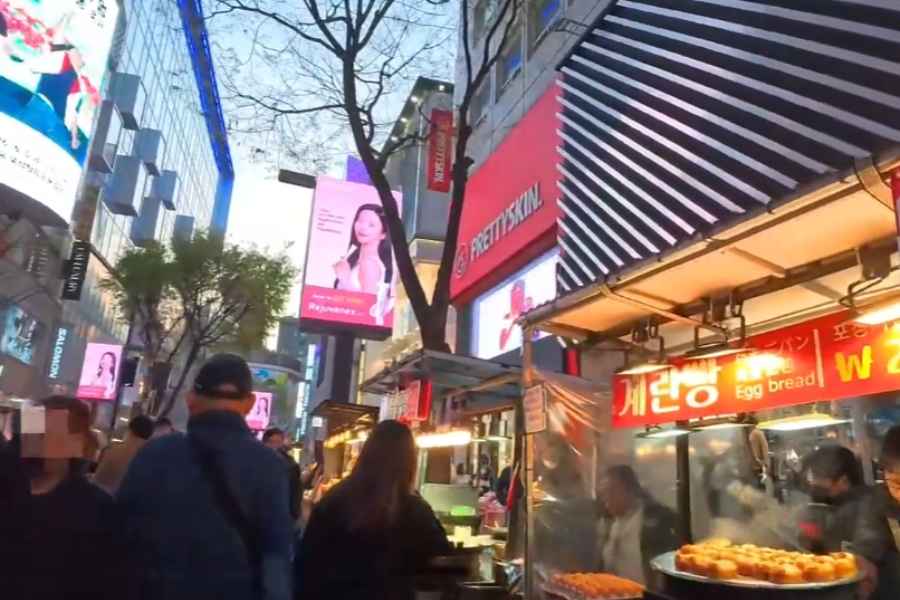
Korea’s food scene runs from a few-thousand-won street snack to a six-figure-won tasting menu, which makes food the category you have the most control over.
- Convenience store meal or street food: ~₩5,000–10,000
- Casual restaurant meal: ~₩10,000–20,000
- Coffee at a cafe: ~₩5,000–7,000
- Korean BBQ dinner for two (samgyeopsal or galbi with sides and a bottle of soju): ~₩60,000–90,000
- Premium Hanwoo beef BBQ for two: ~₩150,000–250,000
Sticking mostly to convenience stores and street food puts you at roughly ₩20,000–30,000 a day, while eating at sit-down restaurants for most meals lands closer to ₩40,000–60,000 a day. Add in cafes, late-night snacks, or a few drinking sessions and the total climbs naturally from there.
3. Transportation — Surprisingly, the Cheapest Category
Transportation ends up being the smallest slice of a Korea travel budget, thanks to a public transit system that’s both efficient and remarkably cheap.
- Subway/bus base fare: ~₩1,550 (free transfers within 30 minutes)
- T-money card: ₩2,500 for the card itself, plus however much you load onto it
- AREX Express Train (Incheon Airport → Seoul): ~₩9,000–11,000
- Taxi (Incheon Airport → Seoul): ~₩60,000–90,000 (₩100,000+ with late-night surcharges)
- KTX high-speed train (Seoul ↔ Busan one-way), if you’re considering a day trip to a regional city: ~₩60,000
If you’re only using public transit within Seoul, riding 3–4 times a day, you’re looking at roughly ₩5,000–7,000 per day, or ₩35,000–50,000 total across 7 days. Add a round-trip airport transfer via AREX (~₩20,000), and your entire transportation budget comfortably stays in the ₩70,000–100,000 range for the whole trip. (For a full comparison of airport transport options and costs, check out our post on 10 Money Mistakes That Will Ruin Your First Trip to Korea.)
4. Shopping — The Category With No Real Ceiling
Shopping is genuinely the one category with no fixed answer. Still, here’s a rough sense of typical prices:
- A single K-beauty item: ~₩5,000–30,000 (Olive Young or brand stores)
- Daiso souvenirs and household items: ~₩1,000–5,000 each
- Clothing/accessories (Dongdaemun or Hongdae): ~₩10,000–50,000 per item
Shopping budgets vary wildly — some travelers keep it light at ₩10,000–30,000 a day, while others go all-in at Myeongdong or Dongdaemun and spend ₩100,000+ in a single day. One thing worth remembering either way: any purchase over ₩15,000 qualifies for a tax refund. If you’re planning to shop, that alone can meaningfully reduce your real out-of-pocket cost. (Not sure how much you’d get back? Check our Tax Refund Calculator for an instant estimate.)
5. Entrance Fees — Cheap Individually, But They Add Up
Individual admission prices in Korea are genuinely affordable, but stack enough of them together and it becomes a real line item. Using our 3-day Seoul itinerary as the reference point, here’s what the actual admission costs look like:
- Gyeongbokgung Palace: ₩3,000 for adults (Changdeokgung is the same at ₩3,000; Changgyeonggung, Deoksugung, and Jongmyo Shrine are each ₩1,000)
- Integrated Palace Pass (4 palaces + Jongmyo Shrine): ₩6,000 — a ₩3,000 savings over buying separately, valid for 6 months from purchase
- Namsan Cable Car (round trip): ₩15,000 for adults
- N Seoul Tower observatory: roughly ₩20,000–26,000, depending on which exhibits are included — check the official site for the current rate before you go
- DDP (Dongdaemun Design Plaza): free for the permanent exhibition halls (special exhibits are ticketed separately)
- Seoul Forest and Hangang Park: free
- Bike rental at Ttukseom Hangang Park: roughly ₩3,000–6,000 per hour
Add all of that up and you’re looking at roughly ₩40,000–50,000 per person for the major sights alone. Add a museum or two and it’ll climb a bit further, but Seoul’s core attractions are still very reasonably priced overall.
Real Sample Budget: 7-Day Category Totals at the Mid-Range Tier (Per Person)
| Category | 7-day total (mid-range) |
|---|---|
| Accommodation (7 nights, 3-star hotel) | ~₩560,000–1,050,000 |
| Food (three meals a day, including cafes) | ~₩300,000–400,000 |
| Transportation (city transit + airport round trip) | ~₩70,000–100,000 |
| Shopping (moderate, individual preference) | ~₩100,000–200,000 |
| Entrance fees (major attractions) | ~₩40,000–50,000 |
| Total (flights excluded) | ~₩1,070,000–1,800,000 |
This is purely on-the-ground spending — flights aren’t included. Depending on where you’re flying from, expect to add anywhere from roughly ₩500,000 to over ₩1,500,000 on top of this for airfare.
Ways to Trim the Budget Further
- Pick accommodation for transit access, not neighborhood prestige — anywhere within a 5-minute walk of a subway station works just as well as Myeongdong or Gangnam, for less.
- Swap one meal a day for street food or a market stall — Gwangjang Market, for instance, is cheaper and arguably more authentic than a sit-down restaurant.
- Use the Integrated Palace Pass if you’re visiting more than one palace — it’s a guaranteed savings.
- Don’t skip the tax refund — it’s the one category where you can genuinely get money back on what you’ve already spent.
- Take AREX over a taxi from the airport — the price difference runs up to 6x.
For more of the specific money mistakes that quietly inflate a Korea trip budget, our 10 Money Mistakes That Will Ruin Your First Trip to Korea post covers several more you can avoid.
Checklist: What to Nail Down Before Setting Your 7-Day Budget
- Decide on an accommodation tier first (dorm vs. 3-star vs. luxury)
- Set a daily food budget range (₩20,000–60,000) before you go
- Don’t over-budget for transportation — realistically under ₩100,000 for the whole week
- Set a shopping cap for yourself in advance
- Check whether the Integrated Palace Pass makes sense if visiting 2+ palaces
- Keep every receipt over ₩15,000 for a tax refund
- Remember flights are not included in this breakdown
[캔바 이미지 프롬프트 5] “한국 7일 여행 예산을 항목별로 보여주는 파이차트 스타일 인포그래픽, 숙박/식비/교통/쇼핑/입장료 다섯 조각을 파스텔톤으로 구분, 깔끔한 여행 가이드 디자인”