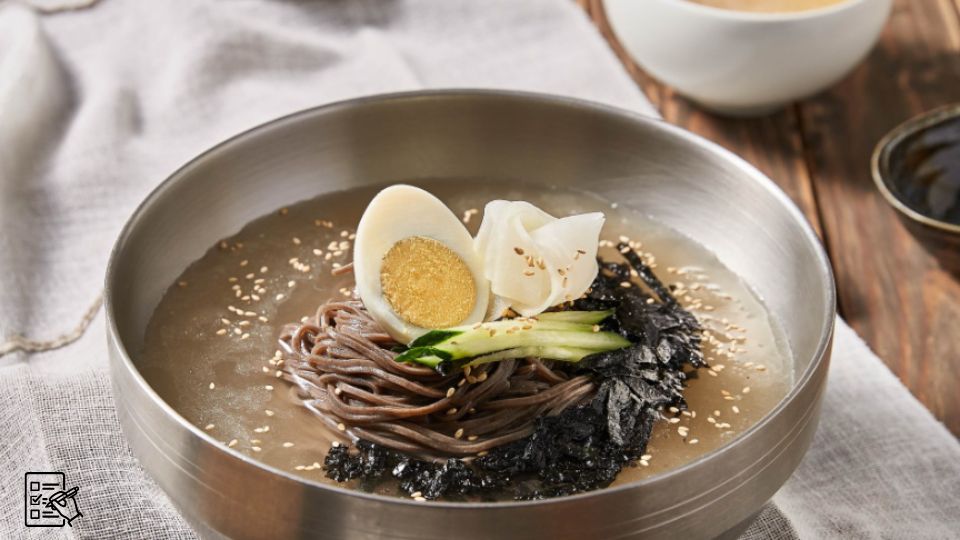
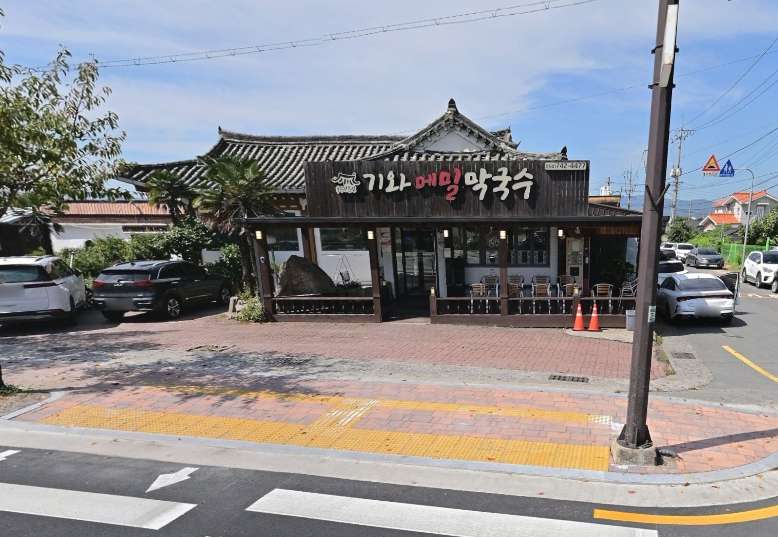
Giwa Memil Makguksu is ranked among the top 4 makguksu restaurants in all of Gyeongsang Province. One bowl — Hanwoo beef bone broth, chewy buckwheat noodles — costs ₩9,000.
I visited, waited an hour, and walked out without a single regret. Living in Korea, when foreign friends ask me “where should I eat in Gyeongju?”, this is the place I now recommend without hesitation.
It’s a five-minute walk from Bunhwangsa Temple and Cheomseongdae Observatory. No restaurant fits more naturally into a Gyeongju travel day than this one.
Before You Go: What Is Makguksu?
Makguksu (막국수) is a traditional Korean noodle dish made from buckwheat flour. It comes in two forms: mul makguksu — chilled noodles in cold broth — and bibim makguksu — noodles tossed in a spicy sauce.
Buckwheat is naturally gluten-free and easy on digestion. That’s why pairing it with sukyuk (boiled pork) creates a combination that is both light and deeply satisfying. It’s the reason Koreans almost always order makguksu and sukyuk together.
Gangwon Style vs. Gyeongsang Style: What’s the Difference?
Makguksu originated in Gangwon Province, where the traditional version uses dongchimi (water kimchi) broth or a light stock poured over cold noodles.
Gyeongsang Province makguksu is a different animal entirely. It uses a slow-simmered Hanwoo beef bone broth — rich, milky white, and layered in a way that makes a cold noodle dish feel unexpectedly warming. That difference is what elevates Gyeongsang makguksu from a simple cold noodle to a full, satisfying meal.
Giwa Memil Makguksu is the best example of that style in the region.
Gyeongju: The Capital of a 1,000-Year Kingdom
To fully appreciate this restaurant, knowing where it sits matters.
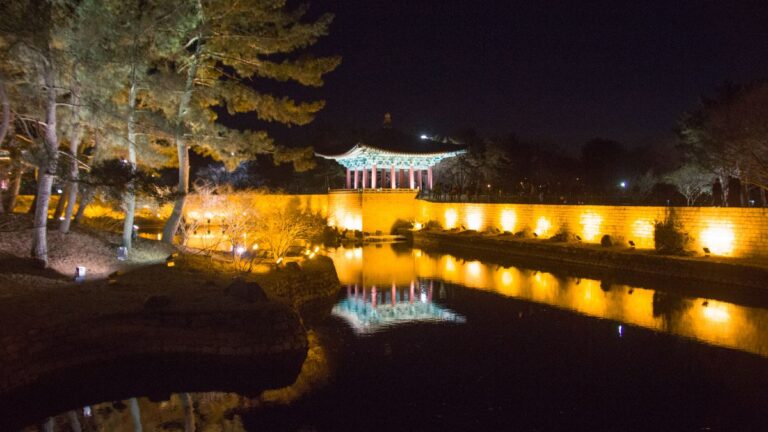
Gyeongju was the capital of the Silla Dynasty (57 BCE – 935 CE) — a kingdom that ruled the Korean Peninsula for nearly 1,000 years. The entire city is designated a UNESCO World Heritage Site. People call it the “museum without walls,” and that description earns its keep the moment you step off the train.
A day here is a break from the modern energy of Seoul or Busan, and a walk through something genuinely ancient. Gyeongju belongs on every Korea itinerary — not as an optional side trip, but as a priority.
Cheomseongdae and Bunhwangsa — A 5-Minute Walk from the Restaurant
Two of Korea’s most significant heritage sites sit steps away from Giwa Memil Makguksu.
Cheomseongdae Observatory (첨성대) was built in the 7th century during the reign of Queen Seondeok of the Silla Dynasty. According to Visit Korea’s official records, it was constructed from 362 individual stones and stands 9.4 meters tall. It is the oldest surviving astronomical observatory in East Asia — built to observe stars and celestial movement over 1,300 years ago.
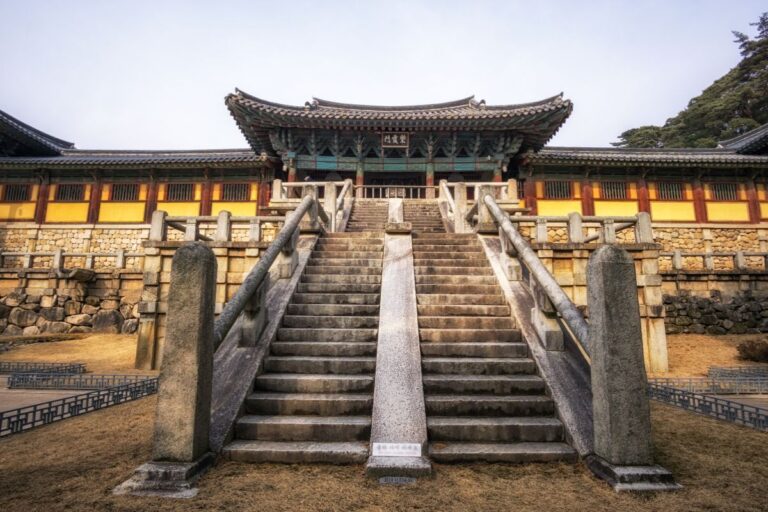
Bunhwangsa Temple (분황사), per UNESCO’s official documentation, was established in 634 CE as a Silla Buddhist temple. It sits directly beside the restaurant, and visiting guests can use Bunhwangsa’s parking lot for free.
Hwangnidan-gil — Gyeongju’s Trendiest Street
A short walk from the restaurant is Hwangnidan-gil (황리단길). According to Wikipedia, the street features roughly 400 cafes, restaurants, gift shops, and bookstores nestled inside and around traditional hanok buildings. K-pop group ATEEZ named it one of Gyeongju’s best spots — which tells you something about its current energy.
What Makes Giwa Memil Makguksu Different
You can find makguksu all over Korea. But the title “one of the top 4 makguksu restaurants in Gyeongsang Province” is not a label that attaches itself to just any place.
Two things set this restaurant apart.
Hanwoo Beef Bone Broth: 10+ Ingredients, Slow-Simmered
The broth for the mul makguksu is made by simmering Hanwoo beef bones (한우 사골) together with more than ten additional ingredients over many hours.
Hanwoo is Korea’s native cattle breed. Unlike imported beef, it carries a different fat marbling and depth of flavor. The resulting broth is milky white, rich, and genuinely complex from the first sip. It is a cold noodle dish that somehow manages to feel warming — a quality that is hard to explain until you experience it.
The Secret Behind the Bibim Sauce
The bibim makguksu sauce is not standard gochujang. It’s a fruit-based sauce that delivers sweet heat without the bitter edge that plain chili paste can leave.
The spice level is real but controlled — accessible even to travelers who don’t typically handle heat well. The natural sweetness of the fruit tempers everything into something balanced and clean on the buckwheat noodle.
Menu & Pricing Guide
| Menu Item | Description | Price |
|---|---|---|
| Mul Makguksu | Hanwoo bone broth + chewy buckwheat noodles (free extra noodles) | ₩9,000 |
| Bibim Makguksu | Fruit-based spicy sauce + chewy buckwheat noodles (free extra noodles) | ₩9,000 |
| Gomguksi | Warm noodle soup — great for kids or cold days | ₩10,000 |
| Sukyuk (S) | Domestic pork belly, served with radish salad & pollack salad | ₩18,000 |
| Sukyuk (M) | ₩27,000 | |
| Sukyuk (L) | ₩36,000 |
What’s included at no extra charge:
- Extra noodles (사리) — free, unlimited
- Self-serve steamed rice — free
- Self-serve white cabbage kimchi & dongchimi — free
- Baby rice (아기밥) — free (a significant plus for families)
- Kiosk ordering — minimizes the language barrier
- Bunhwangsa Temple parking — free
In real money: Mul and bibim makguksu (₩9,000) are roughly $6–7 USD / €5–6 EUR. With free extra noodles and an unlimited self-serve bar on top of that, one person can eat a genuinely satisfying meal at this price.
Best first-visit combination: Order mul makguksu + sukyuk (S). The clean bone broth and chewy noodles first, then the pork for substance. For two people, one mul makguksu and one bibim makguksu plus a small sukyuk lets you taste everything the restaurant does well.
What the Visit Actually Feels Like
Arrive at lunch and there will already be a queue. Expect a wait of 30 minutes to 1.5 hours — longer on peak days. It sounds like a lot. It didn’t feel that way after the meal.
Ordering is done by kiosk, which means foreign visitors can take time reviewing each option at their own pace without any pressure. While waiting, consider walking next door to peek at Bunhwangsa Temple’s stone pagoda, or taking a short stroll down Hwangnidan-gil.
Once seated, head to the self-serve bar first and collect dongchimi and white cabbage kimchi. Dongchimi (동치미) is a traditional Korean water kimchi made from fermented radish — cool, lightly sour, and refreshing. Adding a splash of dongchimi liquid into your bone broth changes the flavor profile entirely.
When the mul makguksu arrives, sip the broth first before touching the noodles. Then use the scissors the staff brings to cut the noodles into shorter lengths — this is standard practice in Korean noodle restaurants, not unusual at all. If you want extra noodles, say “Sari juseyo (사리 주세요)” — it’s free, and you can ask as many times as you like.
When the sukyuk arrives, eat it with the radish salad (무생채) and pollack salad (명태회무침) provided alongside. The rhythm of: one slice of pork → a chopstick of radish salad → a sip of makguksu broth — repeated through the meal — is when you understand why people wait an hour for this.
Getting There & Practical Info
| Address | 91 Bunhwang-ro, Guhwang-dong, Gyeongju, North Gyeongsang Province |
| Map | Search “기와메밀막국수” on Naver Maps or Kakao Maps |
| Hours | Daily 11:00 – 20:00 (last order 19:30) |
| Break Time | Weekdays 15:30 – 16:30 (no break on weekends) |
| Parking | Free use of Bunhwangsa Temple parking lot |
| Payment | Kiosk ordering, cards accepted |
How to Reach Gyeongju
Gyeongju is accessible from both Seoul and Busan, making it easy to include as either a dedicated trip or a stop between cities.
- Seoul → Gyeongju: Take the KTX to Singyeongju Station — approximately 2 hours. From there, take a local bus or taxi to the Cheomseongdae / Bunhwangsa area (around 15–20 minutes).
- Busan → Gyeongju: Bus from Nopo Station terminal takes about 1 hour; train is approximately 1 hour 30 minutes.
- Daegu → Gyeongju: Bus or train, approximately 1 hour.
Traveler’s tip: All major Gyeongju downtown attractions — Cheomseongdae, Hwangnidan-gil, and Daereungwon Royal Tomb Complex — are within a 30-minute walk of each other. Centering your itinerary around Giwa Memil Makguksu and walking to the surrounding sites before and after is the most efficient way to structure the day.
Recommended Day Trip Itinerary
If you’re arriving in the morning, this sequence works well:
Arrive at Singyeongju Station → Bus or taxi to downtown → Cheomseongdae Observatory & Daereungwon Royal Tomb Complex (1.5–2 hours) → Giwa Memil Makguksu for lunch, including wait time (1.5–2 hours) → Bunhwangsa Temple → Hwangnidan-gil cafes and walking → Hwangnam-ppang (Gyeongju’s signature red bean pastry) → Depart Gyeongju
In autumn, pink muhly grass fields bloom around Cheomseongdae — one of the most photographed scenes in all of Korea. In spring, cherry blossoms line the road leading to the observatory.
Tips for Eating at a Korean Noodle Restaurant
① Scissors are normal — use them Using scissors to cut noodles is standard practice in Korean restaurants. Staff will bring a pair automatically, but if they don’t, point to the noodles and mimic a cutting gesture. Nobody will find it odd.
② Ask for extra noodles without hesitation Extra noodles are completely free here. Say “Sari juseyo (사리 주세요)” or simply hold up your bowl. You can ask as many times as you need.
③ Try mixing dongchimi broth into your noodle soup Pour a small amount of the dongchimi liquid from the self-serve bar into your mul makguksu broth. It adds a cool, fermented tartness that layers beautifully with the richness of the bone broth. This is how many Koreans eat it.
④ Eat the sukyuk while it’s warm Once sukyuk is set down, eat it before the fat has time to cool and firm up. The texture difference between warm and room-temperature pork belly is significant — warm is the version worth waiting for.
Who Should Make This Trip
✅ Travelers with Cheomseongdae or Bunhwangsa already on their Gyeongju itinerary — the walk between them is minutes
✅ Anyone who wants to taste Gyeongsang Province’s distinct take on Korean buckwheat noodles rather than the more common Gangwon style
✅ Food travelers curious about what Hanwoo bone broth actually tastes like in the context it was built for
✅ Families visiting Gyeongju with children, needing a menu that works for every age at the table
✅ Budget-conscious travelers looking for a genuinely memorable meal for under $7
A Final Thought
Living in Korea, one pattern keeps repeating itself: the best food tends to sit right next to the most meaningful places.
A city that carried a civilization for 1,000 years, with the oldest observatory in East Asia and a 7th-century Buddhist temple on one side — and a bowl of slow-simmered Hanwoo bone broth makguksu on the other. That combination feels entirely right for Gyeongju.
The broth at Giwa Memil Makguksu isn’t just a good soup. It’s the result of choosing the right ingredients and refusing to rush the process — the same values that built the city around it.
If you’re building a Gyeongju itinerary, plan to arrive at the restaurant 30 minutes before the lunch rush. If there’s still a wait, walk over to Bunhwangsa Temple. By the time you come back, your table will be ready. One bowl will make Gyeongju stay with you a little longer than the sightseeing alone would have.
- tzuyang also visited: Affordable Korean baekban near Gyeongdong Market: Gyeongdong Restaurant
- Art Monster: A Gangnam craft beer pub. Hong Kong back-alley vibe.
- Surimjeong: A great-value ‘bori-gulbi’ set meal restaurant in Cheonan.
- Bang for your buck. Palpal Sundubu. Hidden gem in Gumi
🇰🇷 Budget-Friendly Eats in Korea — the series continues. More local recommendations coming soon.