
Here’s the bottom line: Bulguksa and Seokguram aren’t meant to be visited separately — they’re really one single trip. Almost no one visits Seokguram on its own; most travelers see Bulguksa first, then continue on by shuttle bus or hiking trail. This guide puts together the exact route to see both properly in a single day — and how to extend that day into Gyeongju’s downtown historic sites.
Location and Basic Info
Both Bulguksa and Seokguram sit on Mount Tohamsan in Gyeongju, North Gyeongsang Province. Both are believed to have been founded in the 8th century, during the Unified Silla period, by the statesman Kim Dae-seong. In 1995, they were jointly designated a UNESCO World Heritage Site under the single listing “Seokguram Grotto and Bulguksa Temple.” Jongmyo Shrine and the Tripitaka Koreana woodblocks at Haeinsa were also inscribed that same year.
Good news for travelers: admission to both sites became free as of May 4, 2023. Parking fees still apply separately.
Why You Should See Both Together
If Bulguksa shows the “outward face” of Silla Buddhist art through its elaborate architecture and stone pagodas, Seokguram shows its “inner essence” through the seated Buddha statue carved into an artificial grotto. See only one, and you’re really seeing half the picture. Travel reviews consistently mention the same regret: “we only had time for Bulguksa and missed Seokguram.” Planning your time in advance is the easiest way to avoid that disappointment.
Bulguksa: What Not to Miss
Cheongungyo and Baegungyo — Bridges, Not Just Stairs
The stone staircase near Bulguksa’s entrance is actually named as a “bridge” (gyo). Ancient Silla people believed water once flowed beneath these steps, and the structure symbolically represents crossing from the mortal world into the world of the Buddha. It’s a designated National Treasure, and to prevent damage, visitors can no longer climb it directly — you’ll need to take the detour path around it.
Dabotap and Seokgatap — Two National Treasures, Side by Side
In the courtyard in front of Daeungjeon Hall stand two pagodas with completely opposite personalities: the ornate, decorative Dabotap, and the restrained, minimalist Seokgatap. The contrast between the two captures something essential about Silla aesthetics — a simultaneous pursuit of elaborate beauty and disciplined simplicity. The spot where both pagodas fit in a single photo frame is a well-known favorite.
The Buddha Statues at Geungnakjeon and Daeungjeon
The gilt-bronze seated Amitabha Buddha at Geungnakjeon Hall, and the gilt-bronze seated Vairocana Buddha near Daeungjeon Hall, are considered among the finest examples of Unified Silla bronze Buddhist sculpture. They’re easy to walk past given how much attention the exterior architecture draws — it’s worth deliberately setting aside a few quiet minutes in front of these statues.
Visiting Tip: Early Morning Is the Most Beautiful Time
Bulguksa is said to be at its most beautiful around sunrise, roughly 6:30–7:30 AM. It’s also relatively free of the tour groups that arrive later in the day, making it a good window for unhurried photos and a calmer walk through the grounds.
Seokguram: What Not to Miss

The Main Buddha Statue — National Treasure No. 24
The heart of Seokguram is the seated Buddha carved from granite. Even without artificial lighting, the granite seems to glow faintly, and the domed ceiling above it achieves a remarkable sense of balance. Surrounding the main Buddha are intricately carved figures, including an eleven-faced Avalokiteshvara Bodhisattva, statues of the ten disciples, and the Four Heavenly Kings.
Why You Can Only View It Through Glass
The interior of the grotto is protected by a glass barrier to prevent damage from humidity and human breath, so visitors can only view the main Buddha from outside the front chamber. It can feel disappointing not to get closer, but standing quietly and really looking, the granite’s distinctive texture and the statue’s dignified yet compassionate expression gradually come into focus. As an exception, on Buddha’s Birthday, visitors are allowed inside the grotto and can walk around the main statue, just as ancient Silla worshippers once did.
Photography Is Strictly Forbidden
Photography inside the grotto is strictly prohibited. Knowing in advance that this is a space you can only capture with your eyes, not your camera, helps set the right expectations.
How to Get from Bulguksa to Seokguram: Bus or Hike
Option 1: The Shuttle Bus (Bus No. 12)
From the stop across from Bulguksa’s main parking lot, Bus No. 12 departs every hour at 40 minutes past the hour and takes about 15 minutes to reach Seokguram’s parking lot. The gap between buses is roughly an hour, and the midday departure (usually the 12:40 run) sometimes leaves about 10 minutes late depending on the driver’s lunch break — it’s worth double-checking the posted timetable at the stop itself. The mountain road winds quite a bit, so if you’re prone to motion sickness, sit near the front.
Option 2: The Hiking Trail
If you’re up for it, there’s also a hiking trail of roughly 2.3–3 km, about a one-hour walk, connecting Bulguksa to Seokguram. It runs through the forested slopes of Mount Tohamsan, and is especially worth choosing over the bus during autumn foliage season.
Back in Downtown Gyeongju — Extending to Daereungwon and Cheomseongdae
Once you’ve finished Bulguksa and Seokguram in the morning or early afternoon, you can head into downtown Gyeongju, about 20–30 minutes away by bus or taxi, and continue into the evening. The same buses that run from Bulguksa into town — 10, 11, and 700 — make this an easy, uncomplicated transition.
Daereungwon — A Park Full of Silla Royal Tombs
Daereungwon is a cluster of burial mounds belonging to Silla kings, queens, and nobles, and it’s free to enter and walk through year-round. Wandering among the rounded green mounds is a genuinely unusual sight that many international visitors find one of the most memorable parts of Gyeongju. Cheonmachong, the one tomb whose interior you can actually enter, may carry a separate admission fee — worth confirming on site.
Cheomseongdae — East Asia’s Oldest Surviving Observatory
Just a short walk from Daereungwon, Cheomseongdae is a Silla-era structure believed to be the oldest surviving astronomical observatory in East Asia. It’s small in scale, but its distinctive curved silhouette makes it a popular photo spot, and there’s no admission fee.
Donggung Palace and Wolji Pond — The Real Show Starts at Dusk
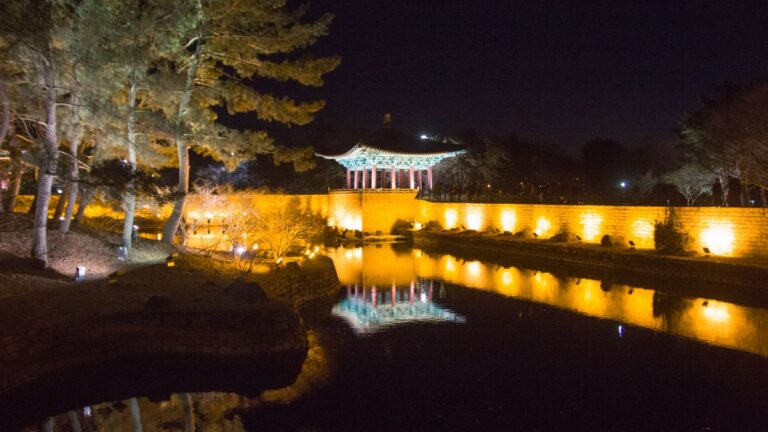
A little further along from Daereungwon and Cheomseongdae, Donggung Palace and Wolji Pond charge a 3,000 KRW admission fee — but in exchange, this is where Gyeongju’s night views are at their most dramatic. The pavilions’ lights reflected in the pond are the site’s signature image, and crowds build steadily from dusk onward. Arrive with some buffer time before closing, since entry can become difficult as the deadline approaches.
Woljeonggyo Bridge — The Finishing Touch on Gyeongju’s Night Views
Continuing on from Donggung and Wolji, Woljeonggyo is a wooden pavilion-style bridge, reconstructed in 2018 based on a Silla-era royal palace bridge originally built in 760. It’s free to enter and open from 9 AM to 10 PM. Once the lights come on around dusk and the bridge reflects on the water, it’s often cited as the highlight of Gyeongju’s nighttime scenery. The most popular photo spot is from the stepping stones in the river just in front of the bridge, framing the whole structure.
Suggested Route
Following the order Daereungwon (daytime) → Cheomseongdae (daytime) → Donggung and Wolji (dusk) → Woljeonggyo (night) lets you experience both daytime and nighttime Gyeongju in a single loop. These sites are all within walking distance of each other, and the route ends near Hwangnidan-gil, making it easy to continue on to dinner or a café.
Pre-Visit Checklist
- Admission to both Bulguksa and Seokguram is free (since May 2023); parking fees apply separately
- Visiting around sunrise makes Bulguksa the quietest and most beautiful
- Cheongungyo and Baegungyo can’t be climbed directly — use the detour path
- Don’t miss the photo spot that frames both Dabotap and Seokgatap together
- Photography is strictly forbidden inside Seokguram — take it in with your eyes only
- The shuttle bus (No. 12) departs at 40 minutes past the hour — double-check the posted schedule on site
- Consider the hiking trail (2.3–3 km) instead of the bus during autumn foliage season
- On Buddha’s Birthday, entry into the grotto interior becomes possible
- Daereungwon and Cheomseongdae are free; confirm on site whether Cheonmachong’s interior requires a separate fee
- Donggung and Wolji costs 3,000 KRW — arrive with buffer time before closing to avoid crowding issues
- Save Woljeonggyo for last — its night view is the highlight
- Plan dinner in Hwangnidan-gil after finishing the route
In one day, you can take in the daytime side of Bulguksa and Seokguram, then close it out with the nighttime side of Gyeongju from Daereungwon all the way to Woljeonggyo. We could go deeper on the downtown Gyeongju route as its own post next, or continue the Five Grand Palaces series with the Gyeonghuigung piece. Which would you like to see next?