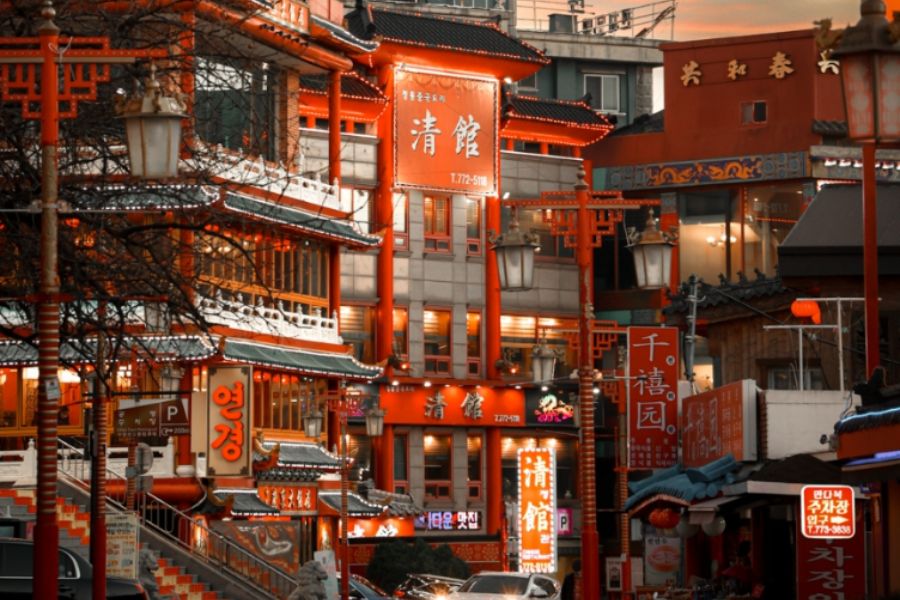
The name “Incheon Chinatown” leads most visitors to a mistaken assumption — this isn’t really a “Chinese” town so much as a “Taiwanese” one. Look closely at the flags hanging throughout the neighborhood, and you won’t find the five-star red flag of mainland China — you’ll find Taiwan’s Blue Sky, White Sun, and a Wholly Red Earth flag instead. Even the neighborhood’s most famous export, jajangmyeon, isn’t technically a Chinese dish at all — it was invented in Korea. Here’s the real history behind this twist-filled neighborhood, and what’s actually worth seeing and eating.
Why This Is a “Taiwan Town,” Not a “China Town”
Incheon Chinatown’s history traces back to the port of Incheon opening in 1883, followed by the establishment of a Qing Chinese concession the following year, in 1884. Under a trade treaty between Joseon and Qing China, Chinese immigration was officially permitted, and this area became Korea’s very first foreign concession. At the time, it was known as “Cheonggwan” — meaning “the neighborhood where the Qing government office was located.”
What happened afterward shaped this neighborhood’s identity. After Korea’s liberation, when the Republic of China (Taiwan) government was pushed off the mainland during the Chinese Civil War, most of the overseas Chinese living in Korea retained their Republic of China (Taiwanese) citizenship. That’s why Incheon Chinatown, unlike other Chinese enclaves in Korea that are mostly home to ethnic Korean-Chinese (Joseonjok) residents, is a community that Taiwanese overseas Chinese have maintained continuously for nearly 140 years. The neighborhood’s only Taiwanese-affiliated educational institution, Overseas Chinese Zhongshan Middle School, still operates here today.
Jajangmyeon Is, Technically, a Korean Dish
No trip to Chinatown is complete without jajangmyeon, but few travelers realize what this dish actually is. There was once a Chinese dish from the Shandong region called “jak-jang-myeon,” made by stir-frying fermented bean paste with noodles. When it arrived in Korea, it transformed entirely into something new. In other words, jajangmyeon isn’t a mainland Chinese dish — it’s an original creation developed by overseas Chinese living in Korea.
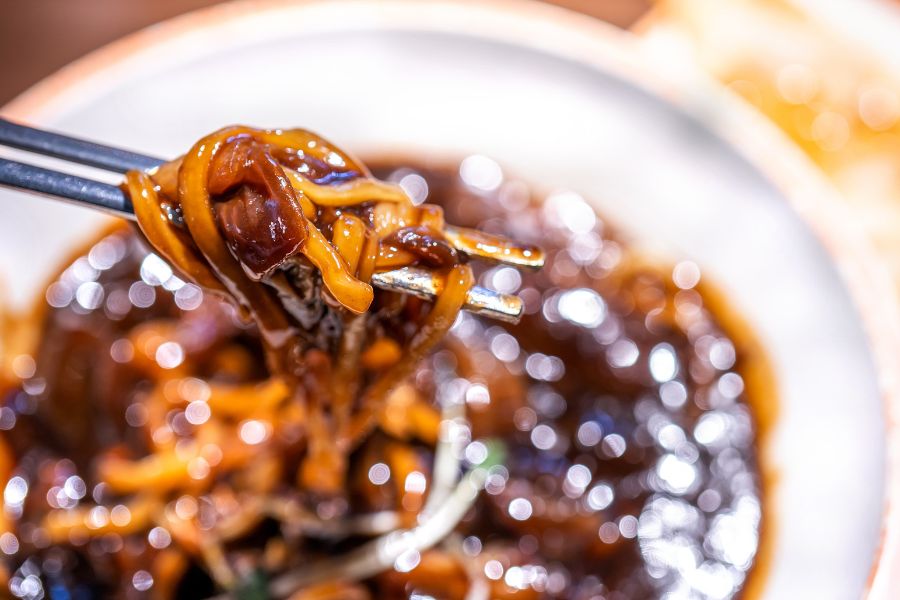
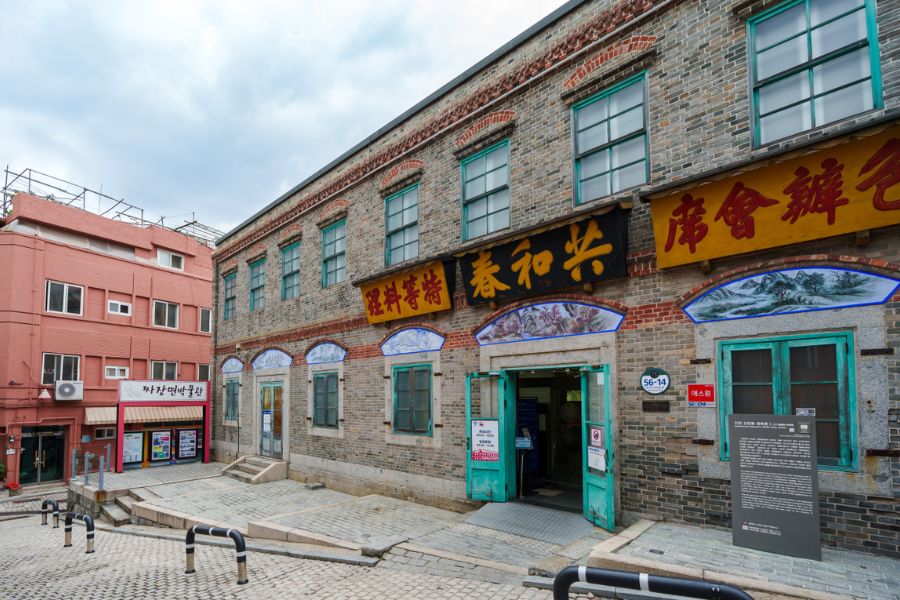
The restaurant credited with inventing this dish is Gonghwachun. Woo Hui-gwang, an overseas Chinese immigrant from Shandong, opened a lodging house called “Sandong Hoegwan” here in 1907. In 1912, to celebrate the founding of the Republic of China, he renamed it “Gonghwachun” — meaning “the spring of the republic has arrived.” The restaurant briefly closed during the Korean War, but afterward flourished into Chinatown’s signature Chinese restaurant.
Today, that same site houses the “Jajangmyeon Museum,” built inside the original Gonghwachun building, which is a nationally registered cultural heritage site. Exhibits recreate a 1960s-era kitchen, and you can see the wooden chopsticks and delivery boxes actually used at the time, tracing the dish’s full history.
What’s Actually Worth Seeing Here
The Romance of the Three Kingdoms Mural Street
Running along the steps that once marked the old Qing concession, this alley is lined on both sides with murals depicting more than 80 famous scenes from the classic novel “Romance of the Three Kingdoms.” Even if you don’t know the story, the vivid colors alone make this a great stretch for photos.
Uiseondang
This shrine has served as the spiritual center of the overseas Chinese community for nearly 140 years. During Chinese holidays like Lunar New Year and Mid-Autumn Festival, the community still gathers here to hold ancestral rites.
The Jajangmyeon Museum + Noodle Platform
Pairing the Jajangmyeon Museum, housed in the old Gonghwachun building, with the nearby Noodle Platform, which opened in 2021, rounds out a complete “jajangmyeon-themed” walking tour.
Practical Information
- Location: Around Bukseong-dong and Seonrin-dong, Jung-gu, Incheon, directly across from Incheon Station
- Getting there: Directly connected on foot from Exit 1 of Incheon Station (Subway Line 1)
- Suggested route: Incheon Station → Chinatown’s main gate (paifang) → Jajangmyeon Museum → Romance of the Three Kingdoms Mural Street → Overseas Chinese Zhongshan Middle School → Uiseondang
- Dining: Most Chinese restaurants here serve jajangmyeon, jjamppong, and sweet and sour pork as staples; expect waits at the most popular spots during peak lunch hours
- Nearby to pair with your visit: The Gaehanghang Historical and Cultural Street and Jayu (Freedom) Park are both within walking distance, home to architecture from Korea’s early port-opening era
Walk This Neighborhood Knowing Its Real Story
Incheon Chinatown is a neighborhood too rich to walk past based on its name alone — nearly 140 years of Taiwanese overseas Chinese history, layered with a genuine piece of Korean food history. Once you know how jajangmyeon actually came to exist, that same bowl of noodles tastes like a completely different dish. If you have a favorite spot or dish from your visit, share it in the comments.