A lot of people searching “Gyeongui Line Forest Park” on Google also search “Seoul Forest” right alongside it. It’s an easy mix-up — both names have “forest” in them. But let’s clear this up right away: these are two completely different places, on opposite sides of the city.
What we’re covering today is a 6.3km linear park built on top of an abandoned railway line, and specifically its most talked-about stretch — the section locals call “Yeontral Park.” Once you hear where that nickname came from, it’ll make a lot more sense why travelers go out of their way for this narrow strip of a park.
Let’s Clear Up the Confusion First
- Gyeongui Line Forest Park: A 6.3km linear park running from Yeonnam-dong in Mapo-gu toward Yongsan-gu, directly connected to Hongik University Station.
- Seoul Forest: A large park in Seongdong-gu — more than 30 minutes away by subway, and a completely different part of the city.
Both are among Seoul’s signature green spaces, but you don’t need to plan them for the same day. (We’ve already covered Seoul Forest in detail in another post, so check that out too if you’re curious.)
How an Abandoned Railway Became “Central Park”
This park’s origin story isn’t particularly romantic. This land once carried the Gyeongui Line railway, which connected Seoul and Sinuiju starting in 1906. Once the tracks were moved underground starting in 2005, all that was left above ground was a long, narrow strip of abandoned railway property. The neglected tracks were an eyesore, and Seoul City spent five years, from 2011 to 2016, turning the land into a park.
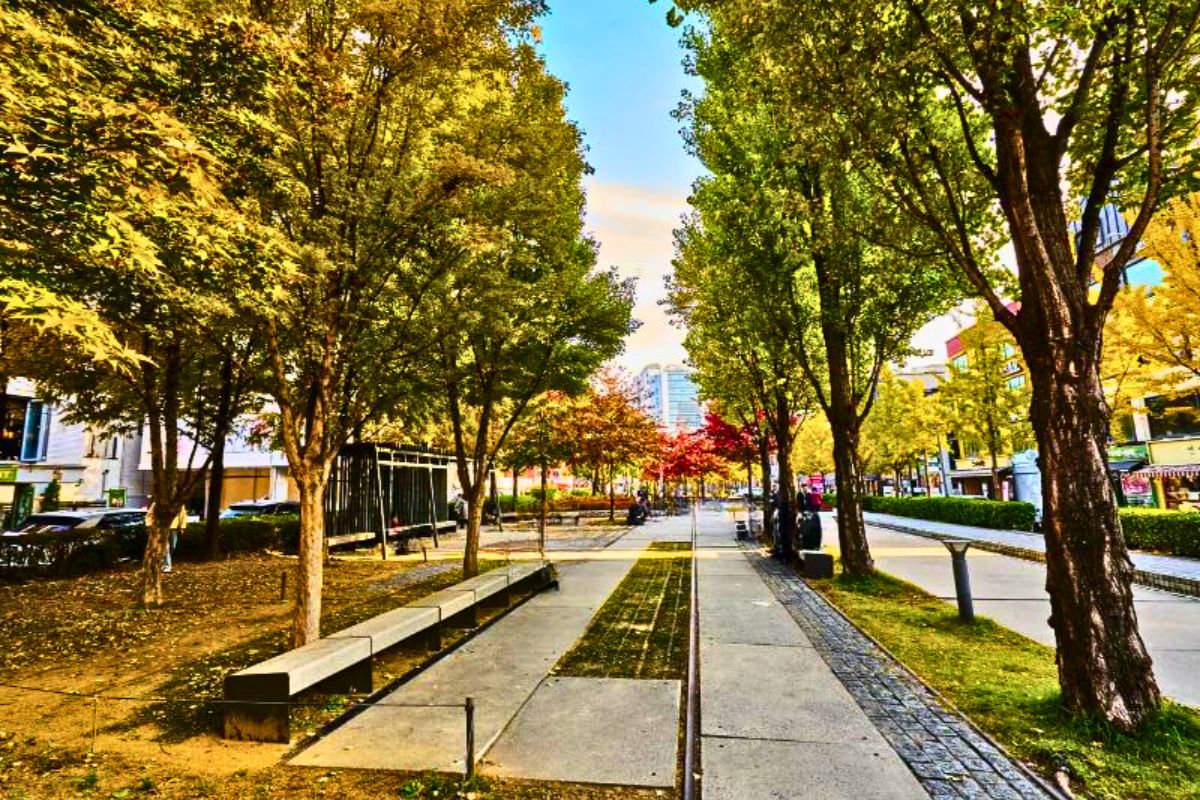
But the park’s longest stretch — the roughly 1.2 to 1.3km Yeonnam-dong section — got a reaction nobody quite expected. People started calling it “Yeontral Park” (a mashup of “Yeonnam” and “Central Park”) because of its resemblance to Manhattan’s Central Park, and that nickname is now more famous than the park’s official name. This small transformation became such a citywide talking point that it actually ranked #1 among physical/environmental changes in Seoul’s own “Top 10 News of 2015” citizen poll.
What’s Actually Fun About Yeontral Park
1. Seoul-style picnics — beer, a mat, and the grass
The defining image of Yeontral Park is the picnic-mat culture. On a sunny day, you’ll see people spread out across the lawns and along the walking paths on picnic mats, convenience store beer and light snacks in hand. This isn’t a formal stroll through a manicured park — it’s a direct look at how Seoulites actually spend a weekend.
2. Every alley branching off has its own personality
The Yeonnam-dong alleys that branch off the park like tree limbs are packed with stylish cafes and quirky craft studios. Here’s the fun part: some of the shops here became famous by their address instead of an actual name. One comic-book-themed cafe, for example, became a genuine viral hit under nothing more than its street address — famous enough that a Russian broadcaster once flew in just to film it. The specific shop may look different today, but the sense that “every alley here has its own story” is still very much intact.
3. There’s a reason you’re walking beside running water
The Yeonnam-dong stretch was actually designed with a flowing water channel running alongside the path. This wasn’t just decoration. When Seoul City designed the park, they asked local residents about the area’s history, and learned that this neighborhood was once known for its abundant water before the railway went underground — so they pumped up groundwater to recreate that flowing stream as part of the design. It’s a pretty walk on its own, but knowing that backstory changes how it feels underfoot.
4. Gyeongui Line Book Street — bookshops lined up like train cars
Starting at Exit 6 of Hongik University Station, you’ll find “Gyeongui Line Book Street.” It’s a row of small bookshops run on consignment by publishers, arranged one after another like train carriages — a distinctive setup that drew more than 110,000 visitors within a short stretch after it opened in 2016.
Why This Particular Neighborhood
Yeonnam-dong wasn’t always a glamorous place. Near the old tracks, you’d find modest Chinese home-style restaurants (clustered around a nearby overseas Chinese school) and diners for taxi and delivery drivers — a quiet, unassuming residential area. Its proximity to Hongdae, combined with comparatively cheap rent, drew in small studios and independent shops one by one, and that’s what shaped the atmosphere Yeontral Park has today. The fact that this neighborhood was built by small independent shop owners rather than big franchises is exactly what still makes it feel different from Seoul’s other trendy spots.
Practical Information
- Getting there: About a 5-minute walk from Exit 3 of Hongik University Station (Line 2, AREX, Gyeongui-Jungang Line)
- Length of the Yeonnam-dong section: About 1.2–1.3km, roughly a 30-minute walk at a relaxed pace
- Parking: There’s no dedicated parking lot within the park, so public transit is strongly recommended
- Etiquette: Pets are discouraged in ecologically sensitive sections, and excessive drinking or noise is discouraged
- Seasonal tip: Plum and cherry blossoms are especially beautiful in spring, and the picnic-mat scene peaks on summer evenings
Ready to Take the Walk?
Gyeongui Line Forest Park isn’t a flashy landmark. But the story of an abandoned railway becoming the city’s most beloved walking path — and the chance to watch Seoulites actually spend their weekend on top of it — makes it worth at least a short visit. If you’re anywhere near Hongdae, set aside 30 minutes and walk this narrow strip of a park yourself. If you find an alley you love, share it in the comments.