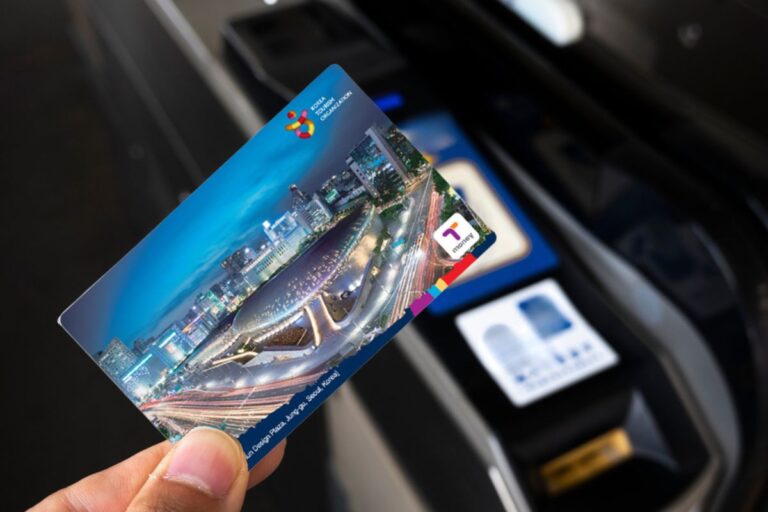

You’re spending three or four nights in Seoul. Which transit card should you buy?
Search around and you’ll find posts saying “the Climate Card is unlimited, so it’s cheaper” and others saying “T-money is easier.” That only makes the choice more confusing.
Here’s the short answer. The Climate Card vs T-money question comes down to how many days you stay and where you go. If you stay in Seoul for 3 days or more and ride about 3 times a day, the Climate Card usually wins. If you need the airport or plan trips outside Seoul, you need T-money.
In this guide, I calculated the break-even point by trip length using the ₩1,550 base fare. I also listed the places where the Climate Card doesn’t work. Everything is based on the Korea Tourism Organization (VisitKorea), Seoul city information, and Korean news reports.
The 30-Second Summary
- Staying only in Seoul for 3+ days? The Climate Card short-term pass often wins.
- Airport transfers, Sinbundang Line, or trips outside Seoul? You need T-money.
- The most practical combo is T-money for the airport, Climate Card for the city.
- Since October 1, 2026, the 30-day pass has ended, so visitors can only use 1–7 day passes.
- The Climate Card now works within Seoul only.
What Is the Difference Between the Two Cards?

T-money: Pay as You Go
T-money is a prepaid transit card that deducts the fare each time you ride. The card usually costs ₩3,000–5,000, and it works on subways, buses, and taxis, even in cities outside Seoul.
Climate Card: Unlimited for a Set Number of Days
The Climate Card is made by the Seoul city government. A short-term pass gives you unlimited rides on Seoul subways and city buses for a set number of days.
The physical card costs ₩3,000, and you load the pass separately. The pass starts the moment you load it, and you can’t change or reload it until it expires.
Prices at a Glance
These are the short-term pass prices from VisitKorea.
| Pass | Price |
|---|---|
| 1-day | ₩5,000 |
| 2-day | ₩8,000 |
| 3-day | ₩10,000 |
| 5-day | ₩15,000 |
| 7-day | ₩20,000 |
| Physical card (separate, non-refundable) | ₩3,000 |
Climate Card vs T-money: Break-Even by Trip Length
This is the heart of the post. Let’s work out how many rides you need before the Climate Card pays off.
How I Calculated It
- Base fare for subways and buses: ₩1,550 for adults (per March 2026 reports)
- Distance surcharges and transfer discounts are not included.
- Each boarding counts as one ride.
The formula is pass price ÷ ₩1,550. The result is the number of rides where you break even.
The Break-Even Table
| Pass | Rides to break even | Per day | Including ₩3,000 card fee | Per day |
|---|---|---|---|---|
| 1-day | 4 | 4 | 6 | 6 |
| 2-day | 6 | 3 | 8 | 4 |
| 3-day | 7 | about 2.3 | 9 | 3 |
| 5-day | 10 | 2 | 12 | about 2.4 |
| 7-day | 13 | about 1.9 | 15 | about 2.1 |
(Ride counts are rounded up. Per-day figures are rounded to one decimal.)
What the Table Tells You
When you compare the Climate Card vs T-money by trip length, the direction becomes clear. The longer you stay, the better the Climate Card gets.
A 1-day pass needs 4–6 rides a day to break even. A 7-day pass only needs about 2 rides a day. So for a one-day trip, T-money is better, and for 5 days or more, the Climate Card is almost always cheaper.
How Do Transfer Discounts Change This?
T-money gives you a discount when you transfer. If you switch within 30 minutes, that leg costs less, so your real T-money cost is a bit lower than the table suggests.
That also means the Climate Card’s break-even is a little higher than the table. Treat the numbers as a minimum baseline.
Checking It Against a Real Day
A typical visitor’s day looks like this. You go from your hotel to a sight, move to another place after lunch, head out again in the evening, and return to the hotel.
That easily adds up to 4–6 rides a day. If you hop between shops and restaurants, it’s even more.
So if you plan to explore Seoul actively, the Climate Card usually saves money. If your pace is slow and you stay in one area, T-money may be better.
5 Places the Climate Card Doesn’t Work
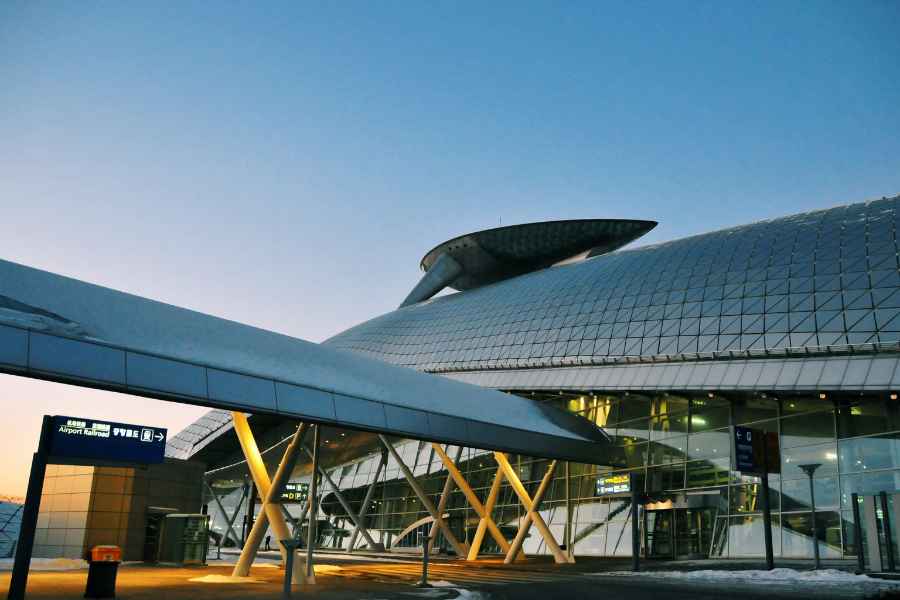
This is where most people slip up. The Climate Card works only within Seoul, and the following are excluded, based on Seoul city guidance.
1) Intercity and airport buses Seoul-licensed city, village, and night buses are fine. Intercity buses, airport buses, and buses licensed in other regions are not.
2) The Sinbundang Line The line from Gangnam toward Pangyo can’t be used with the Climate Card.
3) GTX The Great Train eXpress is excluded too.
4) Subway stations outside Seoul If you board in Seoul and get off at a station outside Seoul, you can’t tap out with the Climate Card. You’ll need to call a station attendant and pay the fare from your boarding station to your exit station.
5) The Incheon Airport segment Incheon Airport is outside Seoul, and many sources say you can’t use the Climate Card to ride the airport railroad in. T-money is the safest choice from the airport into the city.
Some segments, such as the airport railroad between Gimpo Airport and Seoul Station, are described differently across sources. Check Seoul city’s guidance before you ride.
What Changed in 2026
The 30-Day Pass Is Gone
According to VisitKorea, the postpaid and 30-day Climate Cards were discontinued as of October 1, 2026. Visitors can now use only the 1, 2, 3, 5 and 7-day short-term passes.
Many older blog posts still recommend the 30-day pass. Always check the post date.
Seoul Only
From the same date, the Climate Card is described as usable within Seoul only. If you’re heading outside Seoul, prepare a T-money card too.
Ttareungi Bikes and the Han River Bus
According to Seoul city guidance, short-term passes don’t include Ttareungi bikes or the Han River Bus. If you plan to use those, you may need to pay separately, so check the official guidance before you buy.
A New Card on the Way
Korean news reports say the city is working on a “Climate Card Plus,” which would combine the Climate Card with the national “Everyone’s Card.” It could launch as early as October or as late as year-end, but the details aren’t final. If your trip is soon, plan around the current short-term passes.
How to Buy the Climate Card
Where to Buy
Based on VisitKorea, you can buy the physical card at:
- Seoul tourist information centers (Seoul Tourist Plaza, Myeongdong)
- Information centers in subway stations on Lines 1–8 (cash only)
- New transit card machines inside subway stations
- Some convenience stores near subway stations
Can You Pay With a Foreign Card?
According to Korean news reports, since March 2026 the new transit card machines at 273 stations on Seoul subway Lines 1–8 let you buy Climate Card short-term passes with a foreign credit or debit card. Mobile payments such as KakaoPay and Naver Pay are also supported.
However, reports say an average 3.7% service fee applies to foreign cards. Machines and stations can differ, so I suggest carrying a little cash too.
One Thing to Watch
A short-term pass starts the moment you load it. You can’t change it or reload it until it expires.
For example, if you load it on the afternoon of day one, the clock starts that day. Loading it on the morning of your busiest day is usually the most efficient.
How Do You Tap?
According to Seoul city guidance, you must tap both when you board and when you exit. That includes when you transfer.
The 30-day card has a rule that suspends it for 24 hours after two missed exit taps. The guidance says this suspension doesn’t apply to short-term passes.
I couldn’t confirm how the base-fare surcharge for missed exit taps (covered in Post 2) applies to the Climate Card. So I recommend always tapping when you exit.
Which Card Should You Buy? By Trip Type
5 days in Seoul only
Get the Climate Card 5-day pass (₩15,000). You break even at about 2 rides a day, so it’s the best deal for anyone exploring the city. Use T-money only for the trip in from the airport.
2 nights in Seoul, only 2–3 rides a day
T-money is better or about equal. The 2-day pass breaks even at 3 rides a day, and the 3-day pass at about 2.3, which is borderline. Once you add the ₩3,000 card fee, a single T-money card is simpler.
Seoul plus Busan or Gyeongju
Go with T-money, because the Climate Card only works in Seoul. You could use the Climate Card for the Seoul leg only, but on a short trip that’s a hassle.
A day trip toward Gangnam and Pangyo
The Sinbundang Line doesn’t accept the Climate Card. Carry T-money as well.
The Most Practical Option: Use Both
Travel guides often suggest this approach. Use T-money for the airport and trips outside Seoul, and the Climate Card for getting around the city.
That way each card covers the other’s weakness. But buying both means paying two card fees, and neither is refundable.
So this works best if you stay in Seoul for 5 days or more and ride a lot. On trips of 3 days or less, a single T-money card is often enough.
I covered how to get your T-money balance back in Post 1: [T-money Card Refund in Korea: Buy, Top Up & Get Your Money Back (2026)].
One More Option: The Foreigner-Only “Mpass”
VisitKorea also lists Mpass, a time-limited T-money card for foreigners. It gives up to 20 rides a day on Seoul subways, city buses, and the airport railroad (excluding express trains).
Prices are ₩15,000 for 1 day, ₩23,000 for 2 days, ₩30,500 for 3 days, ₩47,500 for 5 days, and ₩64,500 for 7 days. You get and return it at Tmoney Town near Seoul Station, and you can only buy it with cash.
It costs far more than a Climate Card short-term pass. But if you want one card that also covers the airport railroad, it’s worth comparing.
5 Common Mistakes
1) Buying the Climate Card for a short trip If you won’t ride 4–6 times a day, you might lose money.
2) Relying on the Climate Card at the airport Use T-money for the airport segment.
3) Getting off outside Seoul You’ll have to call an attendant and pay the fare separately.
4) Following an old post and looking for the 30-day pass It ended on October 1.
5) Ignoring when you load the pass The days start counting the moment you load it.
Pre-Purchase Checklist
- I checked how many days I’m staying in Seoul.
- I estimated how many rides I’ll take per day.
- I decided to use T-money for the Incheon Airport trip.
- I confirmed I’m not riding the Sinbundang Line, GTX, or intercity buses.
- I confirmed I’m not traveling outside Seoul.
- I’ll load the pass on the first day my travel starts.
- I brought a little cash.
Final Thoughts: One Calculation Can Change Your Transit Cost
A transit card seems like a small thing, but on a 5-day trip the gap can range from a few thousand won to over ₩10,000. That’s a good meal.
For Climate Card vs T-money, it’s really a question of days times rides per day. Count your days in Seoul and your daily rides first. The table above gives you the answer right away.
If this helped, share it with a friend planning a Seoul trip. Many people still don’t know the 30-day pass is gone.
In the next post, I’ll cover how to avoid taxi overcharging. Once you’ve picked your card, knowing the taxi basics makes getting around Seoul even easier.