
If you applied to the Sejong Institute because you wanted to learn Korean, and you’ve heard nothing for months, here’s the short answer: that wait isn’t unique to you.
It’s a structural pattern playing out worldwide. The most rational response is to apply to your local Institute and wait, but in parallel, use the free official online platform and other learning tools so the wait isn’t wasted time.
Across this series, we’ve looked at Duolingo versus the Sejong Institute, paid learning apps versus TOPIK, and content-based versus textbook study — and in the end, every one of those stories traces back to this same gap between demand and supply. Let’s look at why this imbalance exists, using official data, and how to bridge it.
How the Sejong Institute has grown
According to the Sejong Institute Foundation, when the first Institute opened in Ulaanbaatar, Mongolia in 2007, there were just 3 countries and 13 locations, with annual enrollment of only 740 students. After the Foundation formally launched in 2012, that grew to 43 countries and 90 locations, then 172 locations across 57 countries by 2018, 213 locations across 76 countries by 2020, and 248 locations across 85 countries by 2023. By 2024, the network had expanded to 256 locations across 88 countries.
Enrollment grew just as fast — from 101,675 students in 2020 to 138,425 in 2021, 178,973 in 2022, and 216,226 in 2023. By the numbers alone, both the network and enrollment have grown by double digits nearly every year.
But demand grew even faster
That growth looks impressive on its own — but the real problem is that demand for Korean is growing even faster. Duolingo says global Korean learners have reached 5.5 million, and TOPIK applicants exploded from 360,000 in 2022 to over 500,000 last year. AJU PRESS
The Sejong Institute, by contrast, can only operate by physically placing a classroom and a trained instructor in a given city — so no matter how many people apply, there’s a hard physical ceiling on how many it can take in at once.
The real scale of the gap, in data
| Metric | Figure |
|---|---|
| Sejong Institute global footprint (2024) | 256 locations, 88 countries |
| Sejong Institute annual enrollment (2023) | 216,226 students |
| Global Sejong Institute waitlist | ~15,000 people |
| LA Sejong Institute cohort capacity | 80 students |
| LA Sejong Institute waitlist | 600+ people |
| Recent new-location application ratio | 5.4-to-1 |
| Duolingo global Korean learners | ~5.5 million |
| TOPIK applicants (2025) | Surpassed 500,000 for the first time |
What the Los Angeles case shows
A representative from the Korean Cultural Center in LA has said the local Sejong Institute waitlist alone runs past 600 people, even though a single cohort can only take 80 students. Simple math says it would take more than seven cohorts to clear that waitlist alone.
A recent open call for new Sejong Institute locations drew 97 applications from institutions across 40 countries — a 5.4-to-1 ratio, the highest in the past five years. And that’s just competition among institutions applying to run a location — the scale of actual student demand reflects something even more intense.
Among the newly designated locations from that same round were Latvia, Myanmar, Bahrain, and Cuba — countries that had never had a single Sejong Institute before, a sign that demand for Korean is no longer confined to a handful of Asian countries but spreading evenly across continents.
Why is everything converging right now
The driving force behind this rush is the spread of Hallyu content itself. In the Sejong Institute Foundation’s own survey, interest in Korean culture was the top reason for studying Korean, and nearly half of new learners had been studying for less than six months. In other words, far more applicants are people who got suddenly curious after watching content than people who carefully planned their enrollment over a long period.
The same pattern shows up in TOPIK applicant statistics — Hallyu-driven interest pushed applicant numbers up every year, and the growth was too steep for government agencies to predict and build capacity for in advance.
A pace even government agencies are struggling to match
NIIED, which runs TOPIK, has felt the same strain so acutely that it’s reportedly exploring a privately-invested digital transformation project just to handle the operational load.
In the end, learning demand swings fast with content trends, while expanding a formal education institution — securing space, hiring teachers, allocating budget — takes time by nature. That mismatch is structural, and it isn’t closing anytime soon.
How not to waste the wait
The first thing to do is apply now — to your local Sejong Institute, and to Nuri Sejong Hakdang, the official online platform — because if your name isn’t on the list, the clock never starts.
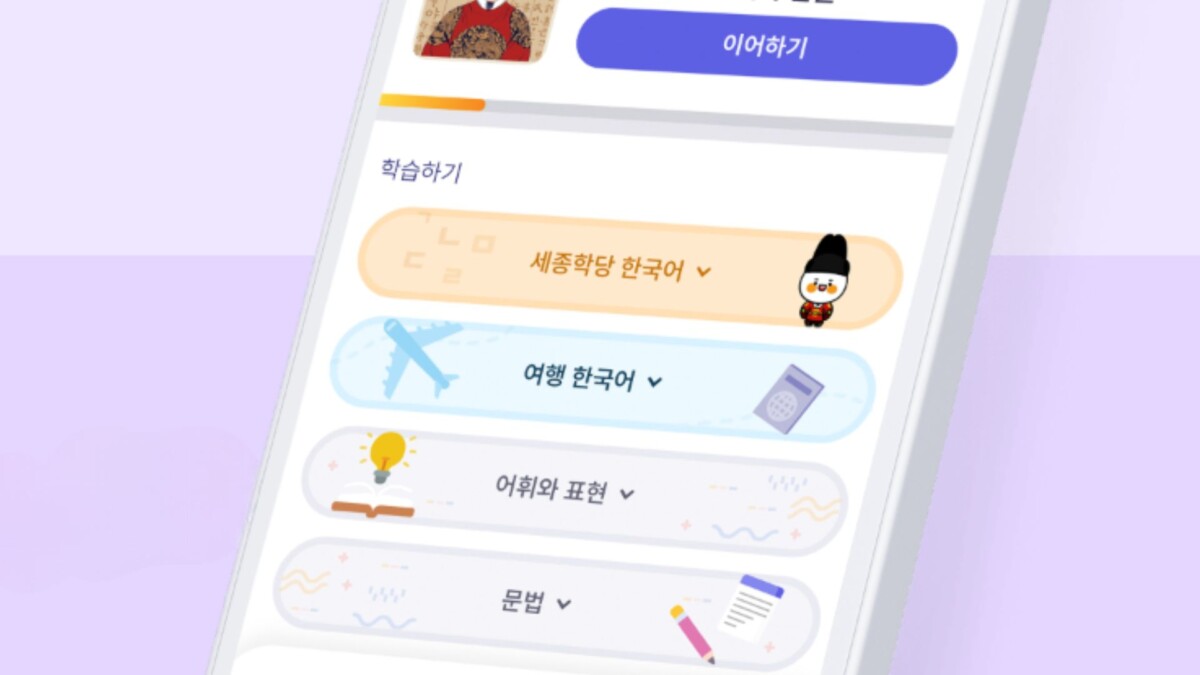
Nuri Sejong Hakdang has no enrollment cap and offers the same standardized textbooks as the in-person Institutes for free online, making it the most realistic alternative if there’s no Institute near you, or the wait is unusually long.
While you wait, build your grammar and vocabulary foundation with a self-study app like Duolingo, so that when your offline spot finally comes through, you can start at a higher level — meaning the wait isn’t wasted time. To stay motivated, keep engaging with your favorite dramas or webtoons as content-based study material so you’re encountering real expressions the whole time.
If certification is your goal, check TOPIK first
If your real goal is certification, check the TOPIK schedule separately from your waitlist status. Unlike the Sejong Institute, TOPIK has no enrollment cap — anyone who registers within the application window can generally take it — so it’s a perfectly achievable goal through self-study and online resources while you wait for an offline seat.
To sum up: register officially first, sign up for the free online alternative immediately, use a self-study tool daily, keep content-based learning fun, and pursue TOPIK independently of your waitlist status — that’s how to make the most of the wait.
Across this series, we’ve covered everything from free apps to paid subscriptions, the TOPIK certificate, and content-based study methods for K-drama fans learning Korean. If you’ve been unsure where to start, pick just one tool from this series and put it into action today.
Sources
- Sejong Institute Foundation official announcements — yearly operation statistics, new-location press releases (ksif.or.kr)
- Korea.net News, Korean Cultural Center under the Ministry of Culture, Sports and Tourism — 256 locations across 88 countries (korean-culture.org)
- Korean-language education field report — LA Korean Cultural Center on Sejong Institute waitlists (edu4mc.or.kr)
- Duolingo official blog, 2025 Duolingo Language Report
- News coverage citing official Ministry of Education / NIIED data on TOPIK applicant trends
- Jeongkyungsisa FOCUS — NIIED’s privately-invested digital transformation initiative for TOPIK


