
whether your 3-day Jeju trip actually works out comes down to one decision more than any other — your rental car. Plenty of travel guides list “3-day itineraries” full of attractions, but they rarely mention the one thing that actually determines how your trip goes: Jeju is an island where, without a rental car, you can’t realistically get through even half of a planned itinerary.
Buses run infrequently and don’t connect attractions tightly enough, and every year, travelers who rely on public transit end up spending an entire day just getting from place to place. This guide puts the rental car front and center, then lays out a realistic 3-day itinerary split between Jeju’s east and west sides.
Why a Rental Car Is Practically Non-Negotiable in Jeju
Unlike Seoul or Busan, Jeju has structural limits that make it genuinely hard to get around on public transit alone. There’s no subway, and city bus routes are built mostly around downtown Jeju City and Seogwipo, so buses to major attractions along the coast or at the island’s volcanic cones often run only once every 30 minutes to an hour.
The island itself is also bigger than most people expect — driving from Aewol on the west coast to Seongsan on the east coast takes nearly an hour and a half, even by car.
In other words, the plan of “just hop on buses and see the sights” simply doesn’t work in Jeju. You’ll often have to walk a fair distance from the bus stop to the actual attraction, and missing one bus can throw off your entire remaining schedule for the day. If you want to make the most of a short 3-day trip, controlling your own route with a rental car is by far the most reliable approach.
What to Know Before You Book Your Rental Car
Bring an International Driving Permit — No Exceptions
To drive a rental car in Korea as a foreign visitor, you need an International Driving Permit (IDP). An IDP issued under the 1949 Geneva Convention is recognized in Korea, and you need to bring all three documents together: your passport, your domestic driver’s license, and your International Driving Permit.
You have to get the IDP issued in your home country before you leave — it can’t be obtained locally in Korea — so forgetting this one document means you simply can’t use a rental car at all.
Book the Car First, Then Build Your Itinerary
Jeju sees an overwhelming share of domestic Korean tourists, so rental cars can sell out within days during summer vacation season and major holidays. As soon as your 3-day dates are set, book your rental car first, then work out the details of your route — not the other way around.
Check Whether One-Way Drop-Off Is Available
Some rental companies let you pick up the car at the airport, drive west, and drop it off somewhere on the east side; others require you to return it to the same location. Confirming this before you book can make your 3-day route far more efficient.
Why You Should Split Your Trip Into East and West
Jeju is an island with a genuinely distinct character depending on which side you’re on. The west side is known for its gentle coastal roads and charming cafe alleys, while the east side’s strength lies in the dramatic landscape created by its volcanic cones and craters.
Trying to cover both sides in a single day means burning 3 to 4 hours just on driving, so the core strategy for a 3-day trip is to commit one full day to the west and one full day to the east.
Day 1: The West Coast — Coastal Roads and Cafe Culture
Since you’ll be arriving on your first day, it’s most efficient to start with the west side, which is closer to the airport, rather than pushing yourself too hard right away.
Aewol Coastal Road and Cafe Street
The Aewol coastal road is one of Jeju’s most famous drives, and cruising alongside the deep blue sea makes for a memorable start to the trip on its own. Along this road, Aewol’s cafe street lets you slow down with a cup of coffee while looking out at the ocean. For specific cafe recommendations in this area, check out our dedicated Aewol Cafe Street guide.
Hallim Park
Hallim Park combines a subtropical botanical garden, lava tube caves, and a folk village all in one complex. Since it’s not heavily weather-dependent, it’s also a great pick for pacing yourself on day one as you adjust to the trip.
Day 2: The East Coast — Landscapes Shaped by Volcanic Fire
On day two, head to Jeju’s east side to experience the landscape that best captures the island’s volcanic identity.
Seongsan Ilchulbong
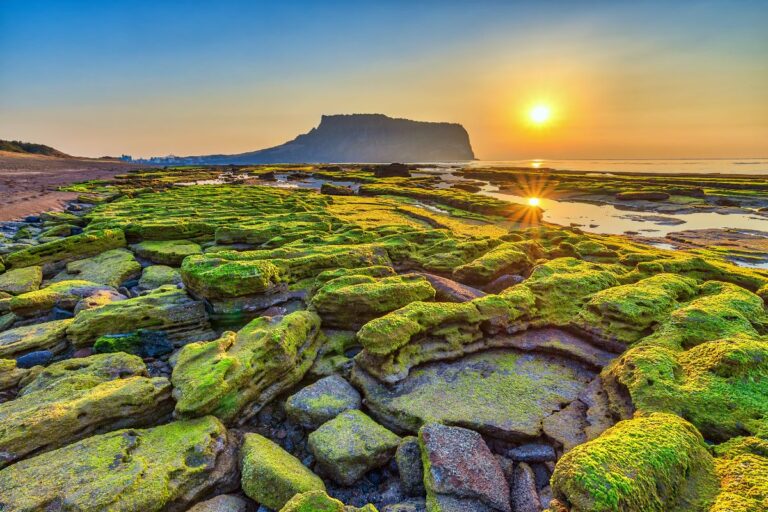
Seongsan Ilchulbong is a massive tuff cone formed by an undersea volcanic eruption roughly 5,000 years ago, and it’s registered as a UNESCO World Natural Heritage site — one of Jeju’s most iconic landmarks. There’s a trail up to the summit, and climbing it early in the morning rewards you with a spectacular view of the sunrise over the entire crater.
Udo
A 15-minute boat ride from Seongsan Port takes you to Udo, an island within Jeju. With its emerald water and wide-open grasslands, a popular way to explore Udo is to leave your rental car parked at Seongsan and circle the island on foot or by electric bike instead.
Manjanggul Cave
Manjanggul is one of the largest lava tube caves in the world, and thanks to its naturally cool interior, it’s an attraction you can enjoy regardless of the season, even in summer. The distinctive cave formations, lit for visitors, offer a completely different kind of scenery from Seongsan Ilchulbong.
Day 3: Stay Flexible With the Weather — Seogwipo or Jungmun
Jeju is famous for how unpredictable its weather can be. For that reason, it’s best not to lock in day three too far in advance — instead, decide based on how the first two days went and how you’re feeling.
If the Weather’s Clear — Cheonjiyeon Falls and the Jusangjeolli Cliffs
Cheonjiyeon Falls, on the Seogwipo side, is easy to reach right near downtown, while the Jusangjeolli cliffs in Jungmun are a striking formation of hexagonal rock columns meeting the sea — a landscape you really can’t see anywhere else in Korea.
If the Weather Turns — Switch to Indoor Attractions
On a rainy or windy day, switching your route to an indoor museum or exhibition space is a far more satisfying choice than pushing through an outdoor plan anyway. Since it’s your last day before heading back to the airport, it’s worth planning with some slack built in for your energy level, your luggage, and your flight time.
Your 3-Day Plan at a Glance
| Day | Area | Key Attractions |
|---|---|---|
| Day 1 | West | Aewol coastal road & cafe street, Hallim Park |
| Day 2 | East | Seongsan Ilchulbong, Udo, Manjanggul Cave |
| Day 3 | Seogwipo/Jungmun (flexible based on weather) | Cheonjiyeon Falls, Jusangjeolli or indoor alternatives |
Rental Car Checklist
- Bring your International Driving Permit, your home driver’s license, and your passport — all three. Missing even one means you can’t use the rental car.
- Book your rental car as soon as your 3-day dates are confirmed. During peak season, cars can sell out within days.
- Confirm one-way drop-off availability before you book. It can make your route far more efficient.
- Keep day three flexible based on the weather. Adjusting to how you feel beats pushing through a rigid outdoor plan.
Start With the Rental Car, Then Build the Rest of Your Trip
The most important decision in a 3-day Jeju trip isn’t which attractions to include — it’s getting your rental car sorted properly. As long as you don’t forget your International Driving Permit, you can experience Jeju’s two completely different faces in just three days: the relaxed coastal roads of the west and the dramatic volcanic landscapes of the east.
Save this checklist and start with your rental car reservation. We’ll continue covering spots worth exploring further on the west coast, like Aewol Cafe Street, in upcoming guides.