“So when am I actually supposed to visit Donggung and Wolji in Gyeongju?” A friend asked me this not long ago, and I couldn’t help but smile — it’s the exact same thing I got confused about on my first trip to Gyeongju.
Here’s the short answer: enter about 20 to 30 minutes before sunset.
That way you catch the sky turning blue during the magic hour at the same time the lights start coming on, one by one.
In this guide, I’ll walk you through everything that tends to trip people up — admission fees, hours, parking, the lotus garden, and the best night photo spots.
What Exactly Is Donggung and Wolji?
Donggung and Wolji refers to two things together: Donggung, a detached palace where the crown prince of Silla once lived, and Wolji, the artificial pond right beside it. For a long time it was better known by the name Anapji, since only wild geese and ducks seemed to visit what was then a ruined pond.
https://english.visitkorea.or.kr/svc/contents/contentsView.do?vcontsId=94404
Excavation research later revealed that this had actually been a banquet site for Silla royalty, and the current official name stuck from there. It was added to the UNESCO World Heritage list in 2000.
If you’re confused by the two names while planning your Gyeongju trip, just know Anapji and Donggung-Wolji are the exact same place.
Historically, it’s said to have been built under King Munmu during the Unified Silla period, used by the royal court to welcome distinguished guests and celebrate major state occasions. Excavations turned up a wealth of artifacts, including a 14-sided wooden dice called jurenggu used for a royal drinking game, giving us a real sense of just how lavish Silla court life once was.
What you see standing today is a partial restoration built after excavation, but even the layout and the shape of the pond alone are enough to feel the scale of Silla a thousand years ago.
Admission Is Cheaper Than You’d Think
This is the question I get asked most. Adult admission is 3,000 KRW, and children pay 1,000 KRW. National merit recipients and basic livelihood security recipients are eligible for free admission — if that applies to you, bring your ID documentation.
| Category | Fee |
|---|---|
| Adult (age 19+) | 3,000 KRW |
| Child / Teen | 1,000 KRW |
| National merit recipients / basic livelihood recipients | Free (ID required) |
Worth noting: Daereungwon Tomb Complex and Cheomseongdae Observatory are both free to enter, so Donggung and Wolji is actually the only paid site among the three.
The ticket booth sits at the main entrance, and there’s a luggage storage service inside the ticket office too, so don’t worry if you’re arriving with a suitcase in tow.
Hours — Don’t Miss This Window
Donggung and Wolji is open from 9 AM to 10 PM, with last entry at 9:30 PM. You can stay until the lights go out, which typically happens around 10 PM.
That said, the exact lighting schedule can shift slightly depending on the season and sunset time, so it’s worth double-checking the posted signage at the entrance or Gyeongju’s official website on the day of your visit.
On weekends and holidays, crowds chasing the night view can create a fairly long line right before last entry. Arriving around 8 PM tends to give you the most comfortable experience.
During peak summer, sunset comes later, so entering around 8:30 PM still gives you plenty of time to catch the magic hour.
Parking, and What to Watch Out For
There’s a free parking lot right in front of the entrance. Just keep in mind that this is one of the most popular night-view spots in the country, so the lot is usually full by evening. If you can’t find a spot, try the nearby Daereungwon parking lot or the public lots around Cheomseongdae.
I’d actually recommend combining public transit with some walking or cycling rather than relying on a car. The route from Daereungwon to Cheomseongdae to Woljeonggyo Bridge to Donggung and Wolji is entirely walkable, and a popular combo is renting a bike to tour the historic sites during the day, then wrapping up the evening on foot at Donggung and Wolji.
The Lotus Garden — Why Summer Is Worth It
The eastern historic district around Donggung and Wolji includes a roughly 60,000-square-meter lotus garden, planted with red, white, yellow, and water lily varieties.
Blooming runs from mid-June through early September, with peak bloom generally landing around mid-July. Seeing lotus flowers rise out of the mud with Cheomseongdae visible in the background is a scene you really only get in Gyeongju, and it photographs beautifully.
Lotus flowers tend to be in full bloom in the morning and gradually close up by the afternoon, so if you want great lotus photos, go in the morning.
If you’re after the night view and reflection shots instead, evening after sunset is the answer. If you want both in one trip, a good plan is lotus garden in the morning, night view in the evening.
Which Season Is Actually Best?
Donggung and Wolji shows a genuinely different face each season — soft cherry blossoms in spring, lush green paired with the lotus garden in summer, cool weather and autumn foliage along the trails in fall, and quiet snow-covered reflections in winter.
If photography is your priority, I’d personally recommend mid-July, when the lotus is at peak bloom, or October, when crowds thin out but the weather is still pleasant.
Summer’s higher humidity often makes for sharper reflection shots, but be ready for the heat and mosquitoes. Winter brings fewer tourists, which means more room to shoot at your own pace, but temperatures drop significantly at night, so dress warmly.
The Best Night Photo Spots — You Really Can’t Miss
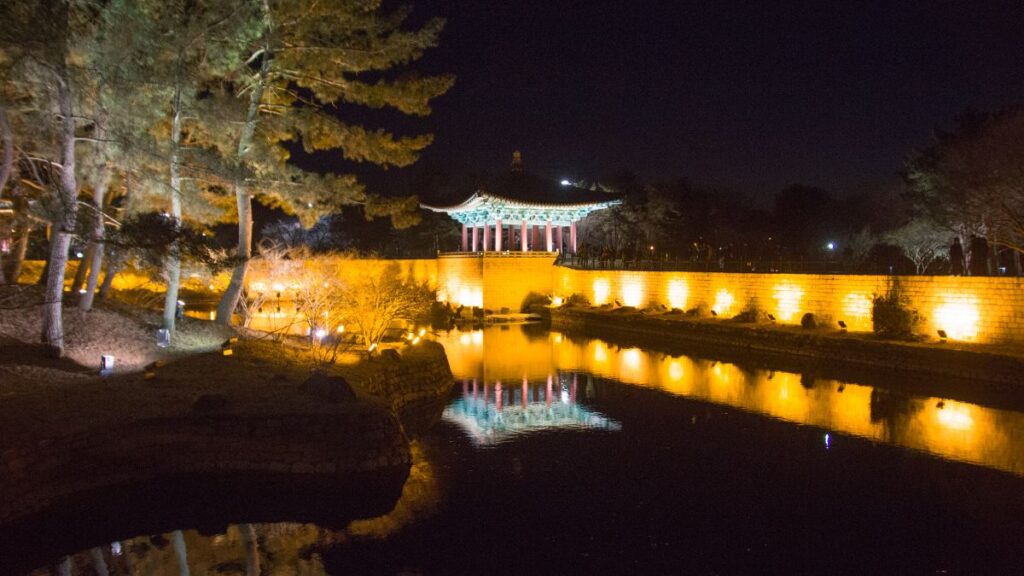
The highlight of Donggung and Wolji is undoubtedly the reflection shot — the palace mirrored perfectly on the pond’s surface. On a calm, windless night, Wolji turns into a giant mirror holding the image of Donggung’s pavilions.
The most popular photo spot is near the third restored building you reach walking clockwise from the entrance — stand facing it directly, and you’ll capture a scene where reality and its reflection form a near-perfect mirror image.
There’s more than one good photo spot along the walking path, so rather than rushing to shoot just one and leaving, I’d recommend taking a slow, full loop and capturing the scene from several angles.
Also worth knowing: on calm nights with just the right amount of humidity, the water surface stays stiller, which makes the reflection even sharper.
[Personal experience note: this is a great spot to add your own account of which season and time you visited, what the atmosphere felt like, and which photo spot you personally found most rewarding — that kind of detail builds a lot of trust with readers.]
For smartphone photos, skip portrait mode or night mode and instead fix your phone on a mini tripod or railing and slightly extend the exposure time — this captures the reflection far more clearly.
Hand shake is the biggest culprit behind blurry night shots, so it’s worth packing a small tripod. If you’re shooting with a DSLR or mirrorless camera, narrowing the aperture for a deeper depth of field will keep both the palace and its reflection sharp.
Getting There by Public Transit
Plenty of visitors come without a car, and Gyeongju’s public transit access here is genuinely decent. From Gyeongju Station or the Gyeongju Express Bus Terminal, a city bus takes about 15–20 minutes, and it’s under a 5-minute walk from the bus stop to the entrance.
There are also well-run tourist circulator bus routes these days, so a lot of visitors tour Daereungwon and Cheomseongdae first, then simply walk over.
If you’d rather take a taxi, the fare from the city center isn’t much of a burden, making it a solid option if you’re carrying luggage or traveling at night. Just note that roads nearby can get congested between 8 and 9 PM when the night-view crowds arrive, so build in some extra travel time.
Nearby Spots Worth Pairing With Your Visit
The historic sites around Donggung and Wolji are close enough to walk between, so bundling them into one day makes for a much richer trip.
| Location | Distance from Donggung & Wolji | Admission | Best Time to Visit |
|---|---|---|---|
| Cheomseongdae Observatory | ~10 min walk | Free | Daytime or during evening lighting |
| Daereungwon Tomb Complex (incl. Cheonmachong) | ~10–15 min walk | Daereungwon free; Cheonmachong separate paid entry | Daytime |
| Woljeonggyo Bridge | ~15–20 min walk | Free | After evening lights come on |
| Donggung Won (botanical garden) | Requires separate travel | Paid (check combo ticket options) | Daytime |
Personally, my favorite way to structure the day is: Daereungwon and Cheonmachong in the daytime, catching Cheomseongdae’s lights as evening sets in, then closing the day with Donggung and Wolji’s night view. All three connect on foot, so you don’t need a rental car or bike to fit everything into a single day.
Pre-Visit Checklist
- Adult 3,000 KRW / Child 1,000 KRW — confirm at the ticket booth whether both cash and card are accepted
- Last entry is 9:30 PM; viewing ends when the lights go out (typically around 10 PM)
- For the magic-hour night view, enter 20–30 minutes before sunset
- The free parking lot tends to fill up on peak-season evenings
- Luggage storage is available inside the ticket office
- The lotus garden blooms mid-June through early September, peaking around mid-July
- The best reflection-shot photo spot is near the third restored building, walking clockwise from the entrance
Frequently Asked Questions
Q. Are Anapji and Donggung-Wolji different places? No, they’re the same place. After excavation revealed it had been a Silla royal banquet site, the official name changed to Donggung and Wolji.
Q. Is it open at night even in rain? Hours can change due to weather or maintenance work. It’s safest to check Gyeongju’s official website or the posted signage on the day of your visit.
Q. Can I combine this with Daereungwon and Cheomseongdae? Yes — they’re all within comfortable walking distance. The most popular route is Daereungwon and Cheomseongdae during the day, followed by Donggung and Wolji’s night view after sunset.
Q. Is it stroller- or wheelchair-accessible? The walking paths are generally flat and easy to navigate. That said, the paths can feel a bit narrow during crowded evening hours.
Q. Can I bring my pet? Given the nature of the historic site, pet entry is often restricted. Check Gyeongju’s official channels for the most current pet policy before you go.
Q. What’s the best season for photos? Reflection shots have their own charm in every season, but summer pairs beautifully with the lotus garden, and winter offers a uniquely quiet, snow-covered reflection. Spring and fall bring cooler, more comfortable weather for lingering and shooting at a relaxed pace.
Donggung and Wolji looks like a completely different place by day versus by night, and I can say with confidence that the 3,000 KRW admission is money well spent for that night view alone. Plan it alongside Daereungwon, Cheomseongdae, and Woljeonggyo Bridge, and you can easily fill an entire day.
I hope this helps with your Gyeongju trip planning — next time, I’ll put together a guide to the night views at Daereungwon and Cheomseongdae too.