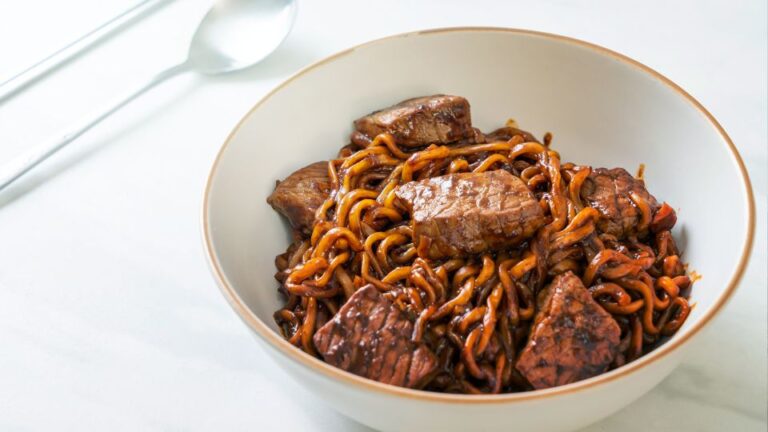

Cheongju Gogi Jjampong is a lunch-only noodle restaurant in Bunpyeong-dong, Cheongju, serving spicy noodle soup made entirely from meat broth — no seafood at all. One bowl costs ₩11,000.
Rich, deep, beef-and-pork broth. Firm, chewy noodles. Glutinous rice tangsuyuk on the side. It’s been verified by one of Korea’s most followed food YouTubers, Hibab, who made the trip to Cheongju specifically to eat here.
Living in Korea, when someone visiting Cheongju asks me where to eat lunch, this is the first place I mention — with one caveat: they close at 3:30 PM, and sometimes earlier. Timing is everything here.

First: What Is Jjampong?
To get the most out of Cheongju Gogi Jjampong, it helps to understand what jjampong actually is.
Jjampong (짬뽕) is a spicy Korean-Chinese noodle soup — stir-fried vegetables, protein, and noodles in a fiery, deeply flavored broth. It originated in China but has been so thoroughly reinvented in Korea that it has become its own distinct dish. Think of it the way American pizza bears little resemblance to Neapolitan pizza — the lineage is there, but the result is completely different.
Jjajangmyeon vs. Jjampong: Korea’s Eternal Dilemma
When you sit down at a Korean-Chinese restaurant, you will face a choice that Koreans have been arguing about for decades. Jjajangmyeon (짜장면) or jjampong (짬뽕)?
Jjajangmyeon is a rich, savory black noodle dish made from fermented black bean paste — sweet, salty, and deeply umami. Jjampong is the opposite: spicy, bright red broth, bold and energizing. The debate between these two dishes is so culturally embedded in Korea that it’s a running joke — some people claim it’s caused more arguments among friends than any other decision in life.
Meat Jjampong vs. Seafood Jjampong: What Makes This Different
Standard jjampong — haemul jjampong (해물짬뽕) — uses shrimp, squid, and mussels. The broth is clean and carries the aroma of the sea.
Gogi jjampong (고기짬뽕), which translates literally as “meat jjampong,” takes an entirely different approach. No seafood at all — only pork and beef broth, slow-cooked until the liquid is thick, heavy, and layered with savory depth. This style is uncommon even within Korea, which is exactly why first-time diners react with surprise: “Jjampong can taste this rich?”
Cheongju: Korea’s Emerging Gateway Beyond Seoul
Before getting into the restaurant, knowing where you’ve landed matters.
Cheongju (청주) is the capital of North Chungcheong Province and sits at the geographic center of the Korean Peninsula. It’s an ideal base for reaching Seoul, Busan, Jeonju, and Gyeongju in roughly equal time — a transport hub that is only now receiving the attention it deserves from international travelers.
Foreign Arrivals at Cheongju Airport Are Surging
According to Kyunghyang Sinmun reporting from June 2025, foreign arrivals through Cheongju International Airport reached 112,612 in 2024 — a 75.8% increase from 2023. Japanese arrivals jumped by an astonishing 164.4%, and Taiwanese visitors grew by 47.5%.
The driving force is AeroK (에어로케이), a Cheongju-based budget carrier that has aggressively expanded direct routes to Japan and Taiwan. Foreign travelers are increasingly choosing Cheongju over Incheon and Gimpo for its lower airfares and the city’s central location within the peninsula.
What to See in Cheongju
Beyond the restaurant, these are the Cheongju attractions worth pairing with your visit.
- Cheongju Early Printing Museum (청주고인쇄박물관): Home to the Jikji (직지) — the world’s oldest surviving book printed with metal moveable type, created in 1377. It predates Gutenberg’s Bible by 78 years and is inscribed on UNESCO’s Memory of the World Register.
- Suamgol Mural Village (수암골): A hillside community formed by war refugees that became a drama filming location. Colourful murals line every alley, and the hilltop viewpoint offers a panoramic view of Cheongju.
- Cheongnamdae (청남대): The former presidential villa overlooking Lake Daecheong — now open to the public, with a scenic lakeside walking trail.
- Yukgeori Comprehensive Market (육거리종합시장): Cheongju’s main traditional market. Street food, local snacks, and an authentic market atmosphere.
- Ullidangil (운리단길): Cheongju’s trendiest street — independent cafes, vintage shops, and locally made goods in a relaxed, walkable setting.
Why Cheongju Gogi Jjampong Stands Out
Korea has no shortage of Korean-Chinese restaurants. But the name of this one says everything about its philosophy. “Gogi Jjampong” is not a restaurant that serves eight different noodle dishes. It is a restaurant that has committed entirely to one thing.
The broth is heavy. A single spoonful immediately tells you this is not ordinary jjampong. There is no fishiness, no oceanic sharpness — just the deep, round, savory weight of long-simmered meat stock. The noodles are firm and chewy. The portion is more generous than the price suggests.
“Is this really jjampong?” is the reaction this restaurant consistently produces. That reaction is why people come.
The Restaurant a Famous Food YouTuber Drove to Cheongju For
Hibab (히밥) is one of Korea’s most prominent food content creators, with over 8 million subscribers on YouTube. Known for spicy food challenges and large-portion eating content, Hibab has a following that spans both Korea and international audiences.
When Hibab visited Cheongju Gogi Jjampong and posted the video, the restaurant’s reputation expanded from a strong local following to a nationally recognized destination. In Korean food culture, a dedicated mukbang YouTuber travelling to a regional restaurant specifically for a single dish is one of the most credible endorsements a local restaurant can receive.
Why Opening Only for Lunch Is Actually a Strength
The restaurant operates from 11:00 AM to 3:30 PM only. On days when ingredients run out early, they close before that.
This isn’t a limitation — it’s the entire operating philosophy. Every day, fresh ingredients go into the broth. The kitchen works at full capacity during a focused window, and when the day’s production is gone, the kitchen stops. The reason you can’t come for dinner is the same reason lunch tastes this good.
Menu & Pricing
| Menu Item | Price | Description |
|---|---|---|
| Gogi Jjampong | ₩11,000 | Meat-broth spicy noodle soup — the signature |
| Gogi Jjampong Bap | ₩11,000 | Same soup with rice mixed in |
| Jjajangmyeon | ₩7,000 | Black bean sauce noodles |
| Pan-fried Dumplings (군만두) | ₩7,000 | Crispy fried dumplings |
| Chapssal Tangsuyuk (S) | ₩20,000 | Glutinous rice sweet-and-sour pork |
| Chapssal Tangsuyuk (L) | ₩33,000 | Recommended size for 2+ people |
💰 In real money: Gogi jjampong at ₩11,000 is roughly $8 USD / €7 EUR. For two people ordering two bowls plus the small tangsuyuk to share, the total comes to around ₩42,000 — approximately $15 per person. For a regional Korean lunch at this quality, that’s genuinely excellent value.
💡 Best first-visit order: Gogi jjampong (2 bowls) + Chapssal Tangsuyuk small (1 order). The deep, savory broth and the crispy, chewy pork complement each other in a way that makes this particular combination the standard at this restaurant.
Chapssal Tangsuyuk: Why You Have to Order It
Tangsuyuk (탕수육) is Korea’s take on sweet-and-sour pork. Protein coated, deep-fried, and served with a bright, tangy dipping or pouring sauce — it’s one of the defining dishes of Korean-Chinese cuisine.
What makes Cheongju Gogi Jjampong’s version different is the batter. Chapssal (찹쌀) is glutinous rice — the same rice used in Korean rice cakes. A chapssal batter produces a much chewier, more substantial crust than standard flour, and critically, it doesn’t go soggy even after the sauce is added. This matters because Korea has a real debate about tangsuyuk.
The “bumeo-k (부먹) vs. jjik-meo-k (찍먹)” debate — whether to pour the sauce over the pork or dip each piece separately — is as culturally significant in Korean food circles as jjajangmyeon vs. jjampong. Pour-camp believes the sauce should soak in. Dip-camp believes crispy texture must be preserved bite by bite. There is no correct answer. Try both methods and pick a side.
What the Visit Actually Feels Like
Aim to arrive between 11:00 AM and noon. After 12:00, the restaurant fills steadily and wait times begin to appear.
The interior is unpretentious — wide tables, practical layout, the kind of space where the focus is unambiguously on the food. As the lunch rush builds, the room becomes noticeably lively. There’s a reason the expression “a restaurant that knows what it is” was invented.
When the jjampong arrives, sip the broth first before touching the noodles. The absence of any seafood character and the presence of deep, meaty umami immediately sets this apart from every other jjampong you’ve tried. Then eat the noodles through the broth, picking up the residual pork pieces as you go.
If you ordered Gogi Jjampong Bap, the rice is meant to be stirred into the broth. This is a natural way of eating in Korean cuisine — adding rice to a flavored liquid and letting it absorb the stock. The result is something between a noodle soup and a risotto in spirit, though entirely its own thing.
The Shoes-Off Dining Format
Cheongju Gogi Jjampong follows a shoes-off entry format — you remove your footwear at the entrance and sit on floor-level seating.
This comes directly from traditional Korean residential culture, where shoes have never been worn indoors. Some Korean restaurants maintain this format, particularly older establishments with a traditional character. It may feel unusual the first time, but it is notably more comfortable than it sounds once you’re seated. Leave your shoes neatly at the entrance — that’s the only protocol required.
Getting There & Practical Info
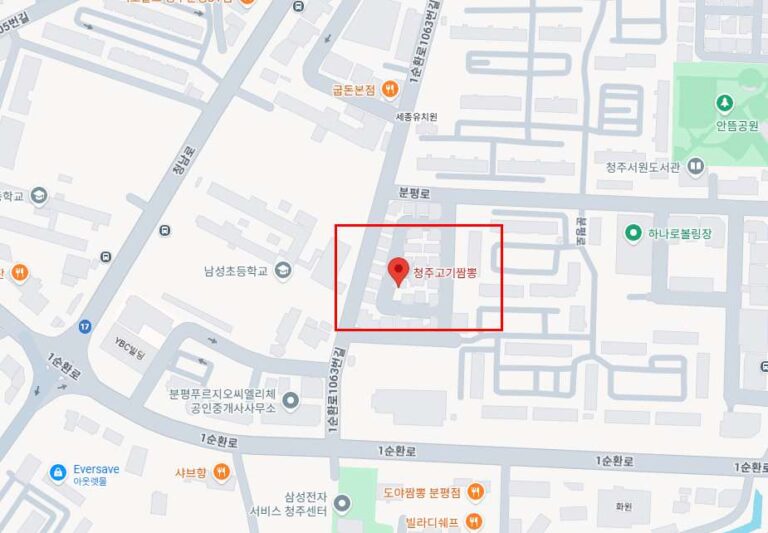
| Address | 14-7 Bunpyeong-ro 6beon-gil, Seowon-gu, Cheongju, Chungcheongbuk-do |
| Map | Search “청주고기짬뽕” on Naver Maps or Kakao Maps |
| Hours | 11:00 – 15:30 only |
| Note | May close earlier when ingredients run out — aim to arrive by noon |
| Payment | Cards accepted |
⚠️ The most important thing to know: This restaurant closes at 3:30 PM. Plan your day around this window. If you’re visiting Cheongju for a day trip or transiting through Cheongju Airport, build lunch first and sightseeing second. Arriving at 11:00 AM opening time guarantees you a seat without a wait.
From Cheongju Airport to the Restaurant
Getting from the airport to Bunpyeong-dong is straightforward.
- Bus: Route 407 from outside the airport → city centre in approximately 20 minutes
- Taxi: Airport → Bunpyeong-dong in approximately 15 minutes / ~₩13,000 ($9–10 USD)
- Practical note: If your flight arrives in the morning, you can go directly from the airport to the restaurant and arrive in time for the lunch opening. This is the optimal sequence for a day trip.
Cheongju 1-Night, 2-Day Itinerary
Cheongju is a compact city. Everything is close.
DAY 1 Cheongju Airport arrival → Taxi to Bunpyeong-dong → Cheongju Gogi Jjampong for lunch (arrive by 11:30) → Cheongju Early Printing Museum (Jikji) → Suamgol Mural Village & viewpoint → Ullidangil cafes for the evening
DAY 2 Cheongnamdae (former presidential villa, lakeside trail) → Sangdang Fortress (light hike, fortress views) → Yukgeori Market street food → Depart Cheongju or continue to the next region
Tips Before You Visit
① Arrive by noon The restaurant runs on a first-come basis, and the lunch rush is real. Showing up at or just after the 11:00 AM opening means no waiting and the freshest broth of the day.
② Gogi jjampong plus tangsuyuk is the standard order Two bowls of jjampong and one small tangsuyuk for two people is the combination most visitors settle on. It covers both things this restaurant does exceptionally well.
③ If someone in your group can’t handle spice, order jjajangmyeon At ₩7,000, the black bean noodles are a reliable alternative. Having both dishes at the same table also lets you compare the two pillars of Korean-Chinese cuisine side by side.
④ Finish every drop of the broth Once the noodles are gone, the remaining broth is the best part. Adding a bowl of rice and stirring it in is the local way to close the meal. Don’t skip this step.
Who Should Visit
✅ Travelers arriving through Cheongju International Airport who want to start their Korea trip with a memorable first meal
✅ Anyone curious about Korean-Chinese food culture beyond the well-known dishes
✅ Travelers intentionally exploring regional Korea beyond Seoul, looking for local restaurants that don’t appear on typical tourist maps
✅ Fans of Korean food content who want to visit a restaurant that Hibab personally endorsed
✅ Budget travelers wanting a complete, satisfying Korean lunch for under $10
One Final Thought
Living in Korea, one pattern holds true across every region: the best local restaurants are the ones that run on the fewest hours and the fewest excuses.
No marketing. No Instagram presence required. Open for four and a half hours, close when the ingredients are gone, do it again tomorrow. Hibab drove to Cheongju for one bowl of noodles. That single decision told regional food lovers everything they needed to know.
According to Kyunghyang Sinmun, foreign arrivals through Cheongju Airport grew by 75.8% in 2024. Cheongju is becoming the entry point that Korea’s regional tourism has needed, and travelers arriving here are discovering a city with real depth — history, culture, and food that Seoul simply can’t offer.
Set your alarm for the 11:00 AM opening. Take the taxi straight from the airport if you land in the morning. One spoonful of broth, and you’ll understand immediately what made a famous YouTuber leave Seoul for this.
🇰🇷 Budget-Friendly Eats in Korea — the series continues. More regional restaurants and hidden gems coming soon.