
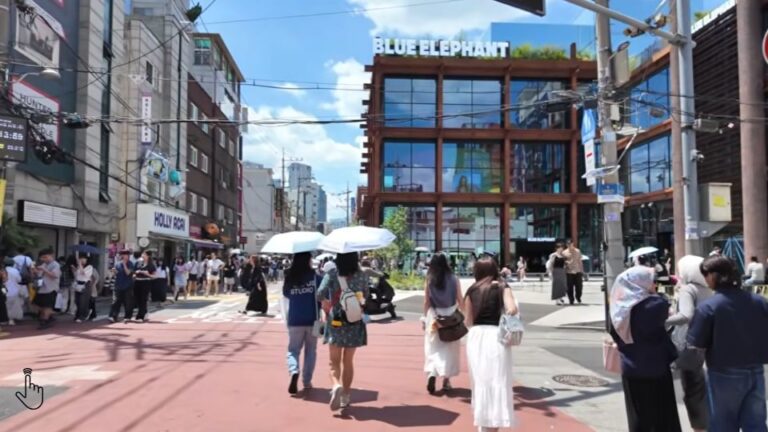
foreign tourists aren’t flocking to Seongsu-dong because it’s “trendy” — they’re coming because it lets them live like a local, even just for a day. According to LG U+ Data Plus big data, analyzed by the Korea Culture and Information Service under the Ministry of Culture, Sports and Tourism, foreign visitors to Seongsu-dong jumped from 330,000 in the first half of 2024 to 910,000 in the first half of 2025 — roughly a 3x increase, the steepest growth rate among Seoul’s major tourist destinations.
I’ve noticed this shift myself every time I’ve been there recently — the share of foreign visitors is obviously growing. Here’s why, backed by data and what I’ve seen on the ground.
The Numbers Behind Seongsu-dong’s Explosive Growth
Seongsu-dong’s rise isn’t a vibe — it’s a documented trend. According to Hankyung’s (Korea Economic Daily) reporting on Korea Tourism Organization’s tourism data lab, foreign visitors to the district surged from 60,000 in 2018 to 3 million last year. Domestic visitors grew as well, from 19.93 million to 26.2 million over the same period — a 31% increase.
Spending followed the same trajectory. Card sales in the Seongsu area grew from 63.7 billion won in 2014 to 238.4 billion won last year — more than triple. Herald Economy reports that foreign visitors grew by roughly 1.5 million in the first half of 2025 alone, putting the district on track to surpass 5 million foreign visitors for the year.
The most striking figure comes from Korea Tourism Organization’s own big data: foreign tourist visit rates to Seongsu-dong grew 863.5% year-over-year in Q1, compared to just 13.1% for Myeongdong and 27.7% for Seogyo-dong (near Hongdae) over the same period. The numbers alone tell you which direction this district is heading.
A Pop-Up Store Mecca — Where Brands Choose to Debut First
The most direct reason foreigners come to Seongsu-dong is pop-up stores. According to Apparel News, Seongsu-dong currently hosts an average of 40 to 50 pop-up stores running simultaneously every week. Luxury brands, K-pop merchandise, and independent designers all coexist within the same few blocks — that mix is what makes Seongsu-dong distinct.
From Chanel and Dior to K-pop character pop-ups like Stray Kids’ SKZOO, Seongsu-dong has become the stage where brands debut to Korean consumers for the first time. Dior opened a permanent “Dior Seongsu” store here, and domestic companies like Musinsa, Gentle Monster, and Krafton have also set up bases in the district.
So why Seongsu-dong specifically?
The district was originally packed with shoe factories and cheap rent, which attracted design-minded entrepreneurs who gradually opened cafés and concept stores. Seongdong-gu district office reinforced this trend at the policy level — designating the area an “IT Industry and Distribution Development Promotion Zone,” relaxing the floor area ratio up to 560%, and cutting construction permit processing time from over a month to within 5 days.
I saw this firsthand a few weeks ago. While walking through one alley to check out the pop-ups, I ran into a long line of foreign fans waiting for a K-pop character pop-up — and right next to it, another line for a luxury brand store. Watching those two completely different worlds coexist in the same block is really the essence of what makes Seongsu-dong work.
“Dailycation” — Buying a Slice of Korean Daily Life, Not a Photo Op
“dailycation” — a blend of “daily” and “vacation,” describing travelers who skip the checklist of famous landmarks and instead experience the rhythms and sensibilities of everyday Korean life.
Seongsu-dong fits that trend precisely. Sipping coffee at a converted factory café, trying on cosmetics at a concept store, snapping photos at an instant photo booth in between — the wandering itself becomes the point of the trip.
One Japanese tourist told reporters, “There are so many brands under one roof, and you can actually try things on or test products. It’s also great for photos.” A Chinese tourist added that Seongsu-dong is frequently mentioned on Douyin (China’s TikTok) as a “must-visit” in Korea, so it was her first stop right after arriving.
In other words, foreign visitors aren’t coming to see something — they’re coming to spend time doing something. That’s the fundamental difference between Seongsu-dong and traditional one-stop shopping hubs like Myeongdong or Gangnam.
Specialty Coffee and Warehouse Cafés — Seoul’s Densest Café District
Seongsu-dong is considered one of Seoul’s highest-density café districts. The alley near Exit 3 of Seongsu Station is known as “café street,” where tourists holding coffee cups constantly photograph each other.
A defining feature is the number of large spaces converted from old factories and warehouses. High ceilings and industrial-style interiors give visitors a completely different experience compared to the small storefront cafés common elsewhere in the city. During on-site reporting, Hankyung journalists directly observed tourists “relaxing at a café converted from an old factory building.”
Coffee quality itself is a draw, too. A cluster of roastery cafés serving specialty beans means the district appeals not just to Instagram culture, but to actual coffee enthusiasts.
Seoul Forest and the Han River — An Escape Into Nature, Minutes Away
Another strength of Seongsu-dong is Seoul Forest, just a 10-minute walk away. After a few hours of pop-ups and cafés, visitors can head straight to the park for a picnic or a walk. Having shopping, cafés, and nature all within walking distance is part of why people describe Seongsu-dong as a neighborhood you can spend an entire day in without getting bored.
The Han River isn’t far either. Seoul Forest connects naturally to the Han River park, letting visitors combine an urban experience with a nature break in a single day.
Craft Workshops — Travelers Who Want to Make Something, Not Just See It
A growing number of foreign visitors are looking for hands-on experiences rather than just sightseeing and eating. Seongsu-dong has ceramics studios, leathercraft workshops, and film camera experience spaces scattered throughout the neighborhood, letting visitors sample a “Korean-style hobby” in a short window of time.
These workshops offer something beyond a good photo. Walking away with something you made yourself creates a longer-lasting travel memory than a shopping bag does.
A New K-Beauty Shopping Destination — Replacing Myeongdong for Some Visitors
Somewhat surprisingly, Seongsu-dong is also emerging fast as a K-beauty shopping destination. According to Jugan Gippeun Sosik, the Olive Young N store in Seongsu-dong sees a roughly 50/50 split between domestic and foreign visitors — but foreign customers account for 70% of total sales, since they tend to buy in bulk.
By nationality, Japanese, Chinese, and Taiwanese tourists dominate. Korea Tourism Organization’s 2024 breakdown of foreign visitors to Seongdong-gu showed Japan at 20%, China at 17.3%, and Taiwan at 14.2%. A currency exchange booth operator in the district also noted that these three nationalities make up roughly 70% of their customers.
A Growing Hub for K-Pop and Entertainment
SM Entertainment’s headquarters is located in Seongsu-dong, making it a destination for K-pop fans as well. (I covered SM’s lobby and its goods shop, KWANGYA, in detail in a previous post.) Beyond that, character brand pop-ups from groups like Stray Kids have started choosing Seongsu-dong as the launch city for their global tours, turning the district into a new hub for K-pop fandom tourism.
It’s not just entertainment companies, either. Gaming company Krafton has also set up a base here, giving Seongsu-dong a broader symbolic status as the neighborhood where Korea’s cultural industries converge.
Can You Actually Go Inside SM, HYBE, and JYP’s Buildings?
The Shadow Behind Seongsu-dong’s Growth: Gentrification
Not everything about this story is positive. As pop-ups and tourists have flooded in, rents have spiked sharply, and long-time small business owners are increasingly being pushed out of the neighborhood — a textbook case of gentrification. Seoul’s first officially designated “master shoemaker” with 56 years in the trade, recently had to relocate his shop to the northern outskirts of Seongsu-dong because he could no longer afford the rent.
Experts describe Seongsu-dong as a successful case of rapid adaptation into a global hot spot, but warn that misjudging what to preserve versus what to change could send the neighborhood back to its quieter, emptier past. As a visitor, this context might not be obvious at first glance, but I think it’s important for understanding the neighborhood honestly.
Practical Tips for First-Time Foreign Visitors
Pop-up store schedules change weekly. Check that week’s pop-up list before you go — otherwise, the one you wanted to see may have already ended or not opened yet.
- Busiest times: Weekend afternoons, especially for popular pop-ups that require early-morning waiting lines
- How to get there: Seongsu Station (Line 2), Exits 3–4, or Seoul Forest Station (Suin-Bundang Line)
- Suggested route: Seoul Forest walk → pop-ups and cafés along Yeonmujang-gil → craft workshops in the side alleys, for an efficient walking loop
Final
There’s no single reason foreign tourists love Seongsu-dong. The trend-of-the-moment energy of its pop-up stores, the everyday authenticity of “dailycation,” the natural escape of Seoul Forest, and the K-beauty and K-pop content all packed within a 10-minute walk — that combination is something no other neighborhood in Seoul quite replicates.