Seoul’s Changsin-dong Toy Street has been around since the 1960s – and after years of quiet, it’s suddenly packed again. Here’s why foreigners and Korean adults are rediscovering this hidden gem, and how to visit it yourself.
The Toy Street That Should Have Been Quiet — But Isn’t
There is a toy market in Jongno-gu, Seoul that has been running since the 1960s.
For decades, Changsin-dong Toy and Stationery Market was the place Korean parents brought their kids before every Children’s Day and Christmas. Over 100 shops lined a 200-meter stretch of alleyway, stacked floor to ceiling with robots, dolls, building sets, and every kind of toy imaginable.
Then things slowed down. The reason was straightforward: there were fewer children to buy toys for. Korea’s birth rate had dropped to one of the lowest in the world. Big-box retailers and online shopping made the trip to Dongdaemun feel unnecessary. Some shops closed. The alleys grew quieter.
But walk through Changsin-dong today, and something unexpected is happening. The market is filling up again — with tourists from China, Japan, Taiwan, Vietnam, Indonesia, and the United States, and with young Korean adults in their 20s and 30s who have no children with them at all.
So what changed?
1. Twenty- and Thirty have started looking for.
Right next to the toy wholesale market sits the stationery and toy street, and the crowd here has changed completely. It used to be mostly parents with kids. These days, adults in their 20s and 30s are the ones lining up on weekends.
The reason comes down to one thing: “mallang-i,” squishy toys shaped like donuts, dumplings, or capybaras, along with wax stress balls. Prices sit at around 2,000 to 3,000 won each, cheap enough that nobody thinks twice.
Search data backs this up. Searches combining Dongmyo with date-related terms surpassed similar searches for Seongsu for the first time this past May — a sign this neighborhood is emerging as a genuine trend spot, not just a niche toy market.
2. Foreign Tourists Discovered It
The first driver of the market’s comeback was entirely unexpected: international visitors.
When China resumed group tourism to Korea in August 2023, a new kind of foot traffic began flowing through Changsin-dong. One Chinese visitor, who had traveled to Seoul for eight days with friends, explained her reason for coming: she had seen Changsin-dong listed online as a must-visit spot in Korea, and said that back home, there was no single place where she could browse such a wide variety of Korean toys all at once.
Vendors confirmed the shift. Sales were up 20 to 30 percent compared to the same period the previous year. The nationalities of visitors expanded rapidly — Chinese and Taiwanese tourists were the early wave, followed by visitors from Japan, Vietnam, the United States, and Indonesia. Families arrived together, grandparents looking for Korean toys to bring home for grandchildren.
For international visitors, Changsin-dong offers something that Seoul’s polished shopping malls cannot. It is unscripted. The stalls spill out onto the pavement. Shop owners arrange their goods in tall stacks outside the doors. Walking through the alley feels like stumbling onto a set from a different era — and that is precisely the appeal.
Travelers tired of identical mall experiences described it as feeling like the real Seoul. A place where the city’s actual commercial history is still visible.
3. Adults Started Buying Toys for Themselves
The second driver may be even more significant over the long term.
Changsin-dong has quietly earned a new reputation: it is now known in Seoul as a top destination for figure collectors and “kidult” shoppers. Young people in their 20s and 30s — with no children in tow — are browsing the aisles for limited-edition character keyrings, anime figures, blind boxes, and retro collectibles. Couples visit on dates to try the gachapon machines together.
The word “kidult” — a blend of “kid” and “adult” — describes exactly this cultural shift. Adults who never stopped loving the toys and characters of their childhood are now spending on them seriously. This is not a niche phenomenon. According to a report by the Korea Creative Content Agency, the kidult market in Korea had already exceeded 1.6 trillion Korean won by 2020, and projections point toward a market worth approximately 11 trillion won in the future.
The shelves at Changsin-dong reflect this shift. Dragon Ball and Star Wars figures sit alongside Gundam model kits and K-character goods. Shops that previously focused on children’s toys have added sections for collector-grade merchandise. New stores targeting adults specifically have opened on the same street, drawing steady foot traffic from the 20–30 age group that now makes up a large share of the market’s daily visitors.
The low birth rate that threatened the market created, in a strange way, its own solution — a generation of childless adults with disposable income and a nostalgia-fueled appetite for the things they loved as children.
Your Complete Visitor Guide to Changsin-dong Toy Market
How to Save 30-45% at the Changsin-dong Toy Wholesale Market
The Changsin-dong toy wholesale market lives up to its name: you’re buying at wholesale prices, not retail. Compared to department stores or big-box marts, prices here run 30-45% lower on average. Discount rates vary by shop, and imported or higher-end toys tend to have smaller markdowns, so it’s worth keeping that in mind before you go.
Getting There
The market is in Changsin-dong, Jongno-gu, Seoul — sandwiched between Dongdaemun and Dongmyo, right in the heart of the city.
Two subway stations put you within a short walk:
Dongmyo Station (Lines 1 & 6) — Exit 6, then a 2-minute walk (164 meters) Dongdaemun Station (Lines 1 & 4) — Exit 4, then a 3-minute walk (213 meters)
Dongdaemun Station Exit 4 is slightly easier for first-time visitors — there is a banner at the exit pointing toward the market entrance. There is no dedicated parking, so public transit is strongly recommended.
Hours
Most shops open from around 8:00 AM and close by 7:00 PM. Individual shop hours vary, and some are closed on Mondays. Arriving after 11:00 AM ensures most stores are fully open and stocked. The market runs daily, with noticeably higher energy in the lead-up to Children’s Day (May 5) and Christmas.
Prices
This is where Changsin-dong genuinely delivers. Goods here are priced 30 to 45 percent below standard retail, because many shops sell directly at wholesale rates. A solid toy for a child costs between 10,000 and 30,000 KRW (approximately $7 to $22 USD). For figures and imported items, discounts vary — always walk the street first and compare prices across a few different stores before buying.
What to Look For
The market covers every corner of the toy and collectible universe:
- Children’s toys: robots, dolls, kitchen sets, educational toys, building kits, LEGO sets
- Figures and collectibles: anime figures, movie IP merchandise (Star Wars, Dragon Ball, Marvel), limited-edition character goods
- Stationery: notebooks, pens, art supplies, school materials
- Party and event supplies: Halloween costumes and decorations, fireworks, masks, cosplay accessories
- Gachapon machines: scattered throughout the market and especially popular with younger visitors
Practical Tips for Foreigners
Most items have price tags displayed, so language is rarely a barrier for basic shopping. Point-and-pay works in most shops. Staff are generally accustomed to international visitors, particularly since the post-2023 tourism wave.
For anything that requires conversation, a translation app on your phone handles it easily. Google Translate’s camera mode reads Korean signs and price boards in real time.
Payment: both card and cash are accepted in most shops, though some smaller stalls may prefer cash for small purchases.
One important tip: Walk the full length of the market before buying anything. Multiple shops carry the same items at different price points. A figure priced at 15,000 KRW in one store may be 11,000 KRW two doors down. Five minutes of comparison shopping makes a real difference.
Seungjin Toys — The Landmark That’s Been There Longest
The oldest wholesaler on this street is Seungjin Toys. It was the very first shop to open here, and it’s still considered the largest toy wholesaler in the country. Its shelves lean heavily toward educational toys — LEGO sets, toys for girls, and miniature or RC cars.
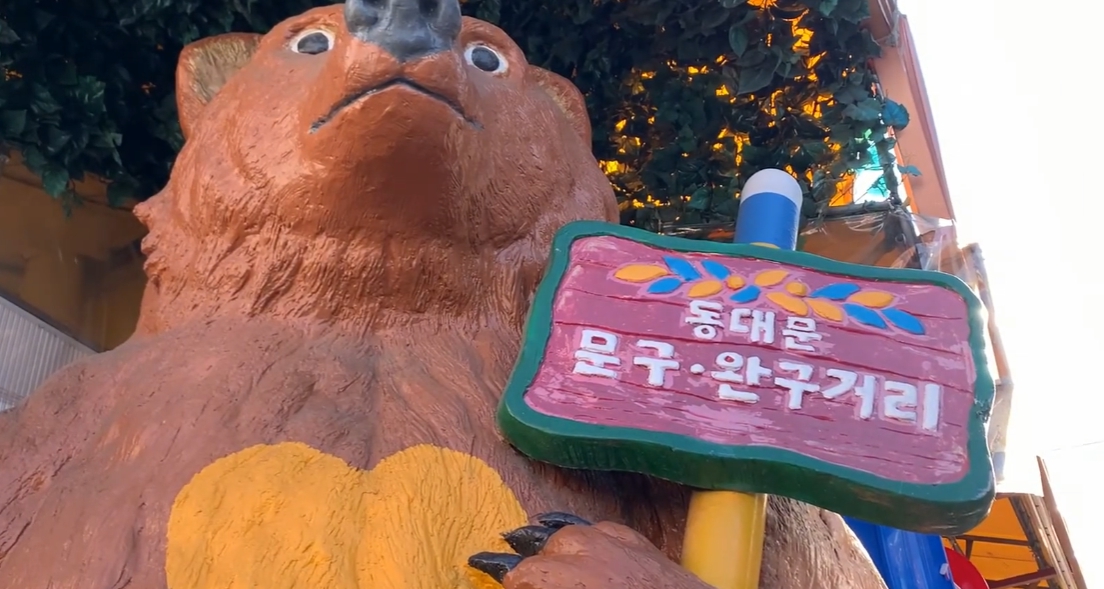
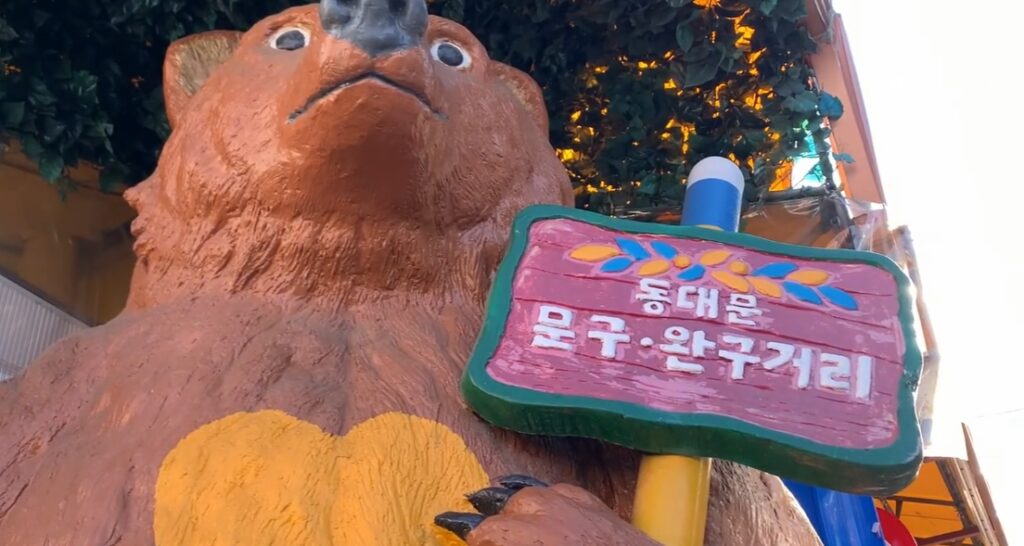
Here’s a tip. Keep walking down the alley until you see a large gorilla statue — that marks the intersection at the heart of the market. Use it as your landmark and you won’t get lost.

Toy Street vs. Stationery Street — What’s the Difference
The two streets sit side by side, but they serve different purposes.
- Toy street: LEGO, RC cars, and other classic wholesale toys — best for kids’ gifts or bulk buying
- Stationery street: mallang-i, wax balls, and stationery — best for photo-worthy finds and quick stress relief
If you’re planning to hit both, remember this one thing. Start at the toy street to browse the wholesalers, then cross the intersection into the stationery street. That’s the most efficient route.
This Street Is at Its Best Right Now
Changsin-dong survived six decades by being useful. It is surviving the current moment by being something rarer: genuinely interesting.
The combination of low prices, unusual merchandise, retro atmosphere, and the ongoing kidult and collector culture has turned a traditional wholesale market into one of Seoul’s more compelling off-the-beaten-path experiences. It sits minutes from Dongdaemun’s design malls and fashion districts, which makes it easy to combine with a broader Dongdaemun half-day.
If you are planning a trip to Seoul and want something that feels nothing like a department store or a tourist hotspot — walk down this alley. You will find a gachapon machine you did not know you needed and a Dragon Ball figure you have been looking for since 2009.
Before You Go — Quick Reference
| Item | Detail |
|---|---|
| Nearest Station | Dongmyo Station Exit 6 (2 min) or Dongdaemun Station Exit 4 (3 min) |
| Hours | ~8:00 AM – 7:00 PM, best after 11:00 AM |
| Price Level | 30–45% below retail for most items |
| Best For | Children’s toys, figures, collectibles, party supplies, stationery |
| Payment | Card and cash accepted |
| Peak Seasons | Around Children’s Day (May 5) and Christmas |
| Pro Tip | Walk the whole street before buying — prices vary by shop |
Changsin-dong Toy & Stationery Market — Changsin-dong, Jongno-gu, Seoul 🚇 Dongmyo Station Exit 6 (Line 1 & 6) | Dongdaemun Station Exit 4 (Line 1 & 4)
Hit the toy wholesale market on a weekday morning, and save the mallang-i shopping for a weekend afternoon. Next up is a guide to Gyeongdong Market, just 15 minutes on foot — subscribe so you don’t miss the rest of the Seoul traditional market series.
- Gyeongdong Market guide (traditional market tour): Affordable Korean baekban near Gyeongdong Market: Gyeongdong Restaurant
- Hongdae guide (Seoul local spots) : Actually Do in Hongdae street. Beyond the Clubs and the K-Pop